
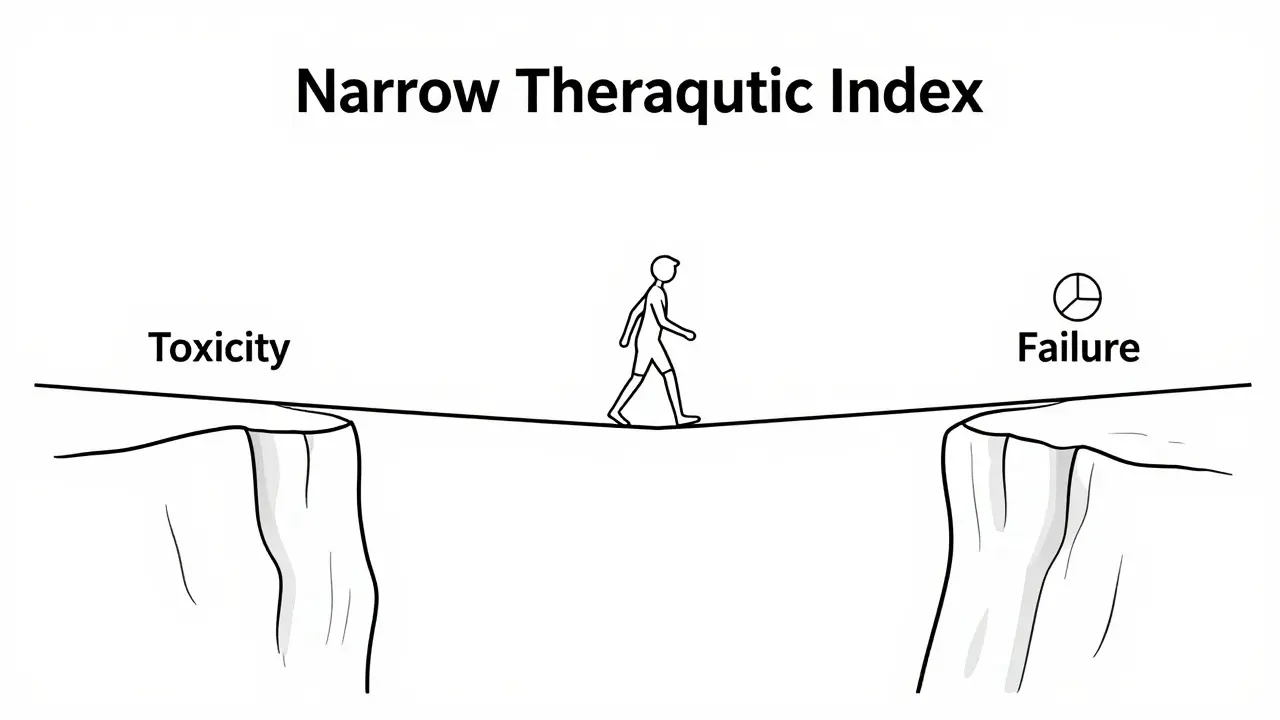
Imagine taking a medication where the difference between healing you and harming you is razor-thin. For most medicines, this isn't an issue. But for Narrow Therapeutic Index (NTI) drugs, which are medications where small changes in blood concentration can cause serious failure or toxicity, every milligram counts. If you have ever wondered why your pharmacist double-checks your prescription for warfarin or phenytoin, it comes down to these strict safety margins.
The Food and Drug Administration (FDA) knows that standard rules for generic drugs don't always cut it for these high-stakes medications. That is why they have created special bioequivalence standards. These rules ensure that when you switch from a brand-name drug to a generic version-or even between different generic manufacturers-the effect on your body remains virtually identical. Let's break down exactly what makes NTI drugs different, how the FDA tests them, and what this means for patients and doctors.
What Defines a Narrow Therapeutic Index Drug?
To understand the regulations, we first need to define the subject. An NTI drug is not just any potent medicine. It is specifically defined by the FDA as a drug where "small differences in dose or blood concentration may lead to serious therapeutic failures or adverse drug reactions." Think of it like walking a tightrope. With regular drugs, you have a wide path; with NTI drugs, the rope is thin, and the margin for error is tiny.
In 2022, the FDA moved away from vague definitions and established a hard mathematical cutoff based on pharmacometric research. They determined that a therapeutic index ≤ 3 is the reasonable cutoff to define NTI drugs. In practical terms, this means the ratio between the dose that causes harm and the dose that helps is three or less. Research showed that 10 out of 13 analyzed NTI drugs fit this ≤ 3 criteria, while others fell slightly higher but still required strict monitoring.
This classification matters because it triggers a completely different regulatory pathway. When a drug gets this label, the FDA applies tighter quality controls and stricter bioequivalence limits than it does for non-NTI generics. This ensures that the generic version behaves exactly like the brand name in your bloodstream.
The Core Bioequivalence Rules: 90-111% vs. 80-125%
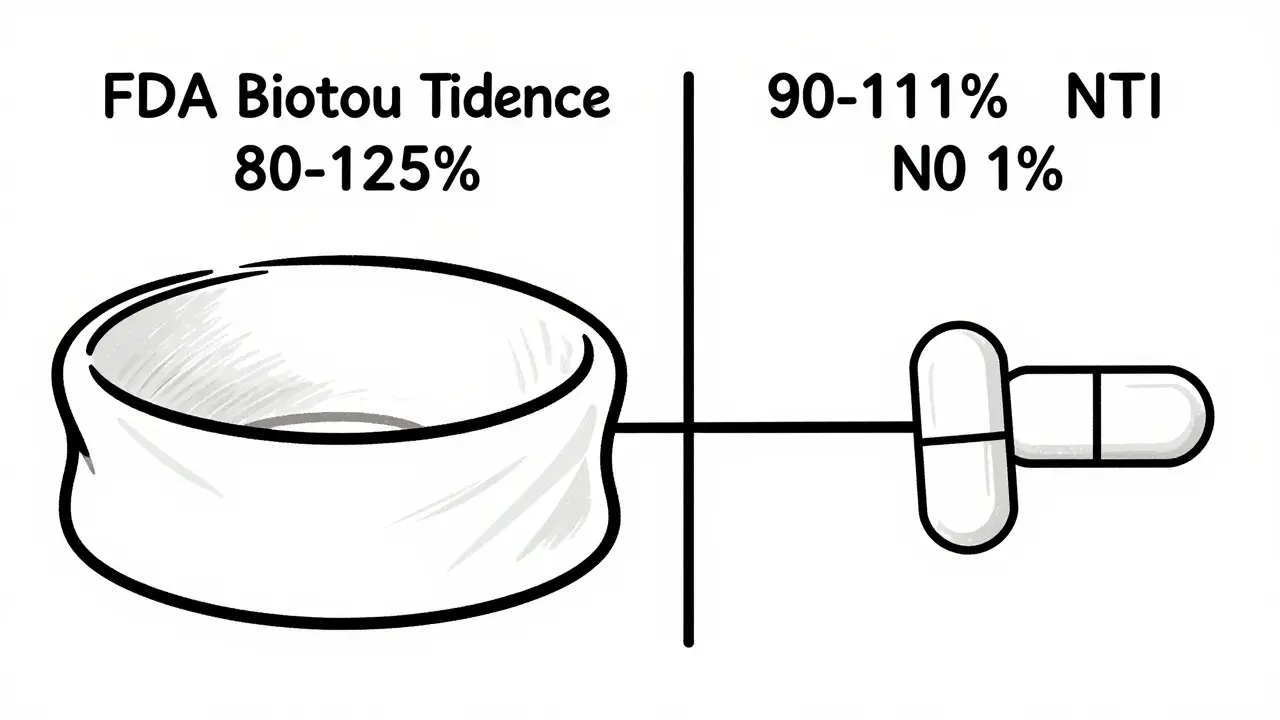
Here is where the technical details get critical. For most generic drugs, the FDA allows a bioequivalence range of 80.00% to 125.00%. This means a generic can deliver up to 20% more or 20% less of the drug into your system compared to the brand name, and it is still considered equivalent. For NTI drugs, that 20% wiggle room is simply too dangerous.
The FDA requires NTI drugs to pass a much narrower acceptance interval of 90.00-111.11% (often cited as 90-111%). This is a significant tightening. To put it in perspective, if a standard generic is allowed to vary by 45 percentage points total (from 80 to 125), an NTI generic is only allowed to vary by about 21 percentage points (from 90 to 111). This ensures that patients switching products do not experience sudden spikes or drops in drug levels that could trigger seizures, bleeding, or organ rejection.
But it doesn't stop there. The FDA uses a dual-criteria approach. An NTI drug must pass both the reference-scaled limits AND the unscaled average bioequivalence limits of 80.00-125.00%. Additionally, the upper limit of the 90% confidence interval of the ratio of within-subject standard deviation must be ≤ 2.5. This complex statistical hurdle ensures consistency not just on average, but across individual patients.
Quality Control and Assay Tightening
Bioequivalence isn't just about how the drug moves through your body; it's also about the physical quality of the pill itself. The FDA has tightened the quality assay requirements for generic NTI drugs significantly.
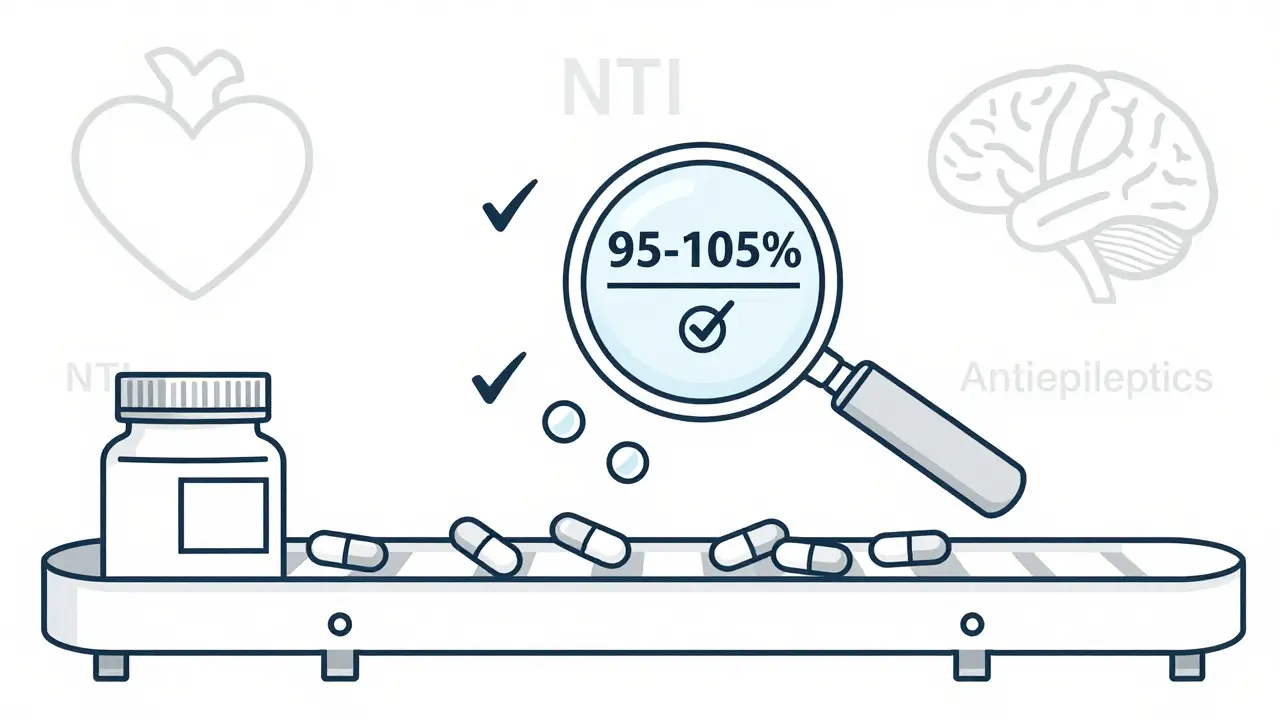
For standard non-NTI drugs, the amount of active ingredient in a tablet is allowed to range from 90% to 110% of the labeled amount. For NTI drugs, this range is squeezed to 95-105 percent. This means the manufacturing process must be incredibly precise. A tablet cannot be slightly under-dosed or over-dosed at the factory level. This reduction in variability starts before the drug even enters the patient's system, adding another layer of safety.
How the FDA Tests NTI Drugs: The Scaled Approach
You might wonder how the FDA proves a generic meets these strict 90-111% standards. They use a method called Reference Scaled Average Bioequivalence (RSABE). This is more sophisticated than the simple average comparison used for most drugs.
The RSABE approach scales the bioequivalence limits based on the variability of the reference listed drug (the brand name). If the brand name drug itself has high variability in how it affects people, the limits might adjust slightly, but for NTI drugs, the constraints remain very tight. Specifically, for NTI drugs with moderate within-subject variability (where the standard deviation sWR > 0.21), the generic must still pass the conventional 80.00-125.00% limits in addition to the scaled ones. This prevents manufacturers from claiming equivalence based on flawed statistical models.
These studies often require replicate designs, meaning participants take multiple doses of both the test and reference products. This provides richer data on how consistent the drug performance is over time, rather than just a one-time snapshot.
| Criteria | Standard Generic Drugs | NTI Drugs |
|---|---|---|
| Bioequivalence Limit | 80.00 - 125.00% | 90.00 - 111.11% |
| Quality Assay Range | 90 - 110% | 95 - 105% |
| Therapeutic Index Cutoff | Not applicable | ≤ 3 |
| Study Design | Crossover (typically) | Replicate studies often required |
| Variability Constraint | None specific | Upper CI of ratio ≤ 2.5 |
Common NTI Drugs You Should Know
The FDA does not maintain a single public list of all NTI drugs. Instead, they identify them through product-specific guidance documents. However, several major categories and specific medications consistently fall under these stricter rules. Knowing these names helps you understand why your doctor might insist on staying with one specific manufacturer.
- Antiepileptics: Drugs like carbamazepine, phenytoin, and valproic acid. These control seizures, and even slight drops in blood levels can trigger breakthrough seizures.
- Immunosuppressants: Medications such as tacrolimus, cyclosporine, sirolimus, and mycophenolic acid. Used in transplant patients, these prevent organ rejection. Too little drug risks losing the organ; too much damages kidneys.
- Anticoagulants: warfarin is the classic example. It thins the blood to prevent clots. Small variations can lead to life-threatening bleeding or stroke.
- Cardiac Glycosides: digoxin and digitoxin, used for heart failure and arrhythmias.
- Mood Stabilizers: Lithium carbonate, where toxicity can occur quickly if levels rise slightly above the therapeutic window.
Addressing Concerns About Generic Substitution
Despite these strict standards, debates persist. Some clinicians and patients worry about switching between different generic versions of NTI drugs. For example, studies on tacrolimus showed that while generics met the stricter NTI limits, some different generic brands were not bioequivalent to each other, even if they were both equivalent to the brand name. This highlights the complexity of equivalence chains.
Dr. Honghui Zhou, Director of the FDA’s Office of Generic Drugs, emphasizes that "generic NTI drugs... are FDA-approved as clinically substitutable with their brand-name versions." Real-world evidence generally supports this, showing that therapeutic equivalence holds up in practice. However, the agency acknowledges concerns, particularly with antiepileptics, where conflicting literature has raised doubts among some providers.
To mitigate risk, the FDA notes the importance of educating pharmacists and potentially eliminating affirmative patient consent requirements that block substitution without cause. The goal is to balance cost savings from generics with the absolute necessity of stable drug levels.
Future Directions and Global Harmonization
The FDA continues to refine its approach. The shift toward using a quantitative therapeutic index ≤ 3 in 2022 marks a move toward more objective classification. Looking ahead, a major priority is harmonizing these standards with global regulators like Health Canada and the European Medicines Agency (EMA). Currently, the FDA's scaled approach differs from the direct tightening methods used elsewhere, which can complicate international drug development.
As more generic NTI drugs enter the market-accounting for roughly 15% of new generic approvals in recent years-these standards will become increasingly vital for healthcare systems worldwide. For patients, the takeaway is clear: NTI drugs require precision. The FDA’s special requirements exist to ensure that when you take a generic, you get the exact same protection as the brand name, no matter how narrow the therapeutic window.
What is the main difference between NTI and non-NTI drug bioequivalence?
The main difference lies in the acceptance intervals. Non-NTI drugs allow a bioequivalence range of 80-125%, while NTI drugs require a much tighter range of 90-111%. Additionally, NTI drugs have stricter quality assay limits (95-105% vs 90-110%) and often require replicate study designs to prove consistency.
Does the FDA publish a complete list of NTI drugs?
No, the FDA does not maintain a comprehensive public list. Instead, NTI status is identified through product-specific guidance documents. Common examples include warfarin, phenytoin, tacrolimus, and digoxin, but you must check specific drug guidelines to confirm status.
Are generic NTI drugs safe to substitute for brand names?
Yes. The FDA states that generic NTI drugs are approved as therapeutically equivalent to their brand-name counterparts. They meet stricter bioequivalence and quality standards designed to ensure clinical substitutability, supported by real-world evidence.
Why is the therapeutic index cutoff set at 3?
In 2022, the FDA used pharmacometric research to establish that a therapeutic index ≤ 3 is a reasonable cutoff. Analysis showed that the majority of known NTI drugs fall into this category, providing an objective scientific basis for classification rather than relying solely on clinical judgment.
What is Reference Scaled Average Bioequivalence (RSABE)?
RSABE is a statistical method used by the FDA to evaluate bioequivalence for highly variable drugs and NTI drugs. It scales the bioequivalence limits based on the variability of the reference product, ensuring that the generic product demonstrates comparable consistency and performance within the tighter 90-111% limits.



12 Comments
It is absolutely fascinating how the FDA tightened those bioequivalence limits for NTI drugs! The shift from the standard 80-125% range to the much stricter 90-111% interval really highlights the precision required here. I always thought generic substitution was a straightforward swap, but seeing the statistical hurdles like the Reference Scaled Average Bioequivalence (RSABE) method makes me appreciate the science behind it so much more! It is reassuring to know that there are such rigorous checks in place for medications like warfarin and phenytoin. The fact that they also tightened the quality assay range to 95-105% is another layer of safety that often goes unnoticed by the general public. We should definitely be more aware of these distinctions when discussing healthcare policy!
Hey everyone! Let's talk about this because it matters for our health! The point about the therapeutic index cutoff being set at ≤ 3 is huge. It means the margin for error is razor-thin. If you are on meds like tacrolimus or lithium, you need to know that your pharmacist isn't just grabbing any pill off the shelf. They are dealing with high-stakes chemistry where small changes can mean big trouble. Stay informed and ask questions about your prescriptions! Your health is worth the extra attention.
The article conveniently glosses over the fact that 'bioequivalent' does not necessarily mean 'therapeutically identical' for every single patient. While the statistics hold up on average, individual metabolic variances can still cause issues when switching manufacturers. The FDA's reliance on aggregate data ignores the outliers who suffer adverse effects. It is a convenient narrative for cost-cutting measures disguised as scientific rigor.
Oh, look at us trying to understand complex pharmacokinetics! :D It is adorable how people think reading one blog post makes them experts on RSABE methods. But seriously, Lilith has a point, though she misses the bigger picture. The system works for 99% of people. The remaining 1%? Well, that is just the cost of doing business in modern healthcare. You cannot have everything. You want cheap generics? Deal with the slight variability. Or pay for brand name and complain about insurance premiums. It is all about balance, folks! Don't sweat the small stuff unless you are actually having a seizure, then maybe call a doctor instead of Reddit. ;)
Variability is inherent in biology. The statistical models attempt to normalize this chaos. Whether the model fits the reality is a philosophical question as much as a scientific one.
I work in a pharmacy and this is exactly why we double-check NTI drugs. It is wild how strict the assay limits are now. 95-105% sounds tiny but it is massive for something like digoxin. Patients often don't realize how precise manufacturing has to be.
It seems like the line between safe and unsafe is drawn by committee rather than nature. The ≤ 3 cutoff feels arbitrary despite the research. Maybe it is enough, maybe it is not. We will see.
So if my wife switches her generic phenytoin brand, I should probably check the manufacturer code next time I pick it up? Just curious since the article mentions different generics might not be equivalent to each other even if they match the brand. Seems like a hassle but better safe than sorry right?
i totally get that worry gary its scary when meds change i had a friend who switched warfarin brands and her INR went crazy for a week just stick with one pharmacy if you can they usually keep the same supplier
Ah, the joy of trusting faceless corporations to keep you alive. How quaint. You people really believe the FDA cares about your individual well-being? Please. It is all about liability management. The 'special requirements' are just legal shields. Enjoy your tightly controlled pills while you can, before the next budget cut widens those windows again. Truly inspiring stuff.
It is imperative that we recognize the significance of global harmonization efforts mentioned in the text. The divergence between FDA standards and those of the EMA creates unnecessary friction in international drug development. A unified approach would undoubtedly enhance patient safety and streamline regulatory processes across borders. We must advocate for stricter adherence to these quantitative thresholds universally.
This is such an important topic for anyone managing chronic conditions. Understanding these differences empowers patients to have better conversations with their doctors. It is not about fear-mongering but about being informed. Great breakdown of the technical details!