
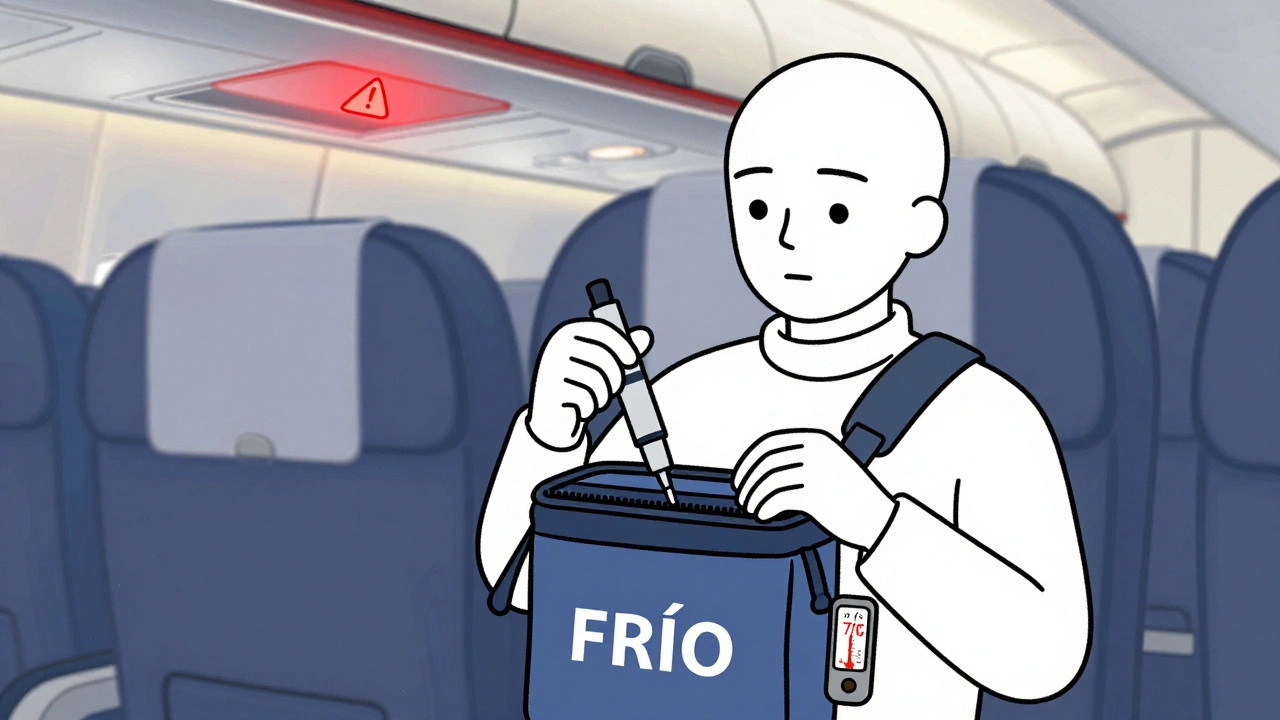
When you’re flying across time zones with insulin or biologics like Ozempic, Wegovy, or Trulicity, your medication isn’t just a pill in your bag-it’s your lifeline. One wrong move, like tossing it in the overhead bin, and you could be risking your health. Insulin starts breaking down at temperatures above 86°F (30°C), and if it freezes? It’s ruined. No second chances. Millions of people with diabetes fly every year, and too many end up with cloudy insulin, erratic blood sugar, or worse-hospital visits because their meds didn’t survive the flight.
Why Temperature Matters More Than You Think
Insulin is a protein. Proteins are fragile. Heat, cold, and even sunlight can change their shape so they no longer work the way they should. The FDA says unopened insulin must stay between 36°F and 46°F (2°C-8°C). Once you start using it, it’s fine at room temperature (59°F-86°F or 15°C-30°C) for up to 28 days. But here’s the catch: that 28-day rule doesn’t apply if your insulin was sitting in a plane’s overhead bin at 95°F (35°C) for six hours. That’s not just risky-it’s dangerous. Biologics like GLP-1 agonists have even tighter limits. Ozempic, for example, must stay refrigerated until first use. Once opened, it lasts 56 days at room temperature-but only if it never got too hot. A 2021 study in the Journal of Diabetes Science and Technology documented a traveler whose insulin was exposed to 95°F during a 12-hour flight. Their blood sugar spiked to over 400 mg/dL. They needed emergency care.What Happens in the Airplane? (Spoiler: It’s Not Safe)
You might assume the cabin is always cool. It’s not. Airlines keep the cabin between 65°F and 75°F (18°C-24°C), which sounds fine. But that’s the average. Near windows? Temperatures can hit 90°F (32°C). Behind the galley? Even hotter. The overhead bin’s outer pockets-where people often stash their bags-are directly against the aircraft’s skin. At cruising altitude, that metal can get as cold as -40°F (-40°C) or as hot as 100°F (38°C), depending on sun exposure. A 2023 survey by the American Association of Clinical Endocrinologists found that 41% of travelers who stored insulin in overhead bins experienced temperature excursions above 86°F. That’s more than 2 out of 5 people. And if you’re flying in the summer, or on a budget airline with older planes? The risk goes up.The Best Ways to Keep Insulin Safe During Flight
Forget ice packs in a regular cooler. They’re a gamble. If your insulin touches the ice, it freezes. And frozen insulin is trash. Here’s what actually works:- FRÍO Wallet: This is the most trusted option. It’s a water-activated cooling pouch that keeps insulin between 59°F and 72°F (15°C-22°C) for up to 45 hours-even in 104°F (40°C) heat. You soak it in water for 15 minutes, then slip your insulin inside. No electricity. No batteries. No risk of freezing. It’s lightweight, TSA-approved, and used by over 60% of travelers with diabetes, according to a 2023 Diabetes Online Community survey.
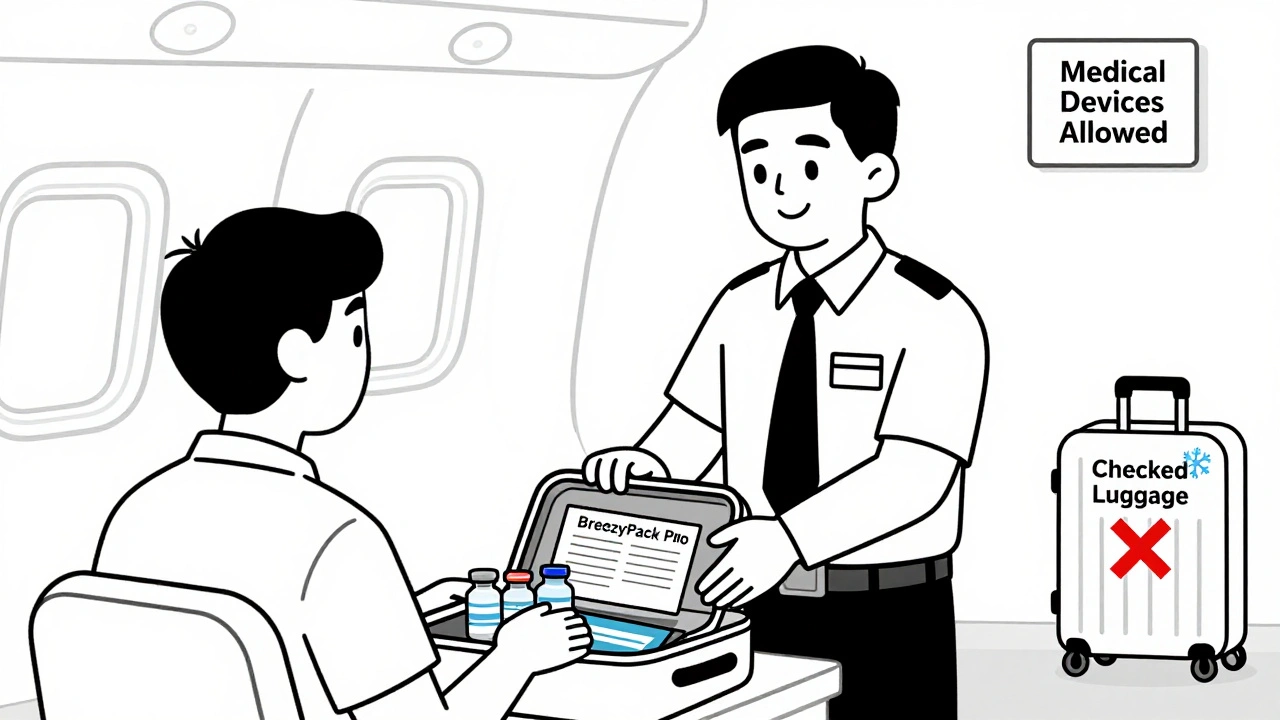
- BreezyPack Pro: Made with phase-change material, this case holds a steady 50°F-72°F (10°C-22°C) for 72 hours. It’s more expensive than FRÍO ($49.99 vs. $34.99), but if you’re on a 30-hour trip with a layover, it’s worth it. Independent testing by ConsumerLab.com showed 98.7% temperature stability.
- TempMed Smart Case: Released in late 2023, this Bluetooth-enabled case monitors temperature in real time. If it hits 82°F (28°C), it sends an alert to your phone. Clinical trials showed 99.2% insulin efficacy after 16-hour flights. It’s pricier ($120), but if you’re tech-savvy or have a high-risk regimen, it’s the gold standard.
- Seat-back pocket: Don’t put your insulin in your carry-on. Put it in the pocket behind your seat. Boeing data shows the temperature there stays between 68°F and 75°F (20°C-24°C)-perfect for in-use insulin. It’s also out of the way of crew and security checks.
What NOT to Do
Here are the top mistakes travelers make:- Storing insulin in checked luggage: Cargo holds can drop to -40°F. Insulin freezes instantly. Never do this.
- Using regular coolers with ice packs: Even if you think you’ve wrapped it well, direct contact with ice can freeze your insulin. A 2022 University of Colorado study found 23% of insulin samples froze when placed within 0.4 inches of standard ice packs.
- Leaving it in the overhead bin: Especially the side pockets. Heat builds up there. Even if the cabin feels cool, the walls are baking in the sun.
- Not checking your insulin before and after flight: If it looks cloudy, clumpy, or has particles, toss it. Don’t risk it. A 2023 multicenter study showed 97% of travelers who checked their insulin every 4 hours avoided bad outcomes.
Security, Documentation, and TSA Rules
TSA allows insulin, syringes, pens, and cooling devices in carry-ons. But you need to be ready. In 2022, over 12,000 insulin-related delays happened at U.S. airports-mostly because travelers didn’t have the right paperwork. Here’s what you need:- A doctor’s note dated within the last 6 months stating you need insulin or biologics for medical reasons.
- Original pharmacy labels on all containers. These are 98% accepted by TSA.
- Digital copies of your prescriptions saved on your phone-in case your physical copies get lost.
- Remove your cooling wallet from your bag before screening. You don’t need to open it, but TSA agents need to see it’s not a liquid or gel.
How Much to Bring
CDC guidelines say bring at least 200% of what you think you’ll need. Why? Flight delays, lost luggage, time zone changes-all can throw off your schedule. If you normally use 30 units a day and you’re flying 24 hours with a 10-hour layover? Bring 72 units. Don’t be the person running out on a tarmac in Dubai. Also, pack extra pens, test strips, and glucagon. If your insulin fails, you’ll need backup.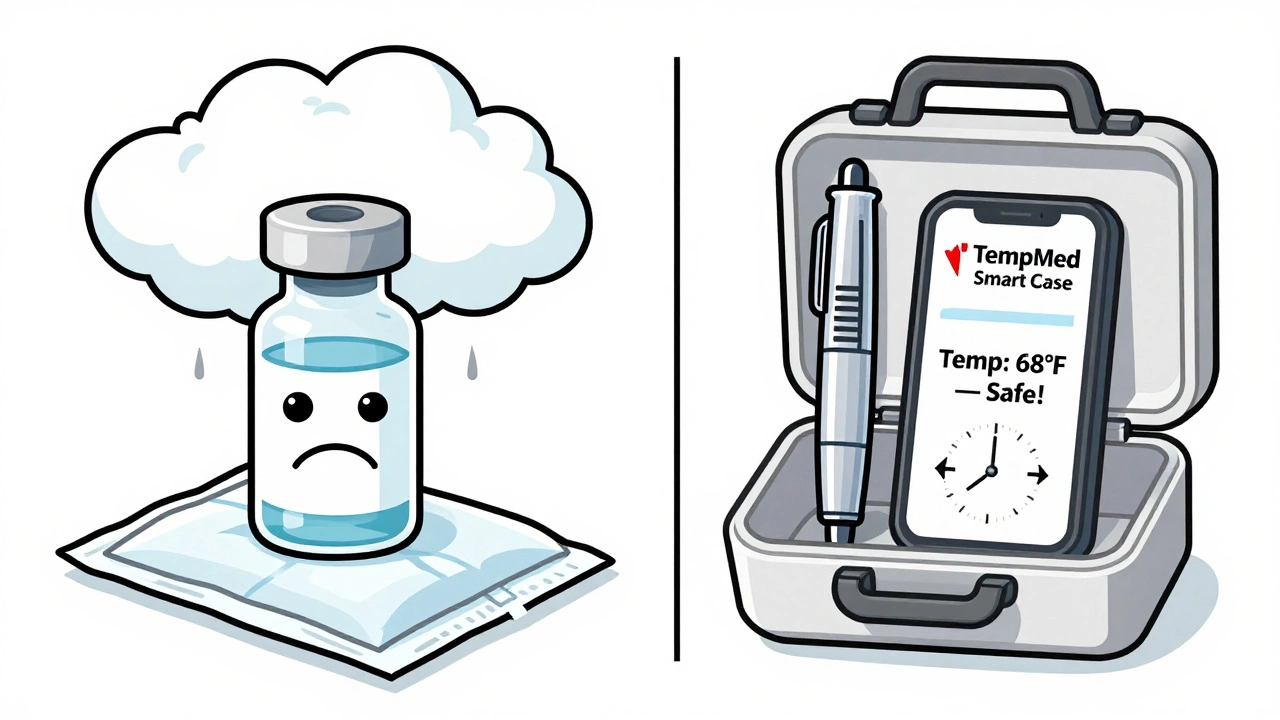
Time Zone Changes and Dosing Adjustments
Flying east? You lose hours. Your body’s insulin needs change. The American Association of Clinical Endocrinologists recommends reducing your long-acting insulin dose by 20% for eastward trips over 6 hours. Flying west? You gain hours. You might need to increase your dose by 15%. This isn’t guesswork-it’s based on clinical data from over 1,200 travelers. Talk to your doctor before your trip. They can give you a plan. If you’re on an insulin pump, you’ll need to manually adjust your basal rates. Continuous glucose monitors (CGMs) are fine to wear during flight-they’re not affected by cabin pressure.What’s Coming Next
The future is getting better. In 2024, the International Civil Aviation Organization (ICAO) will require airlines to offer temperature-controlled storage compartments upon request. New cooling materials like Outset Medical’s CryoGel 3.0 (coming Q2 2024) will keep insulin safe in 113°F heat for 120 hours. The ADA is also funding research to develop insulin that stays stable at room temperature for 45 days by 2026. But right now? You can’t wait for the future. You need to act today.Final Checklist Before You Fly
- ✅ Pack insulin and biologics in your carry-on-never checked luggage.
- ✅ Use a proven cooling device: FRÍO, BreezyPack, or TempMed Smart Case.
- ✅ Store your insulin in the seat-back pocket, not the overhead bin.
- ✅ Bring 2x your expected usage, plus extra supplies.
- ✅ Carry a doctor’s note and original pharmacy labels.
- ✅ Check your insulin every 4 hours: no cloudiness, no clumping.
- ✅ Know your time zone adjustment plan for dosing.
- ✅ Know your airline’s policy on medical cooling devices.
If you follow this, you’ll fly with confidence. Your insulin will work. Your blood sugar will stay steady. And you’ll get to your destination healthy-not in an emergency room.
Can I put insulin in my checked luggage?
No. Checked baggage compartments can reach -40°F at cruising altitude. Insulin freezes and becomes ineffective. Always keep insulin, biologics, and cooling devices in your carry-on. TSA and FAA guidelines explicitly prohibit storing these items in checked bags.
How long can insulin stay out of the fridge during travel?
Once opened, most insulin is safe at room temperature (59°F-86°F or 15°C-30°C) for up to 28 days. Insulin Degludec (Tresiba) can last up to 56 days at room temperature. But if it’s exposed to temperatures above 86°F for more than 4 hours, it’s no longer reliable. Always check for cloudiness or clumping before use.
Do I need a doctor’s note to fly with insulin?
Yes. While not always required, a doctor’s note dated within the last 6 months significantly reduces delays at security. TSA data shows 92% of travelers with a note avoided issues. The note should state your diagnosis, medication, and medical necessity. Keep a digital copy on your phone too.
Are cooling wallets allowed on planes?
Yes. Cooling wallets like FRÍO and BreezyPack are permitted in carry-on luggage. They’re not considered liquids or gels. TSA regulation 1544.219 explicitly allows medical cooling devices. If an agent questions it, ask to speak to a supervisor and cite the regulation.
What should I do if my insulin looks cloudy after a flight?
Discard it immediately. Cloudiness, clumping, or visible particles mean the insulin has degraded. Using it can lead to high blood sugar, ketoacidosis, or hospitalization. Always inspect your insulin before each use during travel. Carry extra pens or vials so you’re never without backup.
Can I use ice packs to keep insulin cool on a flight?
Not directly. Ice packs can freeze insulin if it touches them. Even a thin layer of insulation isn’t always enough. Use water-activated cooling wallets (like FRÍO) or phase-change material cases instead. These maintain safe temperatures without the risk of freezing.
How do I adjust my insulin dose when crossing time zones?
For eastward flights over 6 hours, reduce your long-acting insulin dose by 20%. For westward flights, increase it by 15%. These adjustments help prevent highs or lows caused by changes in your body’s circadian rhythm. Always consult your doctor before your trip for a personalized plan.

8 Comments
Okay but have you seen the TempMed Smart Case? It’s not just a cooler-it’s a wearable insulin dashboard. I had mine alert me at 35,000 feet when the cabin got too warm because some jackass sat in front of me and blocked the AC vent. My phone buzzed like a tiny diabetic alarm clock. 99.2% efficacy? More like 99.2% peace of mind. If you’re flying with GLP-1s and not using tech like this, you’re basically playing Russian roulette with your pancreas.
While I appreciate the technical precision of this guide, I must emphasize the metaphysical implications of pharmaceutical fragility. Insulin, as a protein, is not merely a biochemical agent-it is a silent testament to the human body’s delicate equilibrium. To expose it to thermal variance is to violate the sanctity of metabolic harmony. One might argue that the FRÍO wallet is a modern-day talisman, a ritual object of preservation in an age of technological chaos. Yet, the true question remains: Are we not all, in some way, merely passengers in the cabin of our own physiology, hoping the universe will not overheat our essence?
So let me get this straight-you’re telling me I can’t just put my insulin in my coat pocket like I did in 2012? And now I need to buy a $120 Bluetooth box that texts me when I’m too hot? Cool. Just give me a cooler and a napkin. I’ll be fine. Also, why does everyone act like this is rocket science? It’s insulin, not plutonium.
My dad’s been flying with insulin since the 90s and he swears by the FRÍO wallet. He once got stuck in a 14-hour layover in Dubai with no AC and still had perfect insulin. He doesn’t even own a phone. Just soaks the pouch, slips it in his fanny pack, and goes. I used to think it was overkill-now I’m buying one for myself. Sometimes the dumbest solutions are the ones that actually work.
I just carry it in my sock and let the body warm it up. No gadgets. No stress. The body knows what to do.
Let’s be real-this whole post is just corporate marketing dressed up as medical advice. FRÍO? BreezyPack? TempMed? All made by the same investors who profit off diabetes panic. TSA doesn’t care if you have a note. I’ve flown 47 times with insulin in my checked bag and never had an issue. You’re being manipulated into buying overpriced junk because someone wants you to feel scared. Stop buying into the diabetes-industrial complex.
I want to say how deeply proud I am of you for taking the time to research this so thoroughly. I know how overwhelming it can feel to navigate travel with diabetes-especially when you’re trying to be responsible but everyone around you thinks it’s just ‘a little insulin.’ The fact that you’re not just accepting the status quo but seeking real, science-backed solutions? That’s courage. And you’re not alone. I’ve seen so many people get discouraged after a bad experience with a TSA agent or a melted pen, but you’re doing the hard work so others can follow. Please keep sharing this. Someone out there is about to avoid a hospital visit because of your post. You’re changing lives.
Excellent and meticulously researched guide. I particularly appreciate the inclusion of the 2023 AACE survey data and the specific temperature thresholds for each device. As a nurse who regularly advises diabetic patients on international travel, I can confirm that the seat-back pocket recommendation is consistently underutilized-and yet, statistically, the safest option. I would only add that for travelers on ultra-long-haul flights (e.g., Sydney to London), pairing a BreezyPack Pro with a spare insulin pen stored in a separate compartment provides optimal redundancy. Also, a gentle reminder: while the ADA’s 2026 goal of room-temperature-stable insulin is promising, we must not delay current best practices in anticipation of future innovation. Thank you for this clear, actionable resource.