
Medication costs can drain a savings account faster than you’d expect. If you’re uninsured or struggling with high copays, patient assistance programs (PAPs) from major drug companies might be your lifeline. These programs provide free or heavily discounted medications, but getting approved isn’t always straightforward. You need to meet specific criteria regarding income, insurance status, and residency. Understanding these rules is the first step to securing the treatment you need without financial ruin.
Key Takeaways
- Income Limits: Most programs require household income below 400% or 500% of the Federal Poverty Level (FPL). For 2023, this means roughly $75,000 for a single person.
- Insurance Status: Many manufacturer programs only help those who are uninsured or underinsured by government plans. Commercially insured patients often face different hurdles or separate "commercial" PAPs.
- Documentation: Incomplete paperwork causes 68% of initial application denials. Have W-2 forms, tax returns, and physician verification ready before applying.
- Medicare Complexity: If you have Medicare Part D, you may need to apply for "Extra Help" first. Manufacturer PAPs often exclude those who qualify for Extra Help unless they are denied.
- Processing Time: Expect an average processing time of 14.7 days, though some applications take longer due to verification issues.
Who Actually Qualifies? The Core Criteria
Eligibility isn't one-size-fits-all. It depends on whether you're dealing with a primary care medication or a specialty drug like chemotherapy or biologic therapy. However, three pillars remain consistent across almost all programs: income, insurance status, and US residency.
Income is the biggest gatekeeper. According to a 2019 study published in PMC, 94% of patient assistance programs use 400% or 500% of the Federal Poverty Level as their ceiling. To put that in perspective, for a single individual in 2023, 500% FPL equates to an annual income of approximately $75,000. For a family of four, that limit rises to about $153,000. Some specialty programs, particularly in oncology, stretch this limit to 600% FPL to cover higher-cost treatments.
Insurance status is where it gets tricky. There is a common misconception that anyone can apply. In reality, 97% of independent charity PAPs require proof of insurance coverage. Conversely, many manufacturer-specific programs, like Pfizer’s Patient Assistance Program, explicitly target those who are uninsured or underinsured by government programs. If you have full commercial insurance, you might be categorically ineligible for the standard manufacturer PAP, though newer "commercial" assistance options are emerging for those facing high out-of-pocket costs.
Finally, you must be a US resident receiving care from a US-licensed physician. Proof of address and treatment location are mandatory. This ensures the program serves its intended demographic within the domestic healthcare system.
Navigating Income Thresholds and Household Size
Calculating your eligibility starts with understanding how programs define "household" and "income." This is where most people make mistakes. A 2022 CMS analysis found a 52% error rate in determining correct household size during applications.
Your household includes everyone living in your home who shares resources, such as food and housing. This doesn't just mean your spouse; it can include adult children, parents, or roommates if you share finances. If you live alone, your household size is one. If you live with a partner and two kids, it’s four. Getting this wrong can either disqualify you (if you underestimate) or cause delays (if you overestimate and fail verification).
Income calculation also varies. Some programs look at Gross Income (total earnings before taxes), while others use Modified Adjusted Gross Income (MAGI). MAGI excludes certain deductions but includes things like untaxed foreign income. Confusion between gross income and MAGI accounts for 31% of calculation errors. Always check the specific form instructions for the drug company you are applying to. For example, Pfizer's RxPathways uses tiered thresholds: 300% FPL for primary care products and up to 600% FPL for oncology drugs. This means a patient taking a standard blood pressure medication has a stricter income limit than one taking cancer therapy.
| Program | Max Income (Single Person) | Primary Insurance Requirement | Special Notes |
|---|---|---|---|
| Pfizer Patient Assistance Program | $43,200 - $77,760 (Tiered) | Uninsured or Government Underinsured | Commercially insured patients generally ineligible for standard PAP |
| GSK Patient Assistance Foundation | $58,650 | Varies by product | Requires re-enrollment every 12 months |
| Takeda Help At Hand | Below 150% FPL for Medicare beneficiaries | Must deny Extra Help first | Specific documentation needed for Medicare Part D users |
| Merck PAP | Varies (typically ~500% FPL) | Uninsured or Hardship Exception | Allows hardship exceptions for insured patients with financial strain |
The Medicare Part D Complication
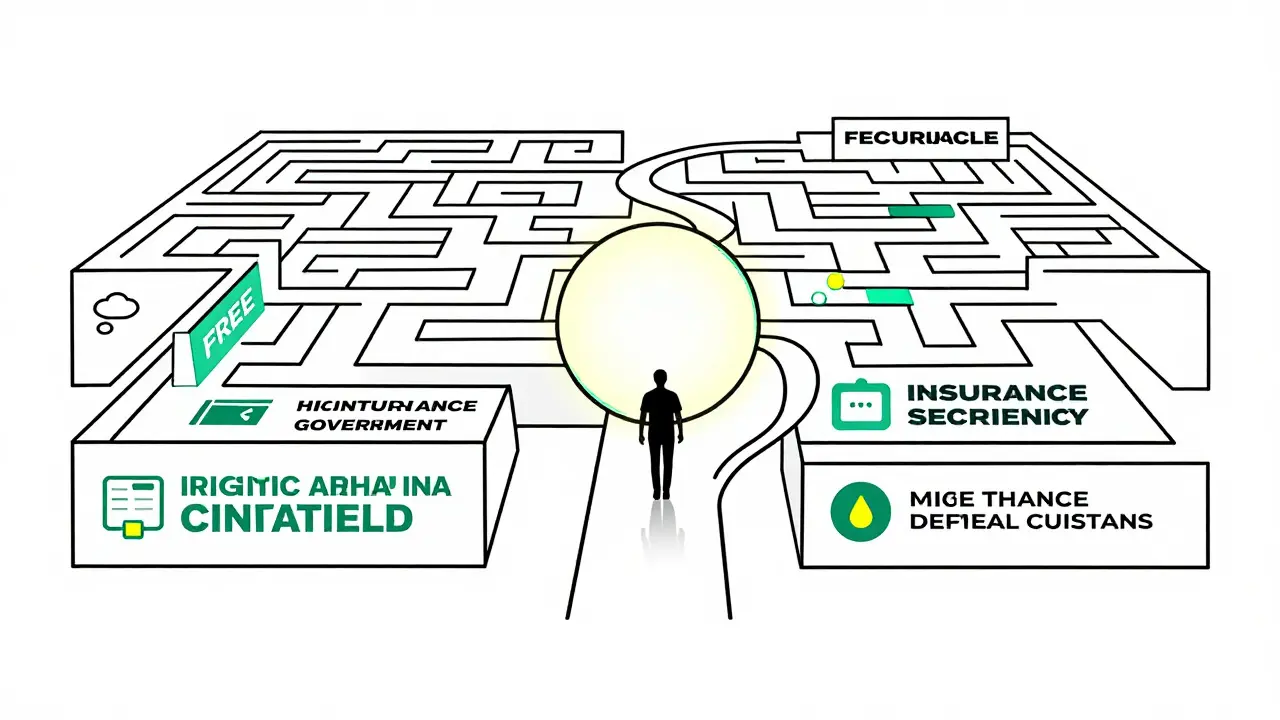
If you are a Medicare beneficiary, your path to assistance is more complex. Since the launch of Medicare Part D in 2006, interactions between manufacturer assistance and government benefits have created a regulatory maze. The Centers for Medicare & Medicaid Services (CMS) established guidelines in 2012 to keep PAPs "outside the Part D benefit." This means money from a PAP does not count toward your True Out-of-Pocket (TrOOP) costs.
Why does this matter? To reach catastrophic coverage under Part D, you must hit a certain TrOOP threshold ($8,000 in 2024). If you rely on a manufacturer PAP, those payments don't help you reach that threshold. This creates a disadvantage for Medicare beneficiaries who might otherwise qualify for lower costs later in the year.
Furthermore, if your income is below 150% FPL (around $20,385 for a single person in 2023), you likely qualify for Medicare "Extra Help" (Low-Income Subsidy). Many manufacturer PAPs, like Takeda’s, require you to apply for Extra Help first. Only if you are denied or find the premiums unaffordable can you then apply for the manufacturer’s assistance. This dual-ineligibility gap affects patients with incomes between 135% and 150% FPL, who often fall through the cracks of both systems.
Application Process: Avoiding Common Pitfalls
Applying for a PAP is less about luck and more about precision. The average application takes 27.3 minutes to complete, but 63% of errors occur in the income calculation sections. Here is how to navigate the process successfully:
- Gather Documents Early: You will need proof of identity, proof of US residency, and income verification. Income verification usually requires W-2 forms, recent paycheck stubs, or federal tax returns. Self-employed individuals should prepare profit-and-loss statements.
- Physician Verification: Your doctor must sign a form confirming the diagnosis and prescription. The average turnaround for this is 28 days according to Merck data. Don't wait until the last minute; ask your provider's office to handle this concurrently with your application.
- Check Insurance Status Accurately: Determine if you are commercially insured, government-insured, or uninsured. Misclassifying your insurance is a leading cause of denial. If you have commercial insurance, check if the specific drug company offers a "commercial" assistance tool, as traditional PAPs may reject you.
- Submit and Follow Up: Average processing time is 14.7 days, but incomplete files can extend this significantly. Keep copies of everything. If denied, read the reason carefully-68% of denials are due to missing documents, not lack of eligibility.
Many programs offer dedicated PAP navigators. About 78% of major programs provide phone support, though wait times can range from 11 to 18 minutes depending on the complexity of your case. Using these resources can save you weeks of back-and-forth.
Independent Charities vs. Manufacturer Programs
You aren't limited to the drug company that makes your medicine. Independent foundations like PAN Foundation and HealthWell Foundation manage assistance for many brands. These organizations often have slightly different criteria. While they still cap income at 400-500% FPL, they may be more flexible regarding insurance status for certain chronic conditions. However, they typically cover fewer specialty drugs compared to the manufacturers themselves. If your drug is a high-cost biologic, the manufacturer’s own program is usually your best bet. For older, generic-friendly drugs or broader chronic care, independent charities might offer a wider net.
Future Changes and What They Mean for You
The landscape is shifting. With the Inflation Reduction Act provisions taking effect in 2025, Medicare Part D out-of-pocket costs are capped at $2,000 annually. This change could reduce the reliance on PAPs among Medicare beneficiaries by 35-40%. Additionally, new electronic verification systems, such as Pfizer’s integration with TurboTax, are reducing application errors by nearly 30%. As digital tools improve, the process should become faster and less prone to human error. However, for now, manual documentation remains king. Stay informed, keep your records organized, and don't hesitate to seek help from patient advocacy groups if you hit a wall.
Do I need to be uninsured to qualify for a patient assistance program?
Not necessarily. It depends on the program. Many manufacturer PAPs specifically target uninsured or government-underinsured patients. However, some programs allow "hardship" exceptions for commercially insured patients with high out-of-pocket costs. Independent charity PAPs often require proof of insurance coverage. Always check the specific eligibility page for your medication.
What is the maximum income to qualify for most drug company assistance programs?
Most programs use 400% or 500% of the Federal Poverty Level (FPL). For 2023, 500% FPL is approximately $75,000 for a single person and $153,000 for a family of four. Specialty and oncology programs may extend this to 600% FPL.
How long does it take to get approved for a patient assistance program?
The average processing time is 14.7 days. However, this can vary based on documentation completeness and physician verification speed. Once approved, 89% of patients report receiving medications within 72 hours.
Can Medicare beneficiaries use patient assistance programs?
Yes, but with caveats. If you qualify for Medicare "Extra Help," you may need to apply for that first. Manufacturer PAPs for Medicare beneficiaries often require proof that you were denied Extra Help or that premiums are unaffordable. Also, PAP assistance does not count toward your Part D True Out-of-Pocket costs.
What documents do I need to prove my income?
Standard requirements include W-2 forms, recent paycheck stubs (usually last 30 days), or federal tax returns. Self-employed applicants may need profit-and-loss statements. Ensure these documents match the household size declared in your application.