

When your asthma feels under control, it’s easy to forget about checking your breathing. But many people with asthma don’t feel symptoms until their lungs are already narrowing-sometimes too late to prevent a flare-up. That’s where peak flow monitoring comes in. It’s not fancy. It doesn’t need a doctor’s office. You just blow into a small plastic device every day, and it tells you how fast you can push air out of your lungs. This number, called your peak expiratory flow (PEF), can warn you of trouble before you start coughing, wheezing, or gasping.
Why Daily Tracking Matters
Peak flow meters measure the speed of your exhale. It’s not about how much air you can blow out-it’s how fast. And that speed drops before you even notice symptoms. Studies show airflow can start to decline 24 to 48 hours before you feel tightness in your chest. If you only check your peak flow when you’re struggling to breathe, you’re already behind.
That’s why consistency is everything. You need to measure your peak flow at the same times every day, usually once in the morning and once in the evening. The best windows are between 7 and 9 a.m. and 6 and 8 p.m. Why? Because lung function naturally dips in the early morning. If you measure right after waking up, your number will be lower-even if you’re perfectly fine. Tracking at the same times lets you spot real changes, not normal daily swings.
And don’t switch meters. Every peak flow meter is slightly different. Using the same one every time means you’re comparing apples to apples. If you get a new one, you’ll need to restart your baseline tracking. Keep it with you. Bring it to every doctor visit. Your doctor needs to see the same device you’ve been using all along.
How to Find Your Personal Best
Your personal best isn’t the number on the chart that says “normal for your age and height.” It’s the highest number you can consistently blow out when your asthma is under control. That’s why you need to track for at least two weeks-sometimes three-during a time when you’re feeling well, not sick, not wheezing, not using your rescue inhaler.
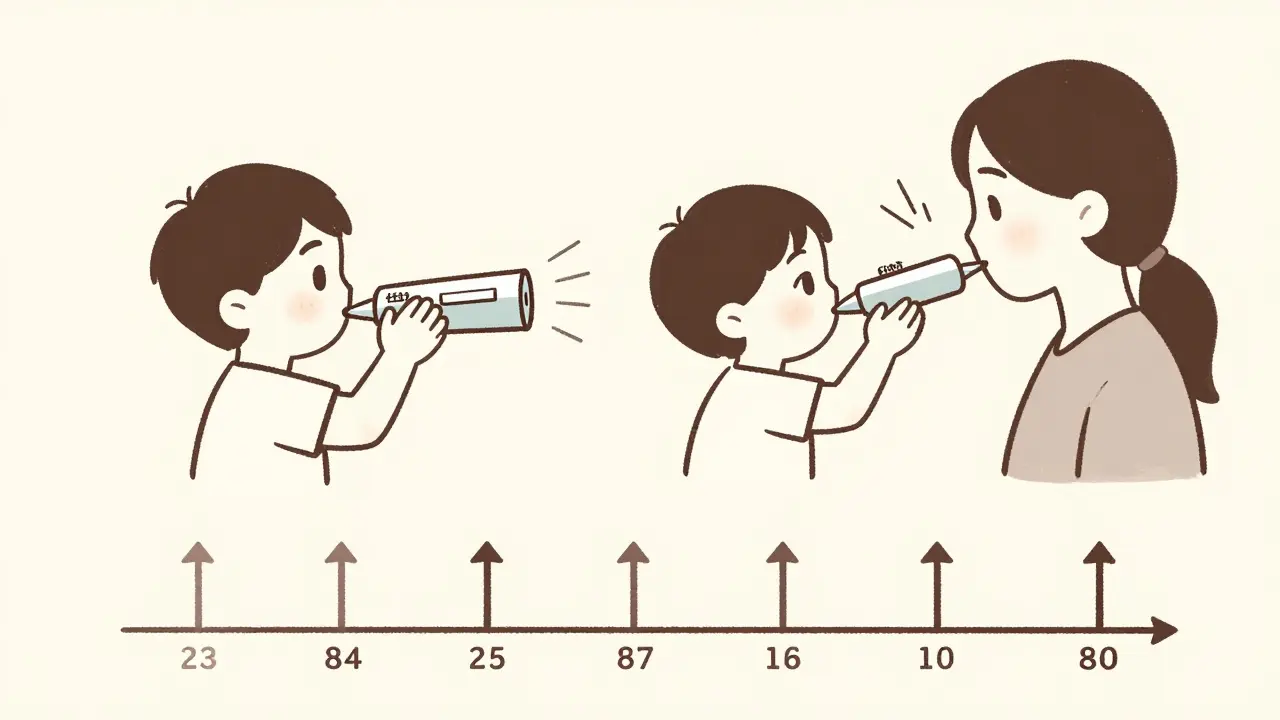
Take three readings each time, and write down the highest one. Don’t settle for the first number. Blow hard, every single time. If your three readings are wildly different, you’re not giving your best effort. Practice until you can get three numbers that are close together. That’s how you know you’re doing it right.
For kids, this number changes as they grow. Recheck their personal best every six to twelve months. For adults, it’s more stable-but if your asthma gets worse or better over time, you should re-establish your baseline. Your personal best is your reference point. Everything else is measured against it.
The Green, Yellow, Red Zone System
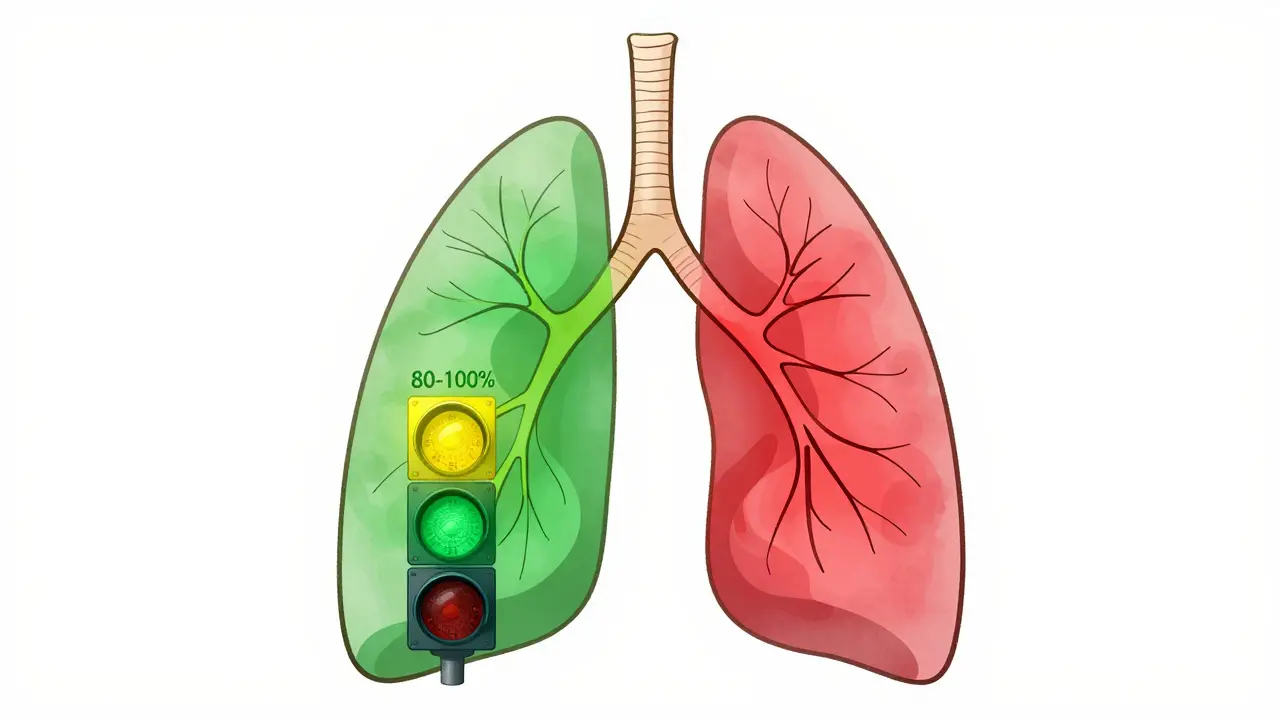
Once you know your personal best, you divide your numbers into three zones. Think of it like a traffic light.
- Green zone (80-100% of personal best): You’re in the clear. Your asthma is under control. Keep doing what you’re doing.
- Yellow zone (50-79% of personal best): Caution. Something’s changing. Your airways are narrowing. This is your signal to follow your asthma action plan. Maybe it’s time to take extra medicine, avoid triggers, or call your doctor.
- Red zone (below 50% of personal best): Medical alert. Your breathing is dangerously restricted. Take your rescue inhaler right away. Call your doctor or go to the emergency room. Don’t wait.
A drop of 20 to 30% from your personal best is often the first sign of an asthma episode. That’s why you track daily. If your usual number is 400, and you wake up at 300, that’s a 25% drop. You’re in the yellow zone. That’s your cue to act-before you’re gasping for air.
Who Needs to Track Daily?
Not everyone needs to check their peak flow every day. If your asthma is mild and stable, checking two or three times a week might be enough. But if you’ve had a recent flare-up, if your asthma is moderate or severe, or if you don’t always feel symptoms when your lungs are narrowing-you need to check twice daily.
People with poor symptom awareness are the ones who benefit the most. You might not feel tightness until you’re already in trouble. Your peak flow meter doesn’t lie. It doesn’t get tired. It doesn’t ignore warning signs. It gives you hard numbers when your body doesn’t.
For those with severe asthma, doctors often recommend tracking for at least eight weeks to get a clear pattern. That’s not just to find your personal best-it’s to see how your numbers shift with weather, pollen, stress, or illness. You’ll start to notice trends. Your peak flow drops every time the air gets cold. It dips after you skip your controller inhaler. These patterns help you predict and prevent attacks.
What to Record
Just writing down a number isn’t enough. You need context. Each time you measure, note:
- The time of day
- Your peak flow number
- Any symptoms you’re feeling (even mild ones)
- What medicine you took, and when
- Any triggers you were exposed to (smoke, dust, exercise, pets, cold air)
Many people use a paper diary. Others use a calendar app on their phone. Some peak flow meters even sync with apps. The point isn’t the tool-it’s the habit. If you don’t write it down, you won’t see the pattern. And if you don’t see the pattern, you won’t know when to act.
Limitations and What to Watch For
Peak flow monitoring isn’t perfect. It’s not as precise as a spirometer, which is the gold standard used in clinics. But spirometers aren’t always available, and they’re not practical for daily home use. Peak flow meters are cheap, portable, and easy to learn.
One big mistake people make is thinking their peak flow should match a “normal” number for their age or height. It doesn’t. Your personal best is what matters. A 65-year-old woman might have a personal best of 320. A 16-year-old boy might have 500. Neither is “right” or “wrong.” It’s about what’s normal for you.
Also, don’t rely on peak flow alone. If you’re wheezing, struggling to talk, or your lips are turning blue, don’t wait to check your meter. Go for help immediately. Peak flow is a warning system, not a replacement for common sense.
When to Call Your Doctor
Call your doctor if:
- Your peak flow stays in the yellow zone for more than 48 hours
- You need to use your rescue inhaler more than twice a week
- Your numbers drop suddenly, even if you feel okay
- You’re in the red zone and your inhaler doesn’t help within 15 minutes
Bring your peak flow diary to every appointment. Don’t just say, “I’ve been having trouble.” Show your doctor the numbers. Show them the pattern. That’s how you get better care.
Real-Life Example
Sarah, 34, has had asthma since childhood. She doesn’t always feel symptoms until she’s gasping. Her personal best is 410. One morning, she wakes up at 280. That’s a 32% drop. She’s in the yellow zone. She takes her controller inhaler as directed in her action plan. She avoids going outside because the air is damp and chilly. She checks again at night: 310. Still yellow. She calls her doctor the next day. They adjust her medication. Two weeks later, her morning numbers are back to 390. She didn’t have an attack. She didn’t go to the ER. She just paid attention.
That’s the power of daily tracking.
Final Thoughts
Peak flow monitoring isn’t about being obsessive. It’s about being prepared. It’s about catching problems before they catch you. You don’t need to be a doctor to understand your own body’s signals. You just need to measure, record, and act.
If you have asthma, especially if it’s moderate to severe or if you don’t always feel symptoms, start tracking today. Use the same meter. Measure at the same times. Write it down. Know your zones. And when your number drops-don’t ignore it. Act.
How often should I check my peak flow if I have asthma?
If your asthma is well-controlled and mild, checking two to three times a week is usually enough. But if you have moderate or severe asthma, or if you’ve had recent flare-ups, check twice daily-once in the morning and once at night. Always use the same peak flow meter and record your highest reading from three attempts.
What is a normal peak flow number?
There’s no universal “normal.” Your personal best is what matters. It’s the highest number you can blow out when your asthma is under control. This number is unique to you and may be higher or lower than standard charts suggest. Always use your personal best as the baseline for your green, yellow, and red zones.
What should I do if my peak flow drops into the yellow zone?
If your peak flow drops to 50-79% of your personal best, follow your asthma action plan. This usually means taking extra medication, avoiding triggers, and checking your peak flow more often that day. Don’t wait for symptoms to get worse. Early action can prevent a full-blown attack.
Can children use peak flow meters?
Yes, children as young as five can use peak flow meters with supervision. Their personal best changes as they grow, so recheck their baseline every six to twelve months. Make sure they’re blowing hard enough and using the same meter every time. Tracking helps catch problems before they become emergencies.
Why is my peak flow lower in the morning?
Lung function naturally dips in the early morning due to circadian rhythms. That’s why it’s important to measure at the same time each day-usually between 7 and 9 a.m. If your morning number is lower than usual, it might signal worsening asthma. But if it’s consistently low in the morning and normal later, that’s normal physiology, not necessarily a problem.
Do I still need peak flow monitoring if I use a spirometer at my doctor’s office?
Yes. Spirometry is more accurate and used for diagnosis, but it’s not practical for daily use. Peak flow monitoring gives you real-time data at home, helping you spot trends and respond before symptoms appear. It’s a tool for daily management, not just clinical assessment.
What if my peak flow readings vary a lot between attempts?
If your three readings are very different, you’re likely not giving your best effort. Practice your technique: stand up straight, take a deep breath, seal your lips tightly around the mouthpiece, and blow out as hard and fast as you can. You should get three numbers that are close together. If you don’t, try again. Consistency matters more than the number itself.
Can I use a peak flow meter if I don’t have asthma?
Peak flow meters are designed for people with asthma or other chronic lung conditions. If you don’t have a diagnosed respiratory condition, there’s no benefit to tracking your peak flow. It’s not a general health tool-it’s a specific management tool for people who need to monitor airflow changes over time.

15 Comments
Been using my peak flow meter for 3 years now and honestly? It saved me from an ER trip last winter. I didn’t feel anything wrong, but the number dropped 25% overnight. Took my med, stayed inside, called my doc. No crisis. This thing is like a silent bodyguard for your lungs.
I used to think this was overkill until my kid started having silent attacks. Now we track twice a day, even when she’s feeling fine. She’s 8 and she knows her zones. It’s weirdly empowering for her.
People who say ‘I don’t need this because I feel it’ are the same ones who end up in the ER gasping. Your body lies. Your peak flow doesn’t. Period.
Consistency is non-negotiable. I track at 7:30 a.m. and 7:30 p.m. every single day-rain, snow, travel, or no sleep. I keep my meter in my toiletry bag. If I forget to brush my teeth, I still blow into it. It’s not optional. It’s part of my routine, like taking my vitamins.
I’ve been in the yellow zone twice this year. Both times, I caught it before symptoms. My doctor was impressed. I showed her the 14-day log. She wrote it into my file. That’s how you get personalized care.
Don’t use different meters. I learned that the hard way. Switched to a new one after mine broke. My ‘personal best’ jumped 50 points overnight. Turned out it was just a different calibration. Took me three weeks to re-establish baseline. Don’t make my mistake.
My green zone is 380–475. Yellow is 238–379. Red is below 238. I have it taped to my fridge. My partner knows what it means. We don’t argue about it. When I’m in yellow, he brings me tea and shuts the windows. Simple. Effective.
And yes, I record triggers. Dusty room? Note it. Cold air walk? Note it. Stressful meeting? Note it. Patterns emerge. I now avoid the laundry room after 8 p.m. Turns out, my detergent triggers me. Who knew?
My doctor told me I’m the most prepared patient she’s ever had. That’s not a compliment-it’s a survival strategy.
LMAO. So you’re telling me I need to blow into a plastic tube every day like some kind of medieval lung monk? 😂 I’ve got a $500 inhaler and a Fitbit that tracks my REM sleep. I don’t need a 1980s gadget to tell me I’m wheezing. My body’s got sensors, dude.
Also, ‘personal best’? Bro, I’m 28. My ‘normal’ should be 550. Why am I being told to accept 390? This is just corporate asthma propaganda to sell more meters.
There’s something deeply human about this whole thing. It’s not just about numbers-it’s about listening. Most of us are taught to push through discomfort. But asthma doesn’t care how tough you are. It just needs you to pay attention.
I used to think peak flow was for ‘serious’ asthmatics. Then I had a panic attack that mimicked an asthma flare. My number was fine. That’s when I realized: it’s not just about lungs. It’s about tuning into your body’s quiet whispers before they become screams.
My personal best is 415. I’ve been at 390 for two weeks now. No symptoms. But I’m not ignoring it. I’m adjusting. Sleeping more. Cutting caffeine. Maybe it’s stress. Maybe it’s pollen. Maybe it’s just Tuesday. But now I know. That’s power.
And yeah, I still blow hard. Even on days I feel great. Because the meter doesn’t care how you feel. It just tells the truth. And sometimes, the truth is the only thing that keeps you alive.
Let’s be real. The entire peak flow system is built on arbitrary thresholds. 80%? 50%? Where’s the peer-reviewed data proving these zones prevent hospitalizations? It’s anecdotal. It’s behavioral nudging disguised as medicine.
Also, why are we assuming every asthma patient has the cognitive capacity or socioeconomic stability to track daily? What about the homeless? The undocumented? The single parents working two jobs? This feels like a wellness trend for the privileged.
And don’t get me started on the ‘same meter’ rule. What if you lose it? What if it breaks? Do you just stop monitoring? This system is fragile. And frankly, it’s a distraction from real systemic failures in asthma care.
My mom has asthma and she refuses to use the meter. Says it’s ‘too much work.’ So I started tracking for her. I log her numbers on my phone, remind her when to blow, and send her a text if her number dips. She hates it. But she’s been in the red zone zero times since I started.
She says I’m a control freak. I say I’m her backup brain.
Same meter. Same time. Same effort. That’s the holy trinity.
Peak flow monitoring is just the gateway drug to the Big Pharma Asthma Industrial Complex™. They sell you the meter, then the app, then the ‘smart inhaler,’ then the subscription-based ‘asthma optimization dashboard.’
Meanwhile, air pollution, mold in public housing, and lack of access to controller meds remain unaddressed. We’re being trained to optimize our compliance while the system burns down.
Also, ‘personal best’? That’s a capitalist illusion. Your body isn’t a stock portfolio. You’re not supposed to ‘maximize’ your lung function. You’re supposed to live without fear.
But hey, at least your Fitbit can tell you how many steps you took while panicking.
I started tracking after my last ER visit. Now I do it without thinking. I don’t even need to look at the number anymore. My body just knows when it’s off. And I’ve got the numbers to prove it. No drama. Just data.
Did you know the FDA approved peak flow meters in 1983… right after the tobacco industry started funding asthma research? Coincidence? I think not. 😏
They want you to think it’s your fault if your lungs narrow. But what if it’s the air? What if it’s the chemicals in your carpet? What if it’s the mold in your apartment building? The meter doesn’t ask those questions. It just gives you a number. And then you blame yourself.
Also, why do all the ‘success stories’ involve middle-class white women? Where are the stories from the Bronx? From Detroit? From the Navajo Nation? This isn’t medicine. It’s performative wellness.
And don’t even get me started on the ‘three readings’ rule. What if you’re tired? What if you’re crying? What if you just had a panic attack? The meter doesn’t care. It just judges you.
It’s not about control. It’s about compliance. And compliance is profitable.
Wait-so you’re telling me that if I don’t track my peak flow every single day, I’m going to die in my sleep?!!??
And who decided the zones? Some doctor in a lab coat who’s never even had asthma?!!
My neighbor’s cousin’s dog got asthma and they used a yogurt container as a peak flow meter and it worked better than the plastic one!!
Also, I’ve been told my meter is ‘off’ because I blew too hard once. But I blew HARD because I was scared!! Is my fear now a medical error??
I think they’re using this to track us. Like, the meter sends data to the government. That’s why they push it so hard. They want to know when you’re breathing. What if you’re a terrorist??
And what if the meter is secretly a spy device? I read a blog once that said peak flow meters were used in Cold War experiments to detect ‘emotional stress’ in lungs!!
Also, I think my personal best is 600, but I don’t trust the device because it’s made in China. I think it’s rigged. I think they’re lowering my numbers to make me buy more inhalers.
I’m not using it anymore. I’m going to start breathing into a mirror. If it fogs, I’m fine. If not… I’m probably dead. But at least I’m free.
USA has the best asthma care in the world. If you’re not tracking your peak flow, you’re not trying hard enough. 🇺🇸💪
My cousin’s nephew in Texas uses a smart meter that syncs with his Apple Watch. He’s got 98% green zone compliance. That’s American grit.
Also, if you’re not using the same meter, you’re basically cheating. And cheating is un-American. 🇺🇸
And if you’re from Canada? You’re probably just lazy. 😏
And if you think you’re too busy to track, ask yourself: how much time did you spend in the ER last year? How many missed workdays? How many nights you couldn’t sleep because you were choking? This takes 30 seconds. The alternative? Not worth it.