
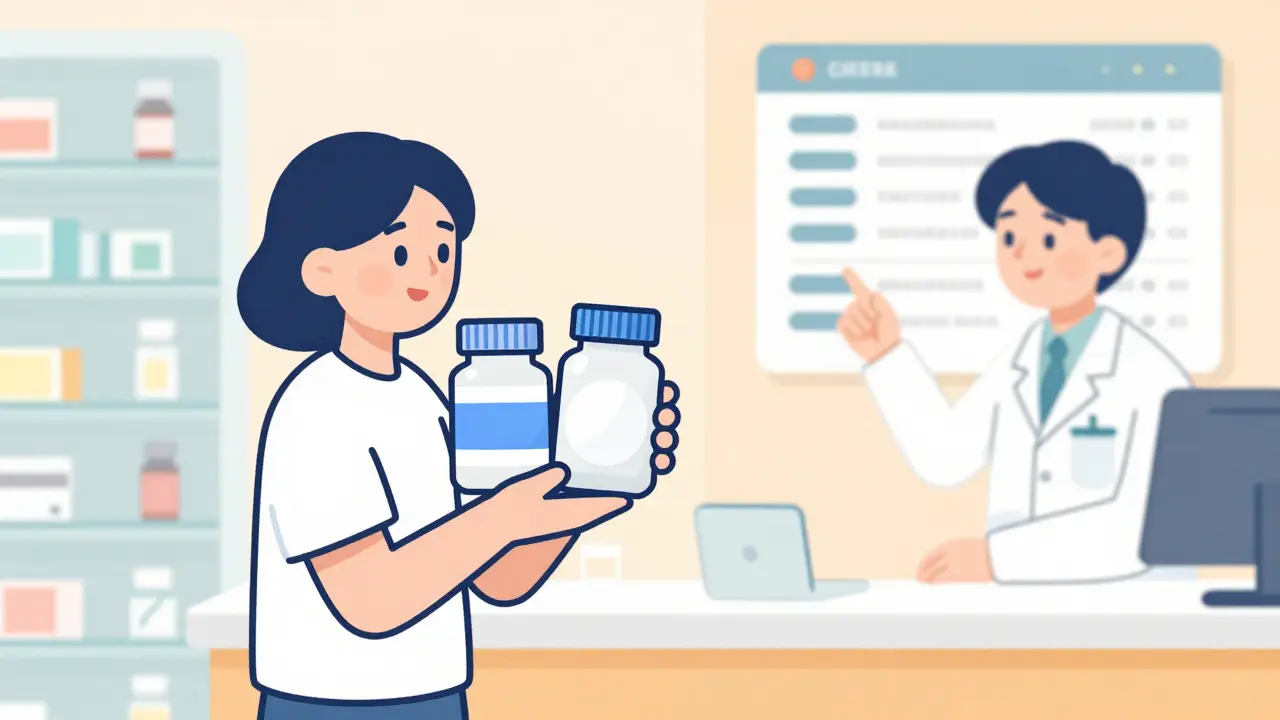
When your prescription switches from a brand-name drug to a generic version, it’s not just a change in packaging or price-it’s a moment that requires clear, honest communication with your pharmacy. Many people assume generics are identical to brand-name drugs, and for most, they are. But for some, even small differences can cause real problems. Knowing what to ask, when to ask it, and how to speak up can make all the difference in your health.
Why Generic Switches Happen
Generic drugs aren’t knockoffs. They’re approved by the FDA to work exactly like their brand-name counterparts. The same active ingredient. Same dose. Same way you take it. But they’re cheaper because they don’t need to repeat expensive clinical trials. When a brand-name drug’s patent expires, manufacturers can produce generics. Insurance companies push for these switches because they save money-on average, $265 per medication per year for Medicare users. In 2023, generics made up 90% of all prescriptions filled in the U.S., but only 23% of drug spending.That’s great for the system. But for you? It can be confusing. One day your pill is blue and oval. The next, it’s white and round. The label says the same thing. But you feel different. That’s when talking to your pharmacist isn’t optional-it’s essential.
What Changes (and What Doesn’t)
The FDA requires generics to be bioequivalent. That means the amount of drug in your bloodstream must be within 80% to 125% of the brand-name version. Sounds strict? It is. But that range still allows for small differences in how fast or how completely your body absorbs the medicine.Here’s what stays the same:
- Active ingredient
- Dosage strength
- How you take it (pill, injection, inhaler)
- How long it lasts in your body
Here’s what can change:
- Color, shape, size
- Inactive ingredients (fillers, dyes, coatings)
- How quickly it dissolves in your stomach
For most people, these differences don’t matter. But for drugs with a narrow therapeutic index-like levothyroxine (for thyroid), warfarin (blood thinner), or seizure meds like levetiracetam-even a 5% difference in absorption can lead to side effects or loss of control. A 2021 study in JAMA Internal Medicine found that 9.4% of patients switching from brand to generic antiepileptic drugs had a seizure within six months, compared to 5.3% who stayed on the brand.
When to Talk to Your Pharmacist
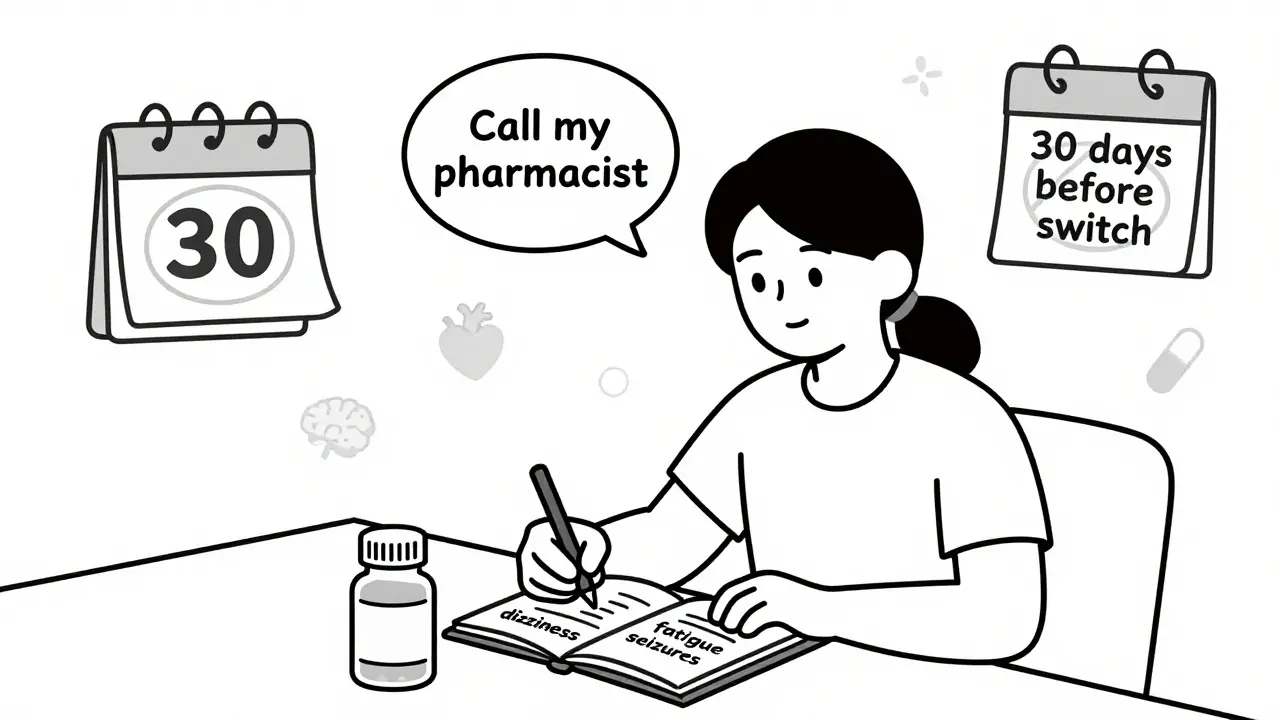
Don’t wait until you feel weird. Start the conversation before the switch happens. If your doctor says your brand-name drug will no longer be covered, call your pharmacy at least 30 days ahead. That gives them time to:- Check if your insurance requires prior authorization to keep the brand
- See if a generic from a specific manufacturer is approved
- Coordinate with your doctor if you need to stay on the brand for medical reasons
Pharmacists can also help you find patient assistance programs. Some generic makers offer discounts or free samples during transitions. For example, Amgen’s support program for Ravicti helped reduce medication gaps by 68% by proactively reaching out to patients.
And if you’re on a controlled substance-like a painkiller or ADHD med-the DEA now lets pharmacies transfer your electronic prescription without your doctor’s involvement. That means less back-and-forth, faster switches, and fewer gaps in your supply.
What to Say at the Pharmacy
When you pick up your new prescription, don’t just take it and go. Ask these four things:- “Is this the same medicine I was on before?” Even if it looks different, confirm the active ingredient matches.
- “Are there any differences I should watch for?” The pharmacist can tell you if this generic has a history of absorption issues.
- “Will this affect how I take it or when I take it?” Some generics need to be taken with food, others on an empty stomach.
- “What should I do if I feel different?” Get clear signs to watch for-like dizziness, nausea, or worsening symptoms-and know when to call back.
Bring your current pill bottle with you. Show the pharmacist what you’ve been taking. Many patients don’t realize pharmacists can compare the two side by side and spot differences in inactive ingredients that might cause reactions.
Red Flags to Watch For
Not all generic switches go smoothly. Here are signs you need to act:- Your symptoms get worse (more seizures, higher blood pressure, fatigue)
- You develop new side effects (rash, upset stomach, dizziness) that weren’t there before
- You feel like the medicine isn’t working the same way
- You’re confused because the pill looks completely different from last time
If any of these happen, call your pharmacist immediately. Don’t assume it’s “just in your head.” Pharmacists have access to databases that track reports of issues with specific generic batches. They can often switch you to a different manufacturer’s version-even if it’s still generic.
How to Stay in Control
You don’t have to be passive during a generic transition. Here’s how to take charge:- Keep a medication list with names, doses, and why you take each one. Bring it to every visit.
- Ask for medication synchronization-this means all your prescriptions are due on the same day. It reduces missed doses and makes transitions easier. One study showed it improves adherence by 27%.
- Know your insurance rules. Medicare Part D plans must give you a 90-day grace period if you’re switching to a new plan. Use it.
- Use one pharmacy. If you switch pharmacies, make sure your old one sends your records. Electronic records help, but human confirmation matters more.
Also, don’t be afraid to ask for the brand-name drug if you’ve had trouble with generics in the past. Your doctor can write “Dispense as Written” or “Do Not Substitute” on the prescription. It’s your right.
What the Experts Say
Dr. Aaron Kesselheim from Harvard Medical School says, “For certain medications, even small differences in how they’re absorbed can be clinically significant.” That’s why he insists pharmacists be part of every transition conversation.The FDA is clear: generics are safe and effective. But they also admit, “Some patients may notice differences in how the medication works for them.” That’s not a flaw-it’s a signal to talk.
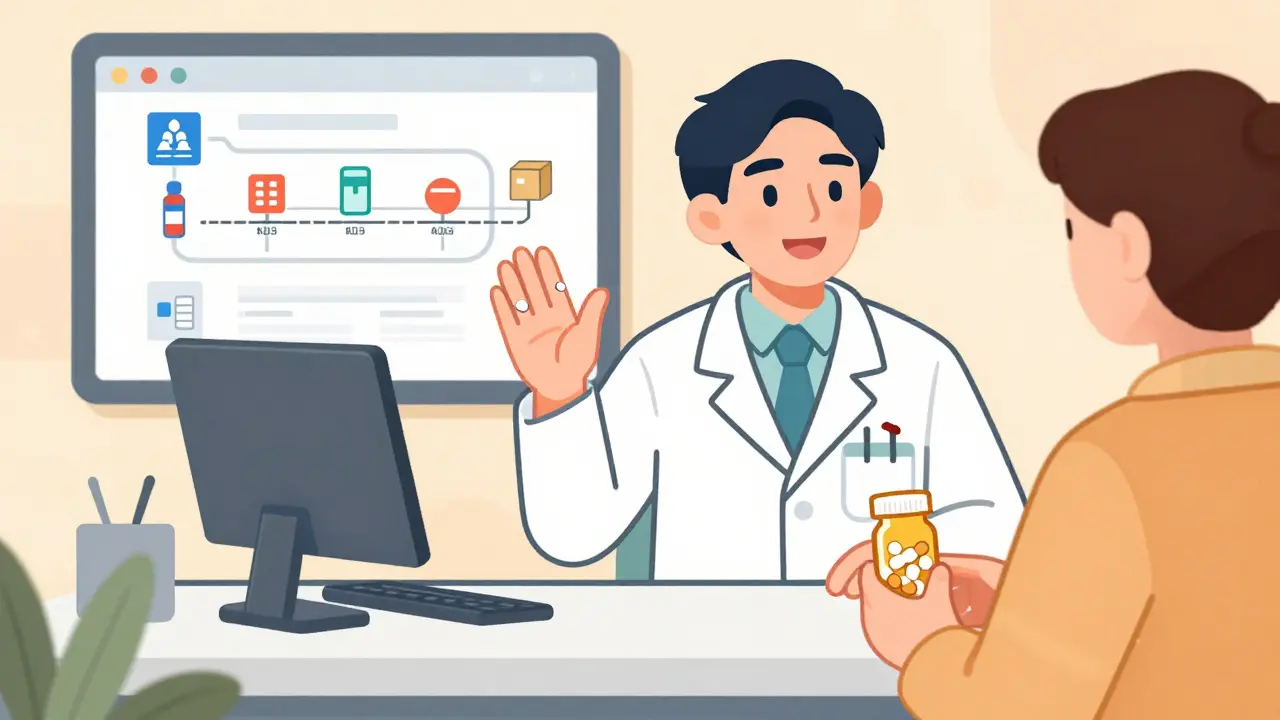
Pharmacists aren’t just dispensers. They’re medication experts. In 2022, the American Association of Colleges of Pharmacy called them “the most accessible healthcare professionals” for managing transitions. They’re trained to spot problems, answer questions, and advocate for you.
Real Stories
One Reddit user, u/MedConcern87, switched from brand-name Keppra to a generic version of levetiracetam and started having seizures again. After months of back-and-forth, their pharmacist helped them get the brand restored-because they’d documented the change in symptoms and brought lab results.Another patient, in a Healthline survey, said they saved $1,200 a year switching to generics. No side effects. No issues. Just lower bills.
There’s no single outcome. But the difference between success and trouble? Communication.
What’s Changing in 2026
New tools are making transitions smoother. EHR systems like Epic now alert pharmacists when a patient is switching from brand to generic, so they can proactively reach out. CVS and Walgreens are testing blockchain systems that let patients see the full history of their medication-from manufacturer to pharmacy-which cuts confusion by 41%.But technology doesn’t replace conversation. The best system in the world won’t help if you don’t speak up.
Can I ask to stay on my brand-name drug instead of switching to generic?
Yes. You can ask your doctor to write “Dispense as Written” or “Do Not Substitute” on your prescription. Insurance may require prior authorization, but if you’ve had side effects or poor results with generics before, your doctor can justify keeping the brand. Pharmacists can help you navigate this process.
Why does my generic pill look different every time?
Different manufacturers make the same generic drug, and each uses its own color, shape, and markings. This is legal and common. If you’re confused or worried, bring your old bottle to the pharmacy and ask them to confirm the active ingredient matches. You can also ask for the same manufacturer each time-if they carry it.
Are generic drugs as safe as brand-name drugs?
Yes. The FDA requires all generics to meet the same strict standards for quality, purity, and strength as brand-name drugs. They’re tested in the same labs and inspected in the same facilities. Over 90% of U.S. prescriptions are generics, and they’ve been used safely by millions for decades. The main difference is cost-not safety.
What should I do if I think the generic isn’t working?
Don’t stop taking it. Call your pharmacist right away. Keep a symptom journal-note when you started the new pill, what changed, and how you feel. Bring this to your doctor. Your pharmacist may be able to switch you to a different generic manufacturer, or help you get your brand-name drug back if medically necessary.
Do all medications switch to generics the same way?
No. Simple pills like metformin or atorvastatin switch easily. But complex drugs-like inhalers, injectables, or topical creams-are harder to replicate exactly. For these, bioequivalence is harder to prove, and switching carries more risk. Always ask your pharmacist if your drug falls into this category.
If you’re taking a medication for a serious condition-thyroid disease, epilepsy, heart failure, or blood thinning-don’t treat a generic switch as routine. It’s a health event. And your pharmacist is your best ally in making sure it goes right.

9 Comments
Generic switches are way more complicated than people think. I’ve been on levothyroxine for 12 years, and every time they switched manufacturers, I felt off for a week-fatigue, brain fog, the whole thing. My pharmacist finally kept a log of which batch I got, and now they always give me the same one. It’s not about the drug-it’s about the fillers. Little things like lactose or dyes can mess with your gut, and no one talks about that.
Pharmacists are the real MVPs here. They’ve got access to batch data, manufacturer histories, even patient feedback databases. If you’re on a narrow-therapeutic-index med, don’t just accept the switch. Ask for the specific manufacturer. It’s your right.
Also, bring your old bottle. I did that once, and the pharmacist spotted the coating difference right away. Turns out, the new one had a delayed-release shell I didn’t know about. That’s why I felt sluggish for days. Knowledge is power.
And yes, I’ve called my doctor to write ‘Do Not Substitute’ twice. No shame. Your body knows when something’s off. Trust it.
So many people in India think generics are cheap and unsafe-but they’re not! We’ve been using them for decades, and my mom’s BP meds? Generic. She’s 72, still hiking, no issues. The FDA standards are solid. If you’re having problems, it’s not the generic-it’s the batch. Talk to your pharmacist. They’ll help you find the right one.
Also, don’t be scared to ask for the brand if it’s working. No one should be forced into a switch that makes them feel worse. Your health > corporate savings.
OMG YES. I switched from brand Keppra to generic and had a FULL-ON SEIZURE. Like, I was in the grocery store, dropped my cart, woke up in the ER. My pharmacist? She cried. She said she’d never seen someone have a reaction like that. Turns out, the generic I got had a different dissolution rate-slower absorption. I had to go back to brand. Insurance fought me. I won. My life is worth more than $120 a month.
PLEASE. If you feel weird after a switch? CALL YOUR PHARMACIST. TODAY. Don’t wait. Don’t Google. Don’t think it’s ‘in your head.’ It’s not. I’m alive because I screamed. You should too.
Let’s be real-this whole ‘generic switch’ narrative is a marketing ploy by Big Pharma to keep people scared. The FDA’s bioequivalence range? 80–125%. That’s a 45% window. That’s not science. That’s a gamble. And now they’re pushing blockchain? Like that’s going to help when the real issue is the lack of transparency in manufacturing? I’ve seen generics with 30% variation in active ingredient concentration. Not from the FDA. From the factories.
And don’t get me started on ‘patient assistance programs.’ They’re just PR stunts. Amgen’s program? They only help people who can prove they’re ‘medically necessary’-which means if you’re poor, you’re out of luck.
Bottom line: if you’re on a critical med, stick with brand. Pay out of pocket. Save your life. The system is rigged.
Interesting how this article frames pharmacists as heroes while ignoring the fact that they’re often incentivized by insurance companies to push generics. They’re not ‘advocates’-they’re middlemen in a cost-cutting machine.
Also, the JAMA study cited? 9.4% vs 5.3% seizure rates. That’s a 77% relative increase. But the absolute risk? Still under 10%. That’s not a crisis-it’s a statistical blip. This article is fearmongering disguised as patient advocacy.
And the ‘dispense as written’ clause? That’s a loophole for the wealthy. Most people can’t afford to pay $500/month for a brand-name drug. This isn’t about health. It’s about privilege.
Also, blockchain? Seriously? You think patients care about the supply chain? They care if they feel dizzy. That’s it. Stop overengineering solutions to a problem that’s mostly non-existent for 90% of users.
I just wanted to say thank you for writing this. I’ve been on warfarin for 8 years. I switched generics once, and my INR spiked. I didn’t know what was wrong. I thought I’d messed up my diet. Turns out, the new generic had a different coating that delayed absorption. My pharmacist caught it because I brought my old bottle. We switched back to the same manufacturer. No drama. Just a quiet conversation.
It’s not about fear. It’s about awareness. And that’s what this post does so well.
Also-medication synchronization? Game changer. I get all my scripts on the same day now. No more missing doses. No more panic. I wish everyone knew about this.
Okay, but let’s unpack this. The article says generics are safe, then cites a study showing a 77% increase in seizure risk. That’s not a contradiction-it’s a red flag. And yet, the solution is ‘talk to your pharmacist.’ But pharmacists don’t control formularies. Insurance does. And if your plan won’t cover the brand, you’re stuck. So what good is talking if you can’t afford the answer?
Also, the ‘dispense as written’ clause? It’s not a right. It’s a privilege. If you’re on Medicare, you’re at the mercy of your Part D plan’s tier system. If your drug is tier 4, you’re paying 40% out of pocket. Most people can’t do that.
And the blockchain thing? That’s tech bro nonsense. Patients don’t care if their pill came from a factory in Mumbai or New Jersey. They care if it works. And if it doesn’t, they’re left to guess why-because no one tells them the batch number. No one tracks it. No one apologizes.
This article is well-intentioned. But it’s also naive. The system isn’t broken. It’s designed this way.
Did you know the FDA doesn’t test generics? They don’t. They just accept the manufacturer’s data. And those companies? They’re owned by the same people who make the brand-name drugs. Pfizer owns 12 generic brands. Merck owns 8. It’s all the same lab. Same equipment. Same people. They just change the label.
And the ‘inactive ingredients’? Those are the real danger. I had a rash after switching to a generic. Turned out, it had a dye that’s banned in the EU. But it’s legal here. Why? Because the FDA doesn’t regulate fillers the same way.
And now they’re pushing blockchain? That’s just to make it look like they’re doing something. Meanwhile, people are dying because they can’t afford to switch back. This isn’t healthcare. It’s corporate theater.
And don’t get me started on the ‘dispense as written’ clause. It’s a joke. My pharmacist said she could help me-but only if I paid $1,200 upfront. For a $15 drug. That’s not access. That’s extortion.
Yessss!! 💖 I’m a nurse and I’ve seen this so many times. A patient comes in crying because their new pill looks different and they swear it’s not working. We check the bottle, the batch, the manufacturer-and 90% of the time, it’s the same exact drug. But the *fear* is real. And that fear makes people skip doses or panic. So we sit down. We compare pills. We call the pharmacy. We reassure. We listen.
And guess what? Most of them feel better just knowing someone took them seriously.
Don’t be afraid to ask. Don’t be ashamed to say ‘I feel different.’ Your pharmacist wants to help. They’re not robots. They’re humans. And they’re on your side. 💪❤️