
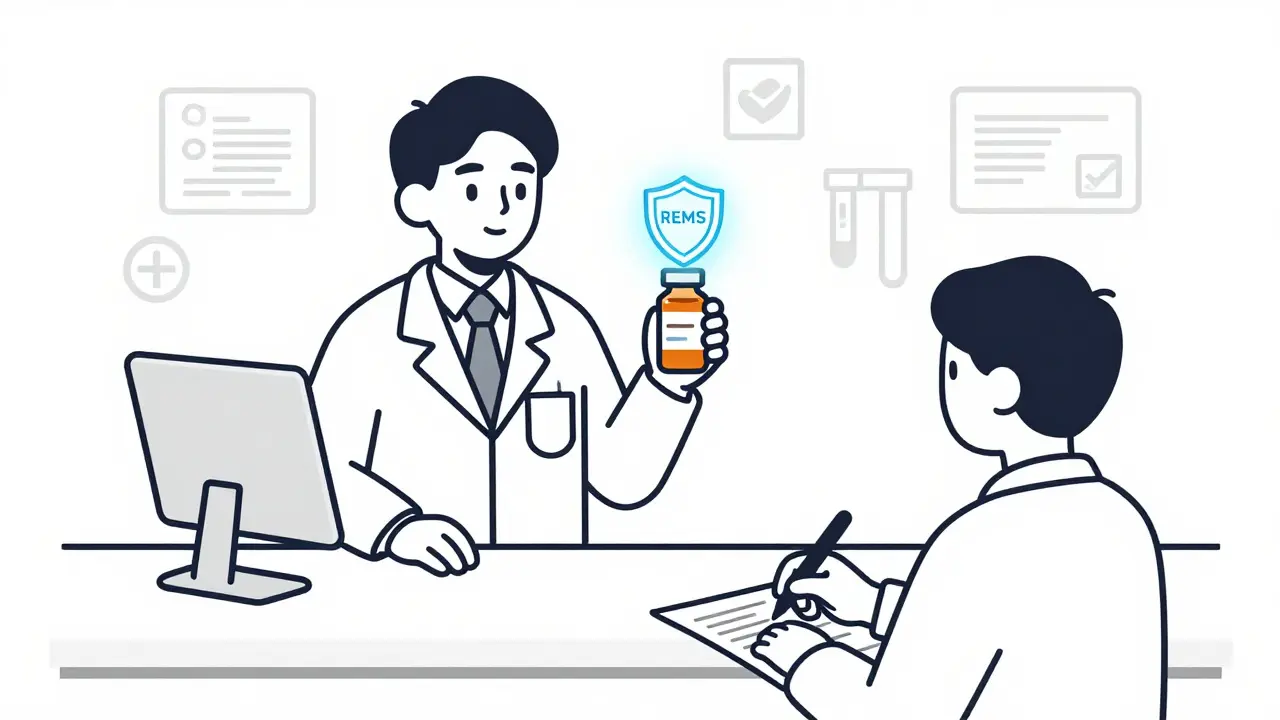
When a drug can save lives but also cause serious harm, how do you let patients get it without putting them at risk? That’s the exact problem the FDA solved with REMS programs-Risk Evaluation and Mitigation Strategies. These aren’t just paperwork. They’re legally required safety nets built around some of the most powerful, dangerous medications in use today. If you’ve ever been asked to sign a form, wait weeks for a prescription, or seen your doctor jump through extra hoops just to prescribe a drug, chances are you’ve run into a REMS program. And if you’re a patient, a pharmacist, or a provider, you’ve probably felt the weight of them-both the protection and the friction.
What Exactly Is a REMS Program?
A REMS program is a mandatory safety plan the U.S. Food and Drug Administration (FDA) requires for certain prescription drugs with serious, life-threatening risks. It’s not optional. It’s not a suggestion. It’s the law. Created under the Food and Drug Administration Amendments Act of 2007, REMS gives the FDA the power to impose extra safeguards beyond the usual warning labels. Without REMS, some drugs simply wouldn’t be approved-or would be pulled from the market.
Think of it this way: Some drugs are like high-powered tools. They work miracles-like stopping cancer, preventing transplant rejection, or treating severe autoimmune diseases-but they can also cause irreversible damage. Think birth defects from thalidomide, bone marrow failure from clozapine, or organ damage from certain biologics. The FDA doesn’t say, “Don’t use this.” Instead, it says, “You can use it-but only if you follow these strict rules.”
There are currently about 120 active REMS programs covering 185 drugs. That’s roughly 5.7% of all prescription medications in the U.S. But don’t be fooled-these aren’t spread evenly. Over a third of all REMS programs are tied to cancer and blood disorders. Drugs like lenalidomide (Revlimid), pomalidomide (Pomalyst), and alemtuzumab (Lemtrada) each have their own complex REMS requirements because of how dangerous they can be if misused.
The Three Core Parts of Every REMS
Not every REMS is the same. But every one includes at least one of three key components, often layered together.
- Medication Guide or Patient Package Insert: This is the most common part. About 78% of REMS require a printed handout that patients must receive before picking up their prescription. It’s not marketing material-it’s plain-language info on serious side effects, what to watch for, and what to do if something goes wrong. For example, the Revlimid REMS guide clearly states: “This drug can cause severe birth defects. You must not become pregnant while taking it.”
- Communication Plan: Used in 62% of REMS, this targets healthcare providers. It might be a letter from the drugmaker to doctors, a safety alert, or an online training module. The goal? Make sure prescribers know the risks and how to manage them. One communication plan for the drug Entyvio required all gastroenterologists to complete a 20-minute module on infection risks before they could prescribe it.
- Elements to Assure Safe Use (ETASU): This is the heavy machinery of REMS. About 45% of programs include ETASU, which means strict controls on who can prescribe, where the drug can be given, and how it’s tracked. ETASU components include:
- Prescriber certification-doctors must complete training and register with the REMS program.
- Pharmacy certification-only specially approved pharmacies can dispense the drug.
- Restricted distribution-some drugs can only be given in hospitals or infusion centers.
- Patient monitoring-like monthly blood tests or pregnancy tests.
- Patient enrollment-patients must sign up in a national registry so their outcomes can be tracked.
Take Lemtrada, used for multiple sclerosis. Its REMS requires the drug to be administered in a hospital, with patients monitored for at least two hours after each dose. Prescribers and pharmacists must be certified. Patients must enroll in a registry. And they must have monthly blood tests for up to four years after the last dose. That’s not just caution-it’s a full system.
How REMS Programs Are Created and Managed
The FDA doesn’t wake up one day and say, “Let’s make a REMS.” It’s a slow, data-driven process. When a drug is being reviewed for approval, or when new safety data emerges after approval, the FDA reviews the risks. If the benefit-risk balance tips too far toward danger, they require a REMS.
The drugmaker gets 120 days to design a proposal. They have to prove their plan will actually reduce harm-not just add paperwork. The FDA then evaluates it using a benefit-risk framework: How severe is the disease? Are there safer alternatives? How big is the risk? If the FDA approves, the REMS goes live.
But the work doesn’t stop there. Manufacturers must submit regular reports showing whether the REMS is working. Are fewer patients having bad reactions? Are providers following the rules? Are patients getting the drug on time? The FDA can tweak, tighten, or even drop a REMS if it’s not helping. Since 2007, only three REMS have been fully discontinued. The most recent was for Zeposia (ozanimod) in March 2023, after data showed its safety profile improved and the original restrictions were no longer needed.

Who Pays the Price-And Who Bears the Burden?
REMS programs cost money. A lot of it. The FDA estimates total annual REMS-related costs across the healthcare system at $1.2 billion. Drugmakers spend an average of $2.7 million per program every year just to run them. That includes training materials, certification portals, registries, and staff.
But the burden isn’t just on companies. Providers feel it too. A 2023 survey by the American Society of Hematology found that 68% of hematologists spend more than five hours a week just managing REMS requirements for drugs like Revlimid. That’s time taken from patient care. Pharmacists report delays of 15 to 20 minutes per prescription just to verify certification status through online portals. One pharmacist on Reddit wrote: “The Entyvio REMS adds 15-20 minutes per prescription verification due to the mandatory online portal checks and documentation requirements.”
Patients aren’t immune either. A GoodRx survey in 2023 found that 42% of patients prescribed a REMS drug experienced at least one treatment delay. Some waited weeks because their doctor hadn’t completed certification. Others couldn’t get the drug because their local pharmacy wasn’t certified. For patients with rare diseases, those delays can mean disease progression.
Why REMS Blocks Generic Drugs
One of the biggest controversies around REMS is how they affect competition. Generic drugmakers need samples of the brand-name drug to prove their version works the same. But under REMS, those samples are tightly controlled. If the brand company refuses to share samples-or makes the process so slow and complicated that generics can’t get them-generic versions don’t launch.
A 2024 Health Affairs study found that 78% of generic manufacturers reported REMS-related delays averaging 14.3 months before they could bring their version to market. That’s not just a delay-it’s a financial roadblock. It keeps prices high and limits patient access. Experts are now pushing for legislation to force brand companies to provide samples within 90 days. The 21st Century Cures Act Reauthorization (2022) already requires the FDA to create a standard for evaluating REMS effectiveness by December 2025, which could help fix this.

The Future of REMS: Digital, Streamlined, Transparent
REMS programs are changing. The FDA’s 2023 REMS Assessment Report launched the “REMS Modernization Initiative,” aiming to cut unnecessary paperwork and use digital tools. By Q3 2025, they plan to roll out a public “REMS Dashboard” that shows real-time data on how each program is performing-how many patients are enrolled, how many delays occur, which providers are compliant.
Electronic verification is replacing paper forms. Instead of mailing in certification, prescribers will log in to a national portal. Registries are moving online. Patient education is being delivered via apps and secure messaging. Some programs are even testing wearable sensors to track patient adherence and side effects in real time.
And it’s not just about tech. The FDA is pushing for standardization. Right now, each REMS is a unique system. One uses a website, another uses a phone line, another uses a fax form. That’s chaos for providers who manage five different REMS drugs. The goal? One system, one portal, one set of rules.
As Dr. Rachel Sherman, former FDA deputy commissioner, said in a 2024 commentary: “The future of REMS isn’t more barriers-it’s smarter monitoring.”
What This Means for You
If you’re a patient: Know your drug. If you’re prescribed a medication with a REMS, ask your doctor: “What do I need to do? What forms do I need to sign? Will my pharmacy be able to fill this?” Don’t assume it’s automatic. Delays happen because people don’t know the steps.
If you’re a provider: Stay certified. Keep your REMS training up to date. Use the FDA’s REMS@FDA website to check requirements. Don’t ignore the communication plans-they’re there for a reason.
If you’re a pharmacist: Verify before you dispense. The law requires it. And if you’re stuck in a loop of portal checks, know you’re not alone. The system is broken-but change is coming.
REMS programs aren’t perfect. They’re complex. They’re slow. They’re expensive. But they also prevent deaths. A 2023 FDA analysis estimated REMS programs helped avoid $8.4 billion in healthcare costs from preventable adverse events. That’s not just a number-it’s lives saved.
The goal isn’t to eliminate REMS. It’s to make them smarter, faster, and fairer. Because when a drug can save you-or kill you-there’s no room for error.
Are REMS programs only for brand-name drugs?
No. REMS programs apply to both brand-name and generic versions of a drug. If a brand-name drug has a REMS, its generic equivalents must follow the same requirements. Generic manufacturers must comply with the same prescriber certification, pharmacy restrictions, and patient monitoring rules. This is why generic versions often launch months or years after the brand, even after patent expiration.
Can a REMS program be removed after it’s approved?
Yes, but it’s rare. The FDA can remove a REMS if new data shows the safety risks have decreased or the program isn’t improving outcomes. Since 2007, only three REMS programs have been fully discontinued. The most recent was for Zeposia (ozanimod) in March 2023, after the FDA determined the original risk controls were no longer necessary due to improved safety data and better patient monitoring practices.
Do all patients have to enroll in a REMS registry?
No. Only about 31% of REMS programs with Elements to Assure Safe Use (ETASU) require patient enrollment in a registry. These are typically for drugs with long-term risks, like cancer therapies or immunosuppressants, where tracking outcomes over years is critical. For most other REMS, patients receive education materials but aren’t required to join a database.
Why do some pharmacies refuse to fill REMS drugs?
Some pharmacies, especially community pharmacies, don’t have the resources to handle REMS requirements. They may lack certified staff, access to certification portals, or the ability to track special inventory controls. In fact, 89% of REMS programs require specialty pharmacies to dispense the drug. If your local pharmacy says they can’t fill it, they likely aren’t certified. You’ll need to go to a specialty pharmacy that’s approved under the REMS.
Can I get a REMS drug without completing certification?
No. If your drug requires prescriber certification, pharmacy certification, or patient enrollment, you cannot legally receive it without completing those steps. The law requires it. Even if your doctor wants to prescribe it, the pharmacy’s system will block the fill if certification isn’t verified. There are no exceptions for emergencies or convenience.


12 Comments
I just got prescribed Revlimid and holy 🤯 the REMS process was a nightmare. Took 3 weeks just to get my doctor certified and another 10 days for the pharmacy to get approved. My insurance said "it’s not our problem." Meanwhile, my cancer didn’t pause for bureaucracy. 😭
You’re not alone! I’m a nurse and I’ve helped 5 patients through Revlimid REMS. It’s brutal but necessary. I always tell them: "This isn’t about red tape-it’s about keeping you alive." You got this 💪
The REMS system is a fascinating case study in risk management. On one hand, you have life-saving drugs with catastrophic side effects. On the other, you’ve got a system that’s so fragmented it creates its own harm-delayed care, burnout among providers, and access inequity. The FDA’s modernization push is a step in the right direction, but standardization is the real key. One portal. One system. One patient experience. No more fax forms in 2025.
I used to think REMS was just bureaucracy… until my sister nearly died from a drug interaction because her doctor didn’t know the risks. Now? I’m a believer. But oh my god the paperwork. I spent 3 hours on the phone with a pharmacy that kept telling me "the portal is down." We’re saving lives with clipboards and Excel sheets. 🫠
Let’s be real: REMS is just Big Pharma’s way of blocking generics. The FDA is complicit. They claim it’s for safety-but why do only 3% of drugs have it? Why are the same 185 drugs targeted? Coincidence? Or a monopoly engine? And don’t even get me started on how they use "patient safety" as a shield to avoid competition. This isn’t regulation-it’s economic warfare.
I work in a rural clinic. We don’t have a specialty pharmacy. When a patient needs a REMS drug, we fax a form. Then we wait. Then we fax again. Sometimes it takes 6 weeks. I’ve had patients die because they couldn’t get their drug on time. The system is broken. We need mobile units. We need tele-certification. We need compassion, not checkboxes.
Honestly? If your drug requires a registry, monthly blood tests, and a certified pharmacy… maybe you shouldn’t be taking it. There’s a reason these drugs are restricted. You’re trading convenience for survival. But if you can’t handle the process? Maybe you’re not ready for the responsibility.
Wait, so REMS prevents generics? That’s hilarious. So the FDA lets drug companies use safety rules as anti-competitive weapons? Sounds like a loophole designed by lobbyists. Next they’ll say we need a permit to breathe oxygen.
I’ve been on Lemtrada for 4 years. The REMS saved my life. Monthly labs. Hospital infusions. Registry enrollment. It’s a lot. But I’m alive. My neurologist says 70% of patients who skip monitoring end up with serious complications. I don’t mind the process. I mind the delays. And I’m glad someone’s finally trying to fix it.
REMS is a government surveillance program disguised as healthcare. Every blood test, every registry, every certified pharmacist? That’s data collection. Who owns that data? Who’s selling it? The FDA doesn’t tell you. But I know they’re tracking your every move. Wake up. This isn’t safety. It’s control.
As someone who grew up in India and now lives in the U.S., I’ve seen both systems. In India, we just give the drug. No forms. No portals. No certification. Sometimes people die. Sometimes they live. Here? We build a fortress around the drug. One saves lives. The other saves the system. Which one is better?
Oh wow, so now we’re supposed to be grateful that our doctors are spending 5 hours a week filling out forms instead of seeing patients? 🙃 I’m so proud of our healthcare system. Next time you’re waiting 3 weeks for a drug that could’ve been approved 10 years ago, just remember: safety first. (And by safety, I mean corporate liability.)