
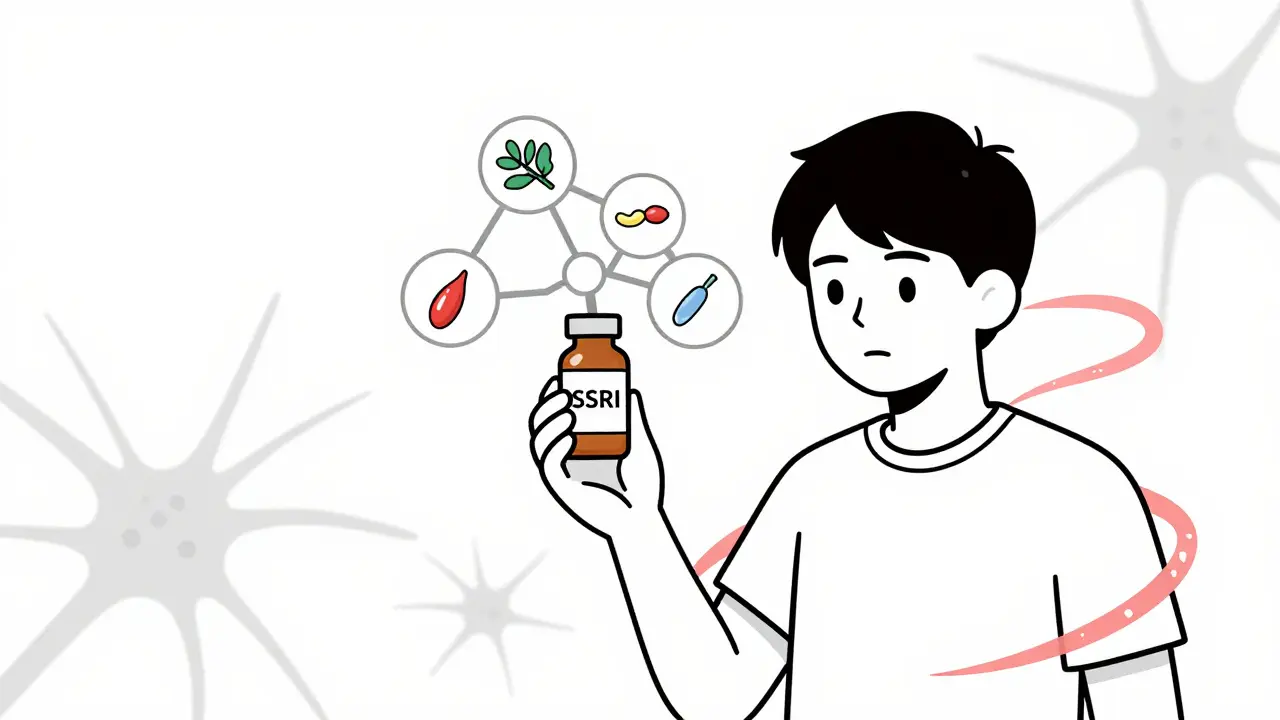
More than 1 in 8 Americans take an SSRI antidepressant. That’s over 30 million people. For many, these medications bring relief from depression, anxiety, or OCD. But behind the quiet success stories is a silent danger: serotonin syndrome. It doesn’t always show up in doctor’s notes. It doesn’t always make headlines. But when it hits, it can kill.
What SSRIs Actually Do
SSRIs - selective serotonin reuptake inhibitors - work by keeping more serotonin in your brain. Serotonin isn’t just a "happy chemical." It’s a key messenger that helps regulate mood, sleep, digestion, and even muscle control. Drugs like sertraline (Zoloft), escitalopram (Lexapro), and fluoxetine (Prozac) block the brain’s ability to pull serotonin back into nerve cells after it’s released. That leaves more of it floating around, which can lift your mood over time. But here’s the catch: serotonin doesn’t stay neatly in the brain. It’s active in the spinal cord, gut, and peripheral nerves too. When too much builds up, it overstimulates receptors. That’s when things go wrong.How Serotonin Syndrome Happens
Serotonin syndrome isn’t caused by taking too much of one SSRI. It’s caused by combining SSRIs with other drugs that also boost serotonin. The body can handle one extra push. But two? Three? That’s when the system floods. The symptoms start small - maybe a slight tremor, a little sweating, a feeling of restlessness. Then they climb fast: muscle rigidity, high fever, confusion, seizures. In severe cases, your body overheats, your heart races out of control, and your organs begin to shut down. Death can happen within hours. Doctors use the Hunter Criteria to diagnose it. You need one of these: spontaneous muscle spasms (clonus), or a mix of tremor, hyperreflexia, and fever. If you’re on an SSRI and suddenly feel like you’re being electrocuted from the inside, you’re not imagining it.The Real Danger: What You Combine With SSRIs
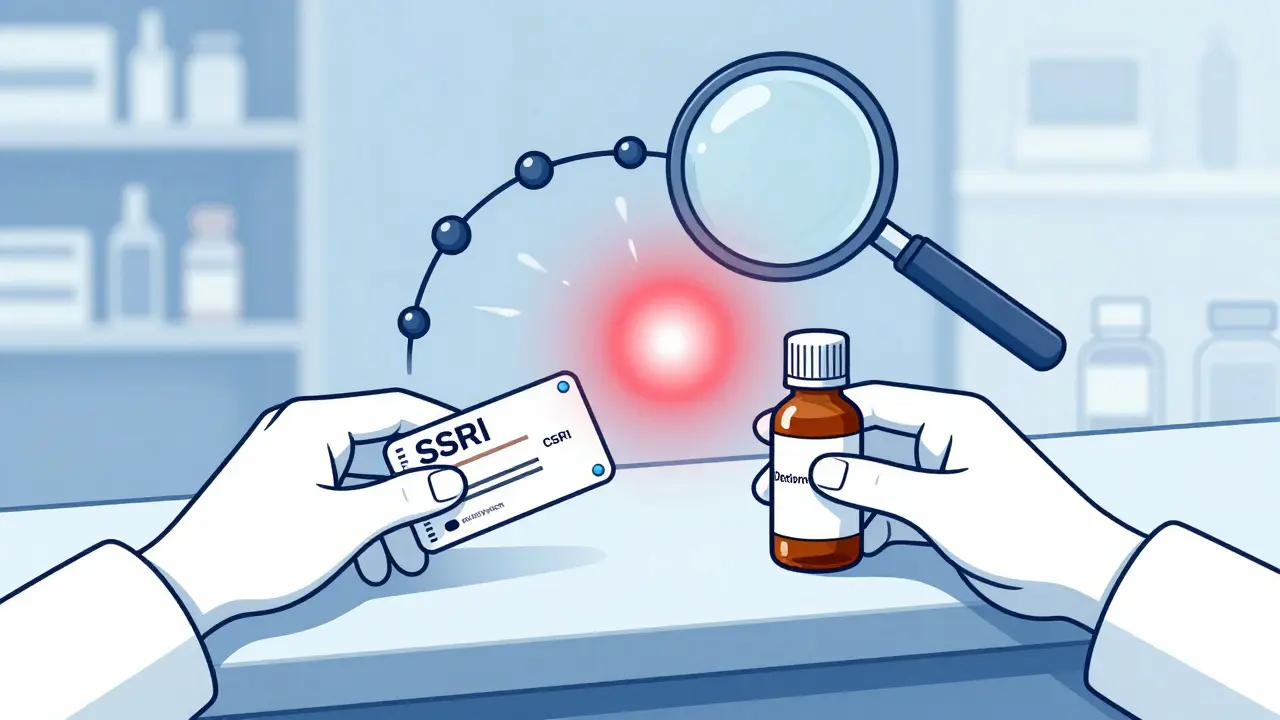
Most people know not to mix SSRIs with MAOIs - those old-school antidepressants. But what they don’t realize is how many common medications can trigger serotonin syndrome. High-risk combos:- Tramadol - a painkiller many think is "safe." It’s actually a serotonin booster. Combine it with an SSRI, and your risk jumps nearly fivefold.
- Dextromethorphan - the cough syrup ingredient in Robitussin and DayQuil. People take it for colds, not knowing it’s chemically similar to MDMA.
- Linezolid - an antibiotic for stubborn infections. It blocks serotonin breakdown. Even a 5-day course can be deadly if you’re on an SSRI.
- St. John’s Wort - the "natural" remedy for depression. It’s not safer. It’s just as potent as prescription drugs at raising serotonin.
- Methadone
- Fentanyl
- Trazodone
- Mirtazapine
Who’s Most at Risk?
It’s not just the elderly. It’s the over-medicated. A 2021 study found that 22% of Americans over 65 take five or more medications daily. Many are on an SSRI for anxiety, an opioid for back pain, a cough syrup for a cold, and a supplement for sleep. That’s four serotonin boosters in one bottle. Women are diagnosed more often - not because they’re more prone, but because they’re more likely to be prescribed SSRIs and to report symptoms. But men die more often. Why? They’re less likely to seek help until it’s too late. A Reddit user named AnxietyWarrior87 described waking up after taking tramadol with sertraline: "My legs were locked in spasm. My temperature hit 104.2°F. I thought I was dying." He spent three days in the ICU.What Doctors Miss - And Why
Serotonin syndrome is misdiagnosed as the flu, heat stroke, or a panic attack. It’s not on most doctors’ radar unless they specialize in psychiatry or toxicology. A 2022 review found that only 2.1% of patients who had mild symptoms - like shivering or sweating - went to the ER. The rest thought it was "just side effects." But mild symptoms can turn deadly in 24 hours. Pharmacists are often the last line of defense. A 2023 study showed pharmacist-led reviews cut serotonin syndrome events by 47% in Medicare patients. Why? They see the full list. They catch the hidden combos.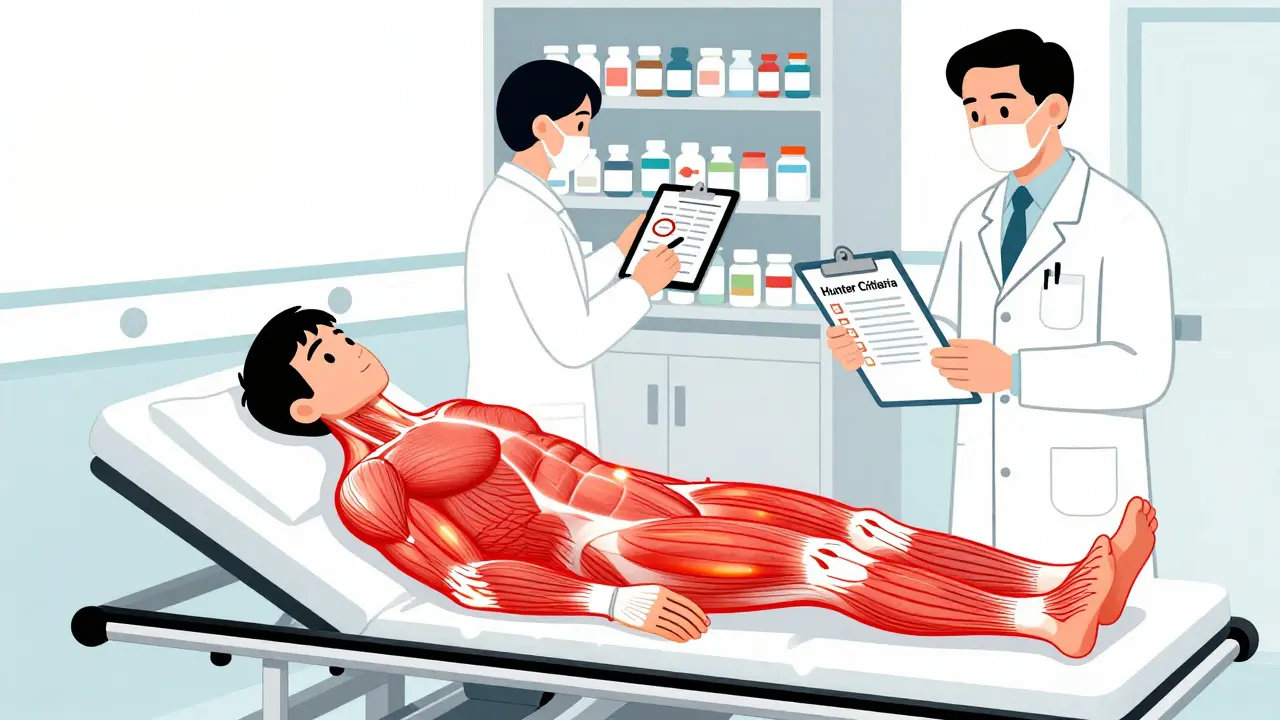
What You Can Do
If you’re on an SSRI, here’s what you need to know:- Never start a new medication - even OTC or herbal - without checking with your doctor or pharmacist.
- Know your drugs. Tramadol? Dextromethorphan? St. John’s Wort? These aren’t "safe" just because you can buy them without a prescription.
- Watch for the 5 S’s: Shivering, Sweating, Stiffness, Seizures, Sudden confusion. If two or more show up within hours of starting a new drug, go to the ER.
- Don’t wait for symptoms to get worse. Serotonin syndrome doesn’t wait.
What’s Changing
The FDA is now requiring electronic prescribing systems to warn doctors when they try to prescribe an SSRI with tramadol, linezolid, or dextromethorphan. That’s new. In 2024, it became mandatory in the U.S. The CDC updated its opioid guidelines in 2024: avoid tramadol and dextromethorphan in SSRI users. Use morphine or oxycodone instead - they don’t raise serotonin. Researchers are even testing a blood test - SerotoninQuant - that could detect serotonin overload before symptoms hit. It’s not available yet, but it’s coming.The Bottom Line
SSRIs save lives. But they’re not harmless. The biggest threat isn’t the drug itself - it’s the other drugs you take with it. You don’t need to stop your SSRI. But you do need to know what’s in your medicine cabinet. Keep a list of every pill, supplement, and cough syrup you take. Show it to your pharmacist every time you refill something. Ask: "Could this interact with my antidepressant?" Serotonin syndrome is rare. But when it happens, it’s often preventable. And it doesn’t care if you thought you were being careful. It only cares if you took two things that together pushed your serotonin too far. Don’t assume it won’t happen to you. It happens to people who did everything "right."Can you get serotonin syndrome from one SSRI alone?
Rarely. Serotonin syndrome almost always happens when an SSRI is combined with another serotonergic drug - like tramadol, St. John’s wort, or linezolid. Overdosing on a single SSRI can cause symptoms, but true serotonin syndrome is overwhelmingly linked to drug interactions.
How long after starting a new drug do serotonin syndrome symptoms appear?
Symptoms usually show up within hours - often 6 to 12 hours after taking the new drug. In rare cases, they can take up to 24 to 48 hours, especially if the new drug has a slow onset. If you feel sudden shivering, muscle stiffness, or confusion after starting a new medication, don’t wait.
Is it safe to take ibuprofen or acetaminophen with SSRIs?
Yes. Ibuprofen and acetaminophen do not affect serotonin levels and are generally safe with SSRIs. But avoid combination cold medicines that contain dextromethorphan or pseudoephedrine - those can be risky. Always check the active ingredients.
Can serotonin syndrome be treated at home?
No. Mild symptoms might seem like a bad flu, but serotonin syndrome can escalate rapidly. Even if you feel "okay," you need medical evaluation. Treatment includes stopping the offending drugs, cooling the body, and sometimes giving serotonin blockers like cyproheptadine. This requires hospital care.
Why is fluoxetine (Prozac) more dangerous than other SSRIs?
Fluoxetine and its active metabolite, norfluoxetine, stay in your body for weeks - up to 15 days. That means even if you stop taking it, it’s still active. Switching to an MAOI or another serotonergic drug too soon can trigger serotonin syndrome. The recommended washout period is five weeks, not two.
Are there any safe antidepressants to combine with SSRIs?
Generally, no. Combining antidepressants increases serotonin syndrome risk. Bupropion (Wellbutrin) is an exception - it doesn’t raise serotonin, so it’s sometimes added safely. But even then, it’s done under close supervision. Never combine SSRIs with SNRIs, MAOIs, or tricyclics without expert guidance.
What should I do if I suspect serotonin syndrome?
Call 911 or go to the nearest emergency room immediately. Do not wait. Bring a list of all medications you’re taking, including supplements and OTC drugs. Time is critical - early treatment saves lives.

13 Comments
SSRIs are fine if you're not polypharmacy-ing. The real issue is prescribers not checking interactions. Tramadol + SSRI is a death sentence waiting to happen, and it's still being prescribed like it's Advil. Pharmacists are the only ones catching this - and they're overworked. Systemic failure, not patient negligence.
so we're supposed to trust doctors who prescribe benzos with opioids and now SSRIs with dextromethorphan like its a breakfast cereal
My pharmacist flagged my sertraline + tramadol combo before I even left the counter. I didn't know it was dangerous. Neither did my PCP. That's the problem - it's not patients who are reckless, it's the system that treats meds like Lego bricks. We need mandatory interaction alerts at the prescription level, not after someone's in the ICU.
Let’s break this down neuropharmacologically: SSRIs inhibit SERT, yes - but the real danger lies in the cumulative serotonergic burden across multiple receptor subtypes (5-HT1A, 5-HT2A, 5-HT3). Tramadol’s dual SNRI + weak opioid activity creates synergistic receptor overstimulation. Linezolid? Irreversible MAO-A inhibition. Dextromethorphan? NMDA antagonism + SERT affinity. The Hunter Criteria aren’t arbitrary - they’re based on receptor-level cascade thresholds. This isn’t anecdotal. It’s pharmacokinetic inevitability. And yes - fluoxetine’s half-life is a nightmare because norfluoxetine lingers like a ghost in your CYP2D6 system. Washout periods aren’t suggestions. They’re life insurance.
Check your meds. Ask your pharmacist. Simple.
Big Pharma doesn’t want you to know this. They profit off the chaos. The FDA only acted because lawsuits piled up. They’d rather you die quietly than admit their drug approval system is broken. And don’t get me started on St. John’s Wort - it’s not ‘natural,’ it’s a weaponized herb sold by corporations who don’t care if you convulse.
they say its rare but i know 3 people who died from this and no one talks about it because the hospitals cover it up as 'heart attack' or 'stroke' ... the truth is they dont want you to know how many people they kill with combo scripts ... and why do you think they made it so hard to get the blood test? because they dont want you to prove it was them
MY BEST FRIEND WAS ON ZOLOFT AND TOOK DAYQUIL FOR A COLD AND WENT INTO SEIZURES AND HAD TO BE INTUBATED FOR 3 DAYS I THOUGHT IT WAS JUST A BAD FLU AND NOW SHE HAS PTSD FROM THE ICU AND I’M TERRIFIED TO TAKE ANYTHING EVER AGAIN
Good post. I’ve been on escitalopram for 5 years and never knew tramadol was risky. I’ve been using it for back pain. Going to talk to my doc tomorrow. Better safe than sorry. Thanks for the clarity.
It is imperative to underscore that the epidemiological data presented herein is not only statistically significant but also corroborated by multiple peer-reviewed pharmacovigilance studies conducted between 2018 and 2023. The underreporting bias is substantial, owing to diagnostic ambiguity and the absence of mandatory adverse event reporting protocols in primary care settings. Consequently, the true incidence of serotonin syndrome is likely an order of magnitude higher than the figures cited. The current regulatory framework remains woefully inadequate.
why do people even take antidepressants anyway? like its not like the world is actually better for you... you just feel worse but now you have to worry about your cough syrup too? lol
Thank you for this meticulously researched exposition. The integration of pharmacokinetic principles with public health policy implications is both timely and necessary. I would respectfully suggest that future iterations consider incorporating global data, particularly from low- and middle-income nations where access to pharmacists is limited and polypharmacy risks are amplified due to unregulated OTC markets.
Just want to say - if you’re reading this and you’re on an SSRI, you’re not alone. I’ve been on Lexapro for 8 years. I take my meds. I check every new pill with my pharmacist. I carry a list. I’m not scared - I’m informed. You can live well with this. Just don’t guess. Ask. Always ask.