
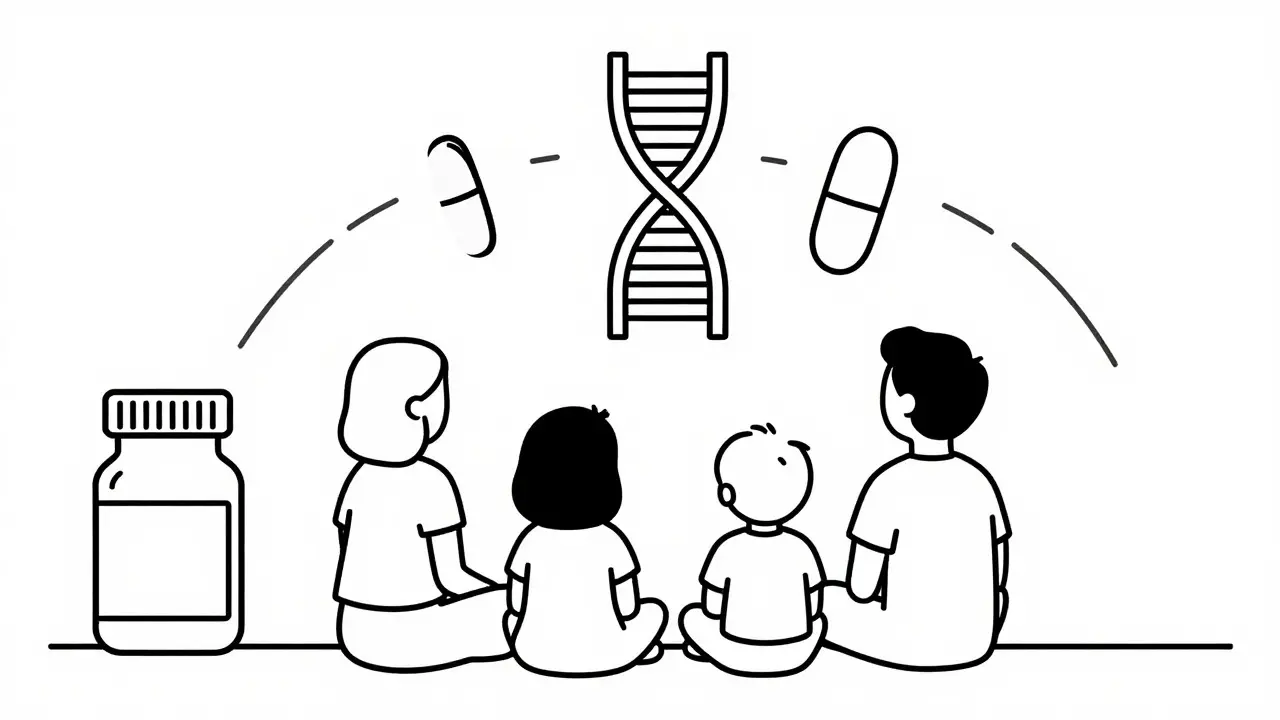
Switching from a brand-name medication to its generic counterpart is supposed to be seamless. The active ingredient is the same, the dosage is identical, and the price tag is significantly lower. So why do some people feel like their blood pressure spikes or their anxiety returns after making the switch? For many, the answer isn't in the manufacturing plant; it’s in their DNA.
Your body doesn’t just process pills; it chemically transforms them using enzymes encoded by your genes. If you have a family history of reacting poorly to certain medications, that reaction might not be an allergy-it could be a genetic trait. Understanding pharmacogenetics, the study of how your genes affect your response to drugs, can explain why a generic version of a familiar drug feels different than the original brand.
The Hidden Role of Enzymes in Drug Metabolism
To understand why generics sometimes fail us, we first need to look at how our bodies handle medication. Most drugs are metabolized (broken down) by a family of liver enzymes called cytochrome P450, or CYP450. These enzymes act as the gatekeepers of drug concentration in your bloodstream.
Genetic variations determine how fast or slow these enzymes work. This creates four distinct metabolic phenotypes:
- Ultra-rapid metabolizers: Their bodies break down the drug so quickly that therapeutic levels never build up, rendering the medication ineffective.
- Extensive (normal) metabolizers: They process drugs at the expected rate, which is what standard dosing guidelines assume.
- Poor metabolizers: Their enzymes work slowly, causing the drug to accumulate in the body, leading to toxicity or severe side effects.
- Intermediate metabolizers: They fall somewhere between normal and poor, often requiring dose adjustments.
When you switch from a brand-name drug to a generic, the active pharmaceutical ingredient (API) remains the same. However, the inactive ingredients-fillers, binders, and dyes-change. For most people, this makes no difference. But if you are a sensitive metabolizer due to your genetic makeup, even minor differences in absorption rates caused by these fillers can push your blood levels out of the narrow "therapeutic window" where the drug works safely.
Family History as a Genetic Roadmap
You don’t need a $300 genetic test to start understanding your risks. Your family medical history is a low-cost proxy for your genetic profile. If multiple relatives on one side of your family report similar issues with specific drug classes, you likely share the underlying genetic variant.
Consider the CYP2D6 gene. Variations in this gene affect how roughly 25% of all drugs are processed, including common antidepressants like paroxetine and painkillers like codeine. If your mother had severe nausea when taking a standard dose of an SSRI, or your father found that codeine provided zero pain relief, you may carry the same variant.
Another critical example involves the TPMT enzyme (thiopurine S-methyltransferase). Patients with low TPMT activity face a high risk of life-threatening bone marrow suppression when taking thiopurines, drugs used for leukemia and autoimmune diseases. This trait is inherited recessively. If both parents carry the variant, there is a 25% chance their child will have the condition. Knowing this family history allows doctors to adjust doses before starting treatment, preventing catastrophic reactions.
Generic vs. Brand: The Bioequivalence Gap
The U.S. Food and Drug Administration (FDA) requires generic drugs to be "bioequivalent" to brand-name drugs. This means they must deliver the same amount of active ingredient into the bloodstream within a similar time frame. However, bioequivalence allows for a variance range-typically 80% to 125% of the brand-name drug’s exposure.
| Feature | Brand-Name Drug | Generic Drug |
|---|---|---|
| Active Ingredient | Identical chemical structure | Identical chemical structure |
| Inactive Ingredients | Proprietary formula | May differ (binders, fillers) |
| Bioavailability Range | Baseline reference | 80-125% of brand baseline |
| Cost | High (patent protected) | Low (market competition) |
| Impact on Poor Metabolizers | Predictable response | Higher risk of variability due to formulation changes |
For a normal metabolizer, a 20% fluctuation in drug levels is negligible. But for a poor metabolizer already sitting near the toxic threshold, a generic formulation that absorbs slightly faster can trigger adverse events. Conversely, an ultra-rapid metabolizer might find that a generic with slower absorption finally provides enough drug in the system to be effective. This explains why switching manufacturers-even between two generic brands-can sometimes cause noticeable shifts in efficacy or side effects.
Key Gene-Drug Interactions to Watch
Not all drugs are equally affected by genetics. Some have a wide therapeutic index, meaning large changes in blood levels don’t cause harm. Others, known as narrow-therapeutic-index (NTI) drugs, require precise dosing. If you have a family history of complications with these specific medications, pay close attention when switching to generics.
- Warfarin (Blood Thinner): Metabolism is heavily influenced by CYP2C9 and VKORC1 genes. African Americans often require higher doses than Europeans due to different variant frequencies. Switching formulations can destabilize INR levels in genetically sensitive patients.
- Clopidogrel (Plavix): A prodrug that requires activation by CYP2C19. Approximately 15-20% of Asians are poor metabolizers, meaning the drug doesn’t activate properly, leaving them unprotected against heart attacks. Generics vary in excipients that might further hinder activation in these individuals.
- Statins (Cholesterol): The SLCO1B1 gene affects how statins enter liver cells. Variants here increase the risk of muscle pain (myopathy). If your family has a history of statin intolerance, generic substitutions might exacerbate muscle symptoms due to slight differences in release kinetics.
- Proton Pump Inhibitors (Acid Reflux): Omeprazole and others are metabolized by CYP2C19. Ultra-rapid metabolizers may get no relief from acid reflux unless the dose is doubled. Generic switches can alter the peak concentration, potentially breaking symptom control.
Navigating the Switch: Practical Steps
If you suspect your genetic background is affecting your response to generic medications, you don’t have to accept suboptimal health outcomes. Here is how to take control of the situation.
1. Document the Pattern. Keep a log of any symptoms that appear after switching from brand to generic. Note the date, the specific manufacturer (often printed on the bottle), and the nature of the side effect. Is it increased bleeding? Return of depression? Muscle cramps?
2. Ask About Therapeutic Interchange Policies. Pharmacists have discretion in substituting generics, but many states allow for "dispensing as written" if medically necessary. If a specific generic brand works for you, ask your doctor to write "Dispense As Written" (DAW) on the prescription to prevent future switches.
3. Consider Preemptive Testing. Services like Color Health or OneOme offer pharmacogenomic panels that test for dozens of gene-drug interactions. While not covered by all insurance plans, the upfront cost can save thousands in trial-and-error prescribing later. Look for tests that include CPIC (Clinical Pharmacogenetics Implementation Consortium) guideline-recommended genes.
4. Monitor Narrow-Therapeutic-Index Drugs Closely. If you take warfarin, lithium, or levothyroxine, request more frequent blood tests immediately after switching to a generic. Early detection of level fluctuations prevents serious complications.
The Future of Personalized Generic Prescribing
We are moving toward an era where your electronic health record includes your pharmacogenomic profile. Major health systems like Mayo Clinic and Vanderbilt University have implemented preemptive testing programs, embedding genetic alerts directly into their prescribing software. When a doctor prescribes a generic clopidogrel for a patient identified as a CYP2C19 poor metabolizer, the system automatically suggests an alternative like ticagrelor.
Until this becomes universal, family history remains your most accessible diagnostic tool. By recognizing that your body’s chemistry is unique-and inherited-you can advocate for safer, more effective medication management. Don’t dismiss side effects as mere coincidence; they might be your genes speaking up.
Do generic drugs contain the same active ingredients as brand-name drugs?
Yes, generic drugs must contain the exact same active pharmaceutical ingredient (API) in the same strength and dosage form as the brand-name drug. However, they may use different inactive ingredients such as fillers, binders, and colors, which can occasionally affect absorption rates in genetically sensitive individuals.
What is a "poor metabolizer" and why does it matter for generics?
A poor metabolizer is someone whose genetic variants cause liver enzymes (like CYP450) to break down drugs very slowly. This leads to drug accumulation in the body. When switching to a generic, even small differences in how the pill dissolves can push drug levels into the toxic range, causing severe side effects that wouldn't occur with the brand name or in normal metabolizers.
Can I ask my pharmacist to keep me on the same generic manufacturer?
In many cases, yes. While pharmacists typically substitute the cheapest available generic, you can request a specific manufacturer if you have experienced issues with others. Your doctor can also mark the prescription as "Dispense As Written" or "Brand Medically Necessary" to lock in a specific formulation, though insurance approval may be required.
Which drugs are most likely to cause issues when switching to generics?
Narrow-therapeutic-index (NTI) drugs are the highest risk. These include warfarin (blood thinner), levothyroxine (thyroid), lithium (mood stabilizer), phenytoin (seizure), and cyclosporine (immunosuppressant). Because the margin between effective and toxic doses is tiny, any variation in generic formulation can lead to clinical instability.
Is pharmacogenetic testing worth the cost?
For patients who frequently experience side effects or have tried multiple medications without success, yes. Tests costing between $200-$500 can identify lifelong genetic traits affecting drug response. This avoids costly trial-and-error prescribing and reduces the risk of hospitalization from adverse drug reactions, particularly for high-risk drugs like antidepressants, painkillers, and chemotherapy agents.
How does family history help predict drug reactions?
Since pharmacogenetic traits are inherited, a pattern of similar drug reactions among close relatives suggests a shared genetic variant. If your parents or siblings had severe side effects from specific drug classes (e.g., statins causing muscle pain or SSRIs causing agitation), you are statistically more likely to have the same genetic predisposition and should be monitored closely when starting or switching those medications.


12 Comments
Wow, this is such a huge relief to read because my mom always swore that the generic blood pressure meds made her dizzy but nobody would listen! It’s crazy how we just assume all pills are created equal when our bodies are literally wired differently. I remember watching her struggle for months before she finally went back to the brand name and felt like herself again. This article totally validates that experience instead of making it seem like she was just being difficult or imagining things.
It’s wild to think about those enzymes acting as gatekeepers in our livers. I never really understood why switching manufacturers could cause such a drastic change in how I feel physically. Knowing that there’s actual science behind the fillers and binders affecting absorption rates makes so much sense now. We really need more doctors to take family history seriously instead of just pushing the cheapest option available at the pharmacy counter.
thats so true i had similar issues with antidepressants and my doctor just kept changing the dosage without looking at my genetics. it took forever to find something that worked right. i wish more people knew about pharmacogenetics because it could save so much trial and error pain. also the part about inactive ingredients changing absorption is super interesting i never thought about that before thanks for sharing this info!
Lol please tell me you guys actually believe this pseudo-science nonsense. The FDA has rigorous standards for bioequivalence and if generics were truly failing that many people the entire healthcare system would have collapsed decades ago. It’s classic confirmation bias where people blame the pill for their own lifestyle failures or placebo effect withdrawal. Most of these 'side effects' are psychosomatic reactions from patients who think they are getting inferior medicine because it costs less. Stop letting big pharma fear-mongering dictate your medical choices and trust the data that shows generics are safe and effective for the vast majority of the population.
Absolutely ridiculous how everyone jumps on this bandwagon without understanding basic statistics! You are ignoring the massive survivorship bias here. For every one person who complains about a generic, there are thousands who take them daily with zero issues and never post online. The variance allowed by the FDA is statistically insignificant for clinical outcomes in broad populations. If you are sensitive enough to notice a 20% fluctuation in drug levels you probably have other underlying health issues that aren't related to the pill itself. This is just another way to justify expensive brand names for profit while scaring poor people away from affordable care options. Wake up and look at the real data instead of anecdotal horror stories!
While the statistical argument holds water for the masses, the nuance lies in the outliers which often suffer the most when systems are designed for averages rather than individuals. Consider the philosophical implication of treating human biology as a uniform machine when it is clearly a complex, inherited tapestry of variations. The 'bioequivalence gap' mentioned in the post isn't necessarily a failure of regulation but a limitation of current technological precision in manufacturing versus biological diversity. Perhaps the solution isn't to demonize generics but to demand better personalized medicine protocols that account for these metabolic phenotypes before prescribing. We stand at a crossroads between cost-effective mass production and tailored therapeutic interventions, and choosing one over the other ignores the full spectrum of human experience.
This is exactly what happens when you let globalist pharmaceutical agendas push their narrative! Our domestic drug manufacturers are top-tier and produce some of the best generics in the world, yet people complain because they want the imported fancy stuff. It’s about supporting local industry and trusting our own regulatory bodies which are far superior to those overseas. If you can’t afford the brand name maybe you should work harder or stop buying unnecessary luxuries. Generics are an American success story and anyone saying otherwise is just spreading fear to keep prices high for the elites. Stand up for our domestic producers and stop whining about minor differences that don’t matter!
Listen here. If the drug works fine do not switch. If it causes problems go back to the old one. Simple logic. Doctors should listen to patients not just follow insurance rules. Many times insurance forces the cheap pill even if it hurts the patient. This is bad practice. Patients know their body best. Do not ignore symptoms. Talk to your doctor firmly. Demand the right medication for your health. Health is wealth. Do not compromise on safety for small savings.
I completely agree with the sentiment that patient advocacy is crucial in these situations. It is empowering to know that we have the right to request specific formulations if we are experiencing adverse effects. The point about documenting patterns is particularly insightful because it provides concrete evidence for healthcare providers rather than vague complaints.
Furthermore, the discussion around narrow-therapeutic-index drugs highlights a critical area where precision matters immensely. It is encouraging to see major health systems beginning to integrate pharmacogenomic profiles into electronic records. This proactive approach could prevent numerous hospitalizations and improve quality of life for countless individuals. Collaboration between patients and providers will undoubtedly lead to better outcomes.
Oh please, spare us the emotional anecdotes. Real intelligence involves understanding that individual variability is accounted for in standard deviation margins that are clinically irrelevant for 99% of the population. Only the intellectually lazy or medically illiterate fall for this 'genetic destiny' trap. Your family history is a fun party trick, not a diagnostic tool. If you are a 'poor metabolizer' you likely have liver disease or are taking conflicting substances, not some magical genetic curse. Stop seeking validation for your inability to tolerate standard treatments and start taking responsibility for your own health management. The elite understand that consistency and discipline outweigh genetic excuses.
The nature of reality is often obscured by the labels we attach to it. When we speak of 'generic' versus 'brand', we are engaging in a dualistic framework that may not reflect the holistic truth of biochemical interaction. The mind influences the body profoundly, and perhaps the expectation of inferiority plays a role in perceived side effects. Yet, the material world also imposes its laws through enzymatic processes that are indifferent to our beliefs. To navigate this tension, one must observe both the internal state and the external chemical environment with equanimity. The answer may lie not in choosing one path over the other, but in understanding the deeper connection between consciousness and cellular function.
In our cultural context, family health history is often passed down orally through generations with great reverence. The concept of inheriting traits extends beyond physical appearance to include susceptibility to ailments and responses to remedies. This article beautifully bridges modern pharmacogenetics with traditional wisdom regarding familial patterns. It reminds us that we are not isolated entities but part of a larger biological continuum. Embracing this interconnectedness allows for more compassionate and informed healthcare decisions. Let us honor our ancestors' experiences by utilizing them as guides in our contemporary medical journeys :)
You gotta take charge of your own health journey folks! Don't let the system dictate what goes into your body without asking questions. If you feel off after switching meds, speak up loud and clear! Your energy and well-being are too important to gamble on assumptions. Reach out to your doctor, get that genetic testing if you can, and find what works for YOU. Stay positive, stay proactive, and never settle for subpar results. You got this!