
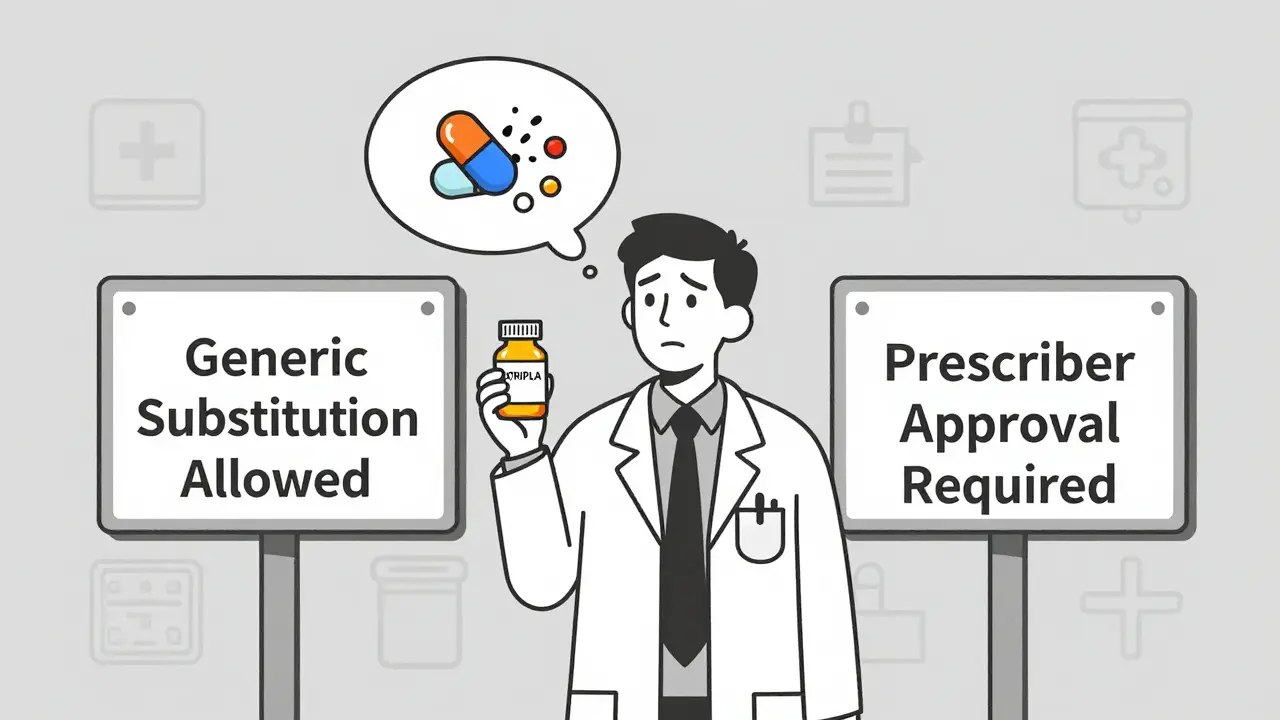
When a pharmacist hands you a pill bottle labeled with your name and a prescription for combination drug substitution, you might assume it’s just a cheaper version of what your doctor ordered. But in reality, swapping one combination drug for another isn’t as simple as switching brands of aspirin. These products-like ATRIPLA, which combines three antiretroviral drugs into one pill-are designed to treat complex conditions with precision. And when you start mixing and matching them under generic substitution rules meant for single drugs, things get messy-fast.
What Exactly Is a Combination Drug?
A combination drug isn’t just two pills in one bottle. It’s a single dosage form-tablet, capsule, injection-that contains two or more active ingredients working together. Think of it like a recipe: one pill might contain a blood pressure medicine and a diuretic, or an antiviral and an immune booster. The goal? To simplify treatment, reduce pill burden, and improve adherence. For someone managing HIV, heart disease, or type 2 diabetes, taking one pill instead of four can make all the difference in sticking to their regimen. But here’s the catch: these aren’t just blends of old drugs. Many modern combinations include novel compounds with unique release profiles, interaction risks, or narrow therapeutic windows. That means even small changes in dosage or timing can lead to side effects-or worse, treatment failure. The FDA defines these as “combination products,” meaning they’re regulated not just as drugs, but often as hybrids involving devices or biologics too. That complexity doesn’t fit neatly into the old rules.Why Generic Substitution Laws Don’t Work for Combination Products
Most U.S. states have laws allowing pharmacists to substitute generic versions of brand-name drugs if they’re deemed “therapeutically equivalent.” That works fine for a single active ingredient like atorvastatin. But when you’ve got a pill with three different drugs-say, efavirenz, emtricitabine, and tenofovir-how do you define equivalence? The technical definition requires identical amounts of the same active ingredients in the same dosage form. But what if the generic version has a different release mechanism? Or includes an extra ingredient that wasn’t prescribed? Or replaces one component with a similar but not identical drug? That’s where state laws break down. Many still treat combination products as if they were just a bundle of single-entity drugs. That’s dangerous. Take the case of Smith v. CVS Caremark in 2022. A pharmacist substituted a combination HIV drug with one that included an additional active ingredient not on the original prescription. The patient developed unexpected side effects. The court ruled: no substitution allowed without explicit prescriber approval. That decision exposed a huge gap in pharmacy practice. Pharmacists were following state substitution laws-but those laws never anticipated this kind of complexity.The Difference Between Generic and Therapeutic Substitution
Not all substitutions are the same. There’s a critical distinction:- Generic substitution: swapping a brand-name drug for a generic version of the exact same drug. Same active ingredient, same dose, same form.
- Therapeutic substitution: replacing one drug with a different one that treats the same condition-like switching from lisinopril to losartan for high blood pressure.
Legal Gray Areas Across States
There’s no national standard. Every state has its own rules-and most haven’t updated them since the 2000s. In Texas, pharmacists must follow strict documentation protocols when substituting. In California, they can substitute certain combinations if the prescriber hasn’t written “do not substitute.” But in New York, even generic versions of combination products require explicit approval. This patchwork creates real problems. A patient moves from Florida to Washington. Their pharmacy can’t refill their pill because the substitute they’ve been using isn’t approved in the new state. Or worse-they get a different combination than they’re used to, and their blood pressure spikes. A 2022 survey by the National Community Pharmacists Association found that 68% of independent pharmacists faced a combination substitution dilemma at least once a month. Nearly half refused to substitute because they weren’t sure if it was legal. And it’s not just about legality. It’s about liability. If a patient has an adverse reaction after a substitution, who’s responsible? The pharmacist? The prescriber? The manufacturer? The answer depends on the state-and often, nobody knows until it’s too late.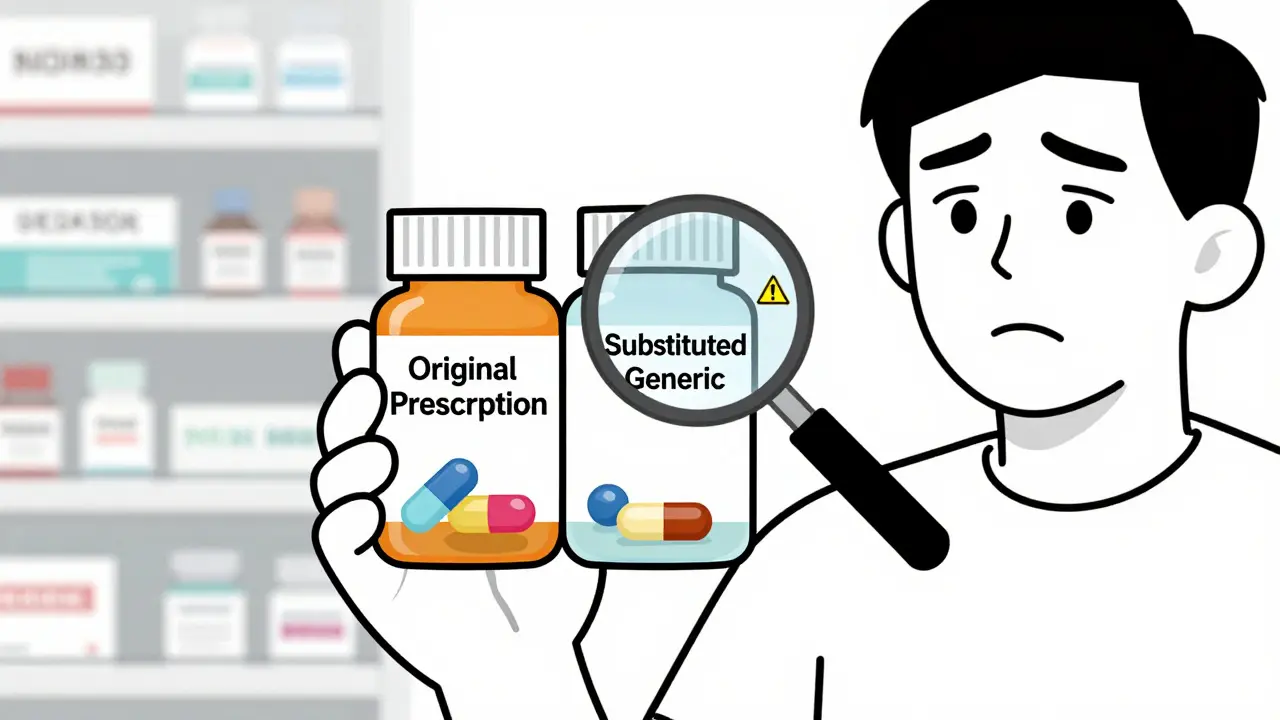
Why Pharmacists Are Caught in the Middle
Pharmacists are trained to be medication experts. But they’re not trained to be doctors. They’re expected to save money, reduce waste, and improve access. Yet when it comes to combination drugs, they’re being asked to make clinical decisions without the authority to do so. The American Pharmacists Association says prescribing by adaptation (changing a prescription) is only allowed for new prescriptions-not refills. That means if a patient comes in for a refill and the pharmacy is out of their combination drug, the pharmacist can’t swap it for another combination, even if it’s clinically better. They have to send the patient back to their doctor. That delays care. It frustrates patients. And it increases costs. Worse, some pharmacists are overstepping. The Alberta College of Pharmacy reported that some are applying therapeutic substitution “very liberally” to combination products-sometimes replacing one drug in a combo with another, or even adding an extra ingredient to “improve efficacy.” That’s not substitution. That’s prescribing.The Economic Pressure Is Real
Let’s be honest: combination drugs are expensive. ATRIPLA costs over $2,000 a month without insurance. Generic versions? Sometimes under $50. That’s why payers-Medicare, Medicaid, private insurers-are pushing hard for substitution. The Inflation Reduction Act of 2022 included new provisions encouraging therapeutic substitution in Medicare Part D. IQVIA reports the global combination drug market hit $184.3 billion in 2022, growing at 12.7% annually. Cost savings are huge. The NHS in England saved £280 million a year by standardizing cardiovascular combination substitutions. But here’s the trade-off: 8% of patients on cardiovascular combination therapies could suffer adverse events if substituted improperly, according to the American Heart Association. That’s not a small number. Especially among elderly patients with multiple conditions. One wrong swap can mean a hospital visit-or worse.What’s Changing? New Rules on the Horizon
The FDA is trying to catch up. In 2022, they released draft guidance on how to prove therapeutic equivalence for fixed-dose combinations. That’s a start. In 2023, the National Association of Boards of Pharmacy proposed a tiered system: simple combinations (two well-known drugs) could be substituted under certain conditions; complex ones (with novel mechanisms or narrow therapeutic windows) require physician approval. The European Commission is pushing for harmonized rules across member states. Denmark already defines substitution as replacing a product with another containing the same combination of active substances-no matter how many ingredients. That’s more practical than the U.S. approach. But change moves slowly. And until there’s a clear, federal-level framework, pharmacists will keep guessing. Patients will keep getting the wrong pills. And the system will keep failing those who need it most.
What Patients Should Know
If you’re on a combination drug:- Ask your pharmacist: “Is this the exact same combination as my original prescription?”
- Check the active ingredients on the label. Don’t assume “generic” means the same mix.
- If you notice new side effects after a refill, contact your doctor immediately.
- Ask your prescriber to write “Dispense as Written” or “Do Not Substitute” on your prescription if you’re concerned.
What Pharmacists and Providers Need to Do
Pharmacists need updated training. State boards need to revise their laws. Prescribers need to be more specific on prescriptions. And everyone needs to stop treating combination products like they’re just two pills in one. The future of medicine isn’t single drugs. It’s combinations. More than 35% of new drug approvals by 2025 will be combination products, according to expert forecasts. If we don’t fix the substitution system now, we’ll be scrambling for years.Can a pharmacist substitute a combination drug without the doctor’s permission?
In most U.S. states, a pharmacist cannot legally substitute a combination drug with another combination product unless the original prescription allows it or the state has specific laws permitting it. Substituting a combination product-even with a similar one-is considered initiating new therapy, which requires prescriber authorization. Some states allow substitution only if the combination contains the exact same active ingredients and dosage as the prescribed product. Always check your state’s pharmacy board rules.
What’s the difference between a generic substitution and a therapeutic substitution for combination drugs?
Generic substitution means replacing a brand-name combination drug with a generic version that has the exact same active ingredients, strength, and dosage form. Therapeutic substitution means swapping the entire combination for a different one-like replacing a pill with two drugs with a different pill that has one overlapping drug and a new one. Therapeutic substitution is riskier and often not permitted without a new prescription, because it changes the treatment plan.
Why are combination drugs harder to substitute than single-drug products?
Combination drugs contain multiple active ingredients, often with complex release profiles or interactions. Two products may have one matching ingredient, but differ in the second or third-changing how the drug works. Traditional equivalence rules, designed for single drugs, don’t account for these interactions. A product might be “pharmaceutically equivalent” but not “therapeutically equivalent,” especially with narrow therapeutic index drugs like those used for epilepsy or heart failure.
Are there any combination drugs that are easier to substitute safely?
Yes-simple combinations with two well-established drugs, like amoxicillin/clavulanate or hydrochlorothiazide/losartan, are more likely to have interchangeable generics. These are often called “simple” combinations by regulators. Complex combinations, especially those with novel mechanisms, extended-release components, or drugs with narrow therapeutic windows (like antiretrovirals or anticoagulants), are much riskier to substitute without clinical oversight.
What should I do if my pharmacist gives me a different combination drug without asking?
Stop taking it. Contact your prescriber immediately and ask if the substitution was intentional. Check the active ingredients on the new bottle against your original prescription. If they don’t match exactly, report the incident to your state’s board of pharmacy. You have the right to receive exactly what your doctor prescribed unless you’ve given written consent for substitution.



12 Comments
Let me just say this - Canada’s been doing this right for years. We don’t let pharmacists play doctor with combination drugs. If your script says ATRIPLA, you get ATRIPLA. No ‘oh but this generic has the same ingredients’ nonsense. The FDA’s playing catch-up like it’s 2005. Meanwhile, we’ve got actual regulations. Stop acting like this is some new problem - it’s been obvious since 2010.
Thank you for writing this. 🙏 I’m a nurse in Toronto and I’ve seen patients end up in ERs because of these swaps. One lady thought she was getting her HIV meds, but the generic swapped out tenofovir for something else. She had a seizure. No one told her. No one asked. Please, if you’re on combo meds - ALWAYS check the label. Don’t trust the bottle. I love my pharmacists, but they’re not trained for this mess. 💔
Look, I get the cost-saving angle. But this isn’t about savings - it’s about laziness. Insurance companies don’t care if you live or die, they just want to cut a few bucks. And pharmacists? They’re stuck between a rock and a hard place. But here’s the truth: if you’re on a combo drug, you’re not a number. You’re a person with a complex medical history. Stop treating your meds like a grocery store coupon.
Really appreciate this breakdown. I work in clinical pharmacy and we’ve had to push back on 3 substitutions this month alone. The biggest issue? Pharmacists think ‘therapeutic equivalence’ means ‘close enough.’ It doesn’t. Especially with antivirals or anticoagulants. I’ve started printing out the FDA’s 2022 draft guidance for patients to show their pharmacists. It’s helped. Also - if your script says ‘do not substitute,’ that’s not a suggestion. It’s a legal boundary.
OMG. I just got my combo med swapped and I’m literally shaking. I took it for 2 days and felt like I was being slowly poisoned. My heart was racing, my hands were numb. I called my doctor - turns out they replaced the emtricitabine with something called ‘emtricitabine analog’?? Like, what even IS that?? I’m filing a complaint with the state board. This is a medical horror story. 🤯💉
Big Pharma and the FDA are in cahoots. They want you dependent on their drugs. They make the combo pills expensive so you’ll beg for generics. Then they let pharmacists swap in unsafe versions. You think this is about cost? No. It’s about control. They don’t want you to know what’s really in your pills. Google ‘FDA loophole 2023’ - it’s all there. They’re hiding it. Don’t trust anyone. Check your pills. Every. Single. Time.
Interesting read. In India, we don’t have this problem because generics are the only option. But we also don’t have the same regulatory oversight. Still - I’ve seen patients get confused when their pills look different. Maybe the solution is simpler: better labeling. Clear icons. Color codes. Maybe even QR codes that link to the exact ingredients. No need for complex laws if people can just see what’s inside.
thank you for this!! i’ve been on a combo med for 8 years and my pharmacist always swaps it without asking. i just assumed it was fine… but now i’m checking the label every time. i found out last month they switched the diuretic and i was getting dizzy all day. i told my doctor and now he writes ‘do not substitute’ in red ink. you’re not alone. we got this 💪
Of course this is a mess. Who do you think runs the pharmacy boards? Pharma lobbyists. They wrote the laws. They fund the training. They profit from confusion. And now you’re blaming pharmacists? They’re just the puppets. The real villains are the CEOs who make $50M a year while you’re dying because your pill has the wrong third ingredient. Wake up. This isn’t incompetence. It’s corporate murder.
so like… pharmacists are just supposed to be magic pill wizards now? cool. next they’ll be doing surgeries too. just say no to combo swaps. easy. problem solved. 🤷♂️
wait so if my doctor prescibed a combo pill and i get a generic with the same 3 drugs but diffrent color… is that ok? i think mine changed color last month but i didnt check the names… oops. i’ll look next time. thanks for making me nervous lol
This issue transcends national borders and reflects a broader failure in pharmaceutical governance. The regulatory frameworks in place were designed for monotherapies, not the increasingly complex pharmacological cocktails that define modern chronic disease management. Harmonization of therapeutic equivalence criteria - particularly for fixed-dose combinations - is not merely advisable; it is an ethical imperative. Without standardized testing protocols, we are institutionalizing clinical risk under the guise of cost-efficiency.