
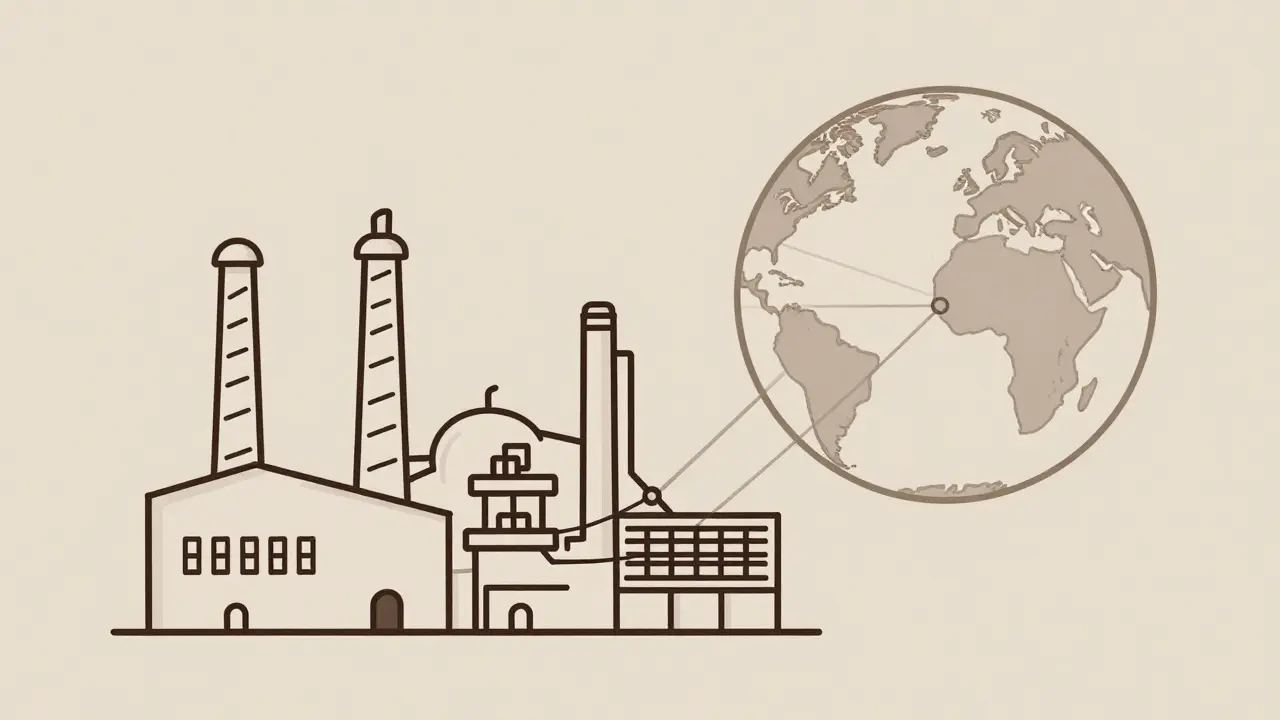
When you pick up a generic prescription, you might assume it’s simple. But behind the scenes, a complex network moves these life-saving medications from labs to pharmacies. This article breaks down each step of the generic drug supply chain-where it starts, who’s involved, and why it matters to you.
The journey starts: raw materials and manufacturing
Generic drugs start with Active Pharmaceutical Ingredients (APIs). These are the core components that make the medicine work. For example, the API for metformin (a common diabetes drug) is often made in India’s Hyderabad region, which accounts for 40% of global metformin production. Similarly, China’s Shandong province supplies 60% of the world’s antibiotics. But here’s the catch: 88% of all APIs come from outside the U.S., mostly China and India. Why does this matter? Because when global events disrupt production-like the pandemic or trade issues-supplies can dry up. In 2020, over 170 generic medications faced drug shortages due to API delays. Manufacturers must follow strict rules for quality. The FDA requires Good Manufacturing Practices (GMP), meaning every batch is tested for purity and potency. Think of it like baking: if the ingredients aren’t right, the final product won’t work.
FDA approval and quality control
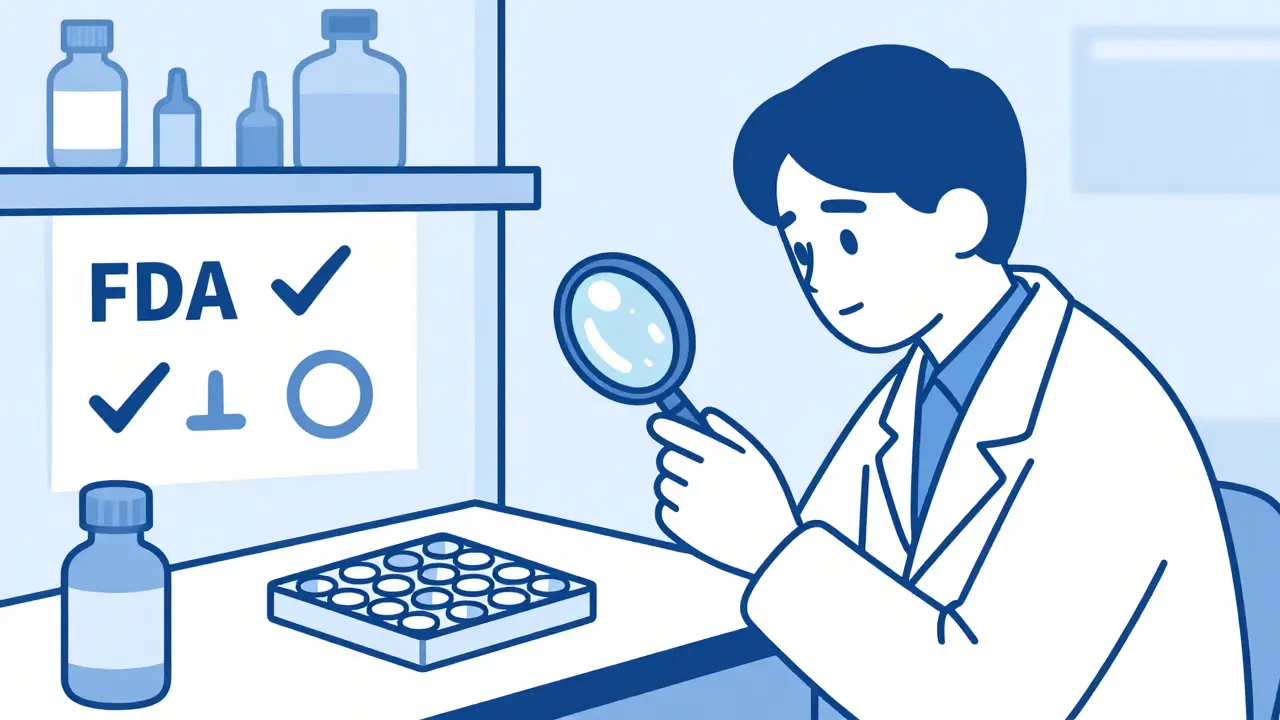
Before a generic drug hits shelves, it must prove it’s just as effective as the brand-name version. This happens through an Abbreviated New Drug Application (ANDA). Unlike brand drugs that need full clinical trials, generics only need to show bioequivalence-meaning your body absorbs the medicine the same way. For instance, a generic version of atorvastatin (a cholesterol drug) must dissolve in your bloodstream exactly like the brand-name Lipitor. The FDA reviews this data and inspects manufacturing facilities. If approved, the drug can be made. But this process isn’t cheap or easy. Manufacturers spend millions on testing and documentation just to get that green light. The ANDA process takes about 18 months on average. For example, a generic sertraline (an antidepressant) must release the same amount of medicine into the bloodstream as Zoloft. The FDA also checks for consistency across batches. If one batch fails, the whole production line gets halted.
Distribution to pharmacies
After manufacturing, drugs move to wholesale distributors. These companies buy in bulk and sell to pharmacies. They often offer discounts for quick payment-called 'prompt payment discounts.' A pharmacy might pay 10% less if they settle their bill within 15 days. In the U.S., three major distributors handle most generics: McKesson, AmerisourceBergen, and Cardinal Health. They ship to over 60,000 pharmacies nationwide. But here’s a twist: the Wholesale Acquisition Cost (WAC) is the price manufacturers charge distributors. Pharmacies then buy from distributors at a discount off WAC. For example, a generic drug with a $100 WAC might sell to pharmacies for $90. This discount varies based on how much the pharmacy buys. Big chains get better rates than small independent shops. Distributors also handle logistics for temperature-sensitive drugs. For example, insulin generics require refrigerated transport. If a shipment is delayed, it can spoil, leading to shortages. This is why distributors use GPS tracking to ensure timely delivery.
| Step | Generic Drug Supply Chain | Brand Drug Supply Chain |
|---|---|---|
| Manufacturing | APIs mostly from China/India (88% overseas) | Same API sourcing, but higher R&D costs |
| Regulatory Approval | Abbreviated New Drug Application (ANDA) | New Drug Application (NDA) with full trials |
| Reimbursement | Maximum Allowable Cost (MAC) | Percentage of list price |
| Rebate Negotiations | Rarely negotiated with PBMs | Common with PBMs |
How pharmacies handle generics
Pharmacies face tight margins when handling generics. Reimbursement is based on Maximum Allowable Cost (MAC), which sets a cap on what insurers will pay. Let’s say the MAC for a 30-day supply of generic lisinopril is $5. If the pharmacy bought it for $6, they lose money on every prescription. This happens often-68% of independent pharmacy owners say MAC prices are below their actual cost. Pharmacies also juggle inventory. If a drug goes into short supply, they scramble to find alternatives. Some use real-time data tools to track stock levels. For example, a community pharmacy might use software that alerts them when a drug is running low, so they can order more before patients are affected. Independent pharmacies often struggle more than big chains. A 2023 survey found that 68% of independent owners report MAC prices below their acquisition cost. This forces some to close or rely on subsidies. Meanwhile, large chains like CVS and Walgreens have more negotiating power, securing better prices from wholesalers.
Challenges and future trends
Supply chain issues are a growing concern. The U.S. saw 170 generic drug shortages in 2023 alone. Why? Over-reliance on overseas manufacturing and sudden demand spikes. To fix this, companies are using Artificial intelligence (AI) to predict shortages. For instance, a major manufacturer now uses AI to monitor factory output in real-time, reducing delays by 30%. Blockchain is also being tested to track shipments from raw materials to pharmacies. This way, if a batch is contaminated, they can quickly recall it. The FDA is speeding up approvals for generics to prevent shortages. Meanwhile, the Inflation Reduction Act of 2022 introduced new pricing rules that could affect how much pharmacies get paid for generics. For example, if a manufacturer pays a larger rebate to Medicare, they might lower the wholesale price for pharmacies. However, this could also squeeze margins for smaller manufacturers. Industry consolidation continues, with companies like Teva and Viatris merging to stay competitive. Experts warn that without policy changes, some manufacturers may stop producing certain generics if profits vanish.
Why are generic drugs cheaper than brand-name drugs?
Generics don’t need to repeat expensive clinical trials. They only prove they work the same as the brand, which saves manufacturers money. This cost difference gets passed to patients. For example, a generic version of a cholesterol drug might cost $10 instead of $300 for the brand name.
How do Pharmacy Benefit Managers (PBMs) affect generic drug pricing?
PBMs negotiate rebates with drug manufacturers but don’t directly set prices for pharmacies. Instead, they influence reimbursement rates through formularies and MAC lists. For example, a PBM might set a MAC for a generic drug at $5, even if pharmacies paid $6 for it. This creates financial pressure on independent pharmacies.
Are generic drugs as safe as brand-name drugs?
Yes. The FDA requires generics to meet the same quality, safety, and effectiveness standards as brand drugs. Every batch is tested for purity and potency. For example, a generic metformin must dissolve in your body exactly like the brand name. If it doesn’t, the FDA blocks it from sale.
Why do drug shortages happen for generics?
Shortages often occur due to manufacturing issues or raw material shortages. For example, if a factory in China that makes APIs for a generic drug shuts down temporarily, supplies can dry up quickly. Over 170 generic medications faced shortages in 2023 because of these disruptions. Globalization makes the supply chain fragile; when one country faces problems, it affects many drugs.
What’s being done to improve the generic drug supply chain?
Companies are using AI to predict demand and blockchain to track shipments. The FDA is also speeding up approvals for generics. For instance, a manufacturer now uses AI to monitor factory output in real-time, reducing delays by 30%. Some are diversifying sourcing-making APIs in multiple countries to avoid single-point failures. These steps help prevent shortages and keep medicines available.
10 Comments
India's role in API production is crucial. Hyderabad produces 40% of global metformin, and China's Shandong supplies 60% of antibiotics. This dependence on foreign sources creates vulnerabilities, especially during global disruptions like the pandemic. We need to diversify our supply chains to prevent shortages. It's a matter of national security for healthcare.
The fact that 88% of APIs come from outside the US is a major vulnerability. Especially with recent pandemic disruptions.
I've been reading about this for a while.
The FDA's ANDA process is crucial, but it's not just about getting approval.
They have to ensure bioequivalence, which means the drug works the same in your body.
Like with atorvastatin, it has to dissolve exactly like Lipitor.
But the problem is that even after approval, manufacturing issues can happen.
For example, if a factory in China has a problem, it can cause shortages of multiple drugs.
And with the current global supply chain issues, it's a real risk.
I think more investment in domestic production would help, but that's not easy.
Also, the MAC pricing for pharmacies is a big issue.
If the reimbursement is lower than what they pay, they lose money.
That's why so many independent pharmacies are struggling.
It's a complex system, but understanding it helps us see why some meds are hard to get.
The part about the 170 shortages in 2023 is scary.
It's not just about one drug; it's a whole chain of dependencies.
If one part breaks, everything else falls apart.
We need better coordination between countries and maybe even more transparency in the supply chain.
Otherwise, people might not get the meds they need when they need them.
APIs from China? That's a problem. We need to make more here in India. It's ridiculous how dependent we are.
People don't realize that the FDA requires the same standards for generics. It's not just about cost. They have to prove bioequivalence. So the generics are just as safe. But yeah, the supply chain issues are real.
AI for shortages is a good step.
India should control all API production. Why rely on China? It's a national security issue. We have the capability. Stop being weak.
Pharmacies are struggling with MAC prices. Many small shops can't afford to sell at that price and are closing.
88% of APIs come from outside the US. The real issue is the lack of innovation in manufacturing. We need to use blockchain and AI properly. 😒
The proposed solutions like AI and blockchain for supply chain issues are missing the point. They don't address the root causes like over-reliance on foreign manufacturing.