
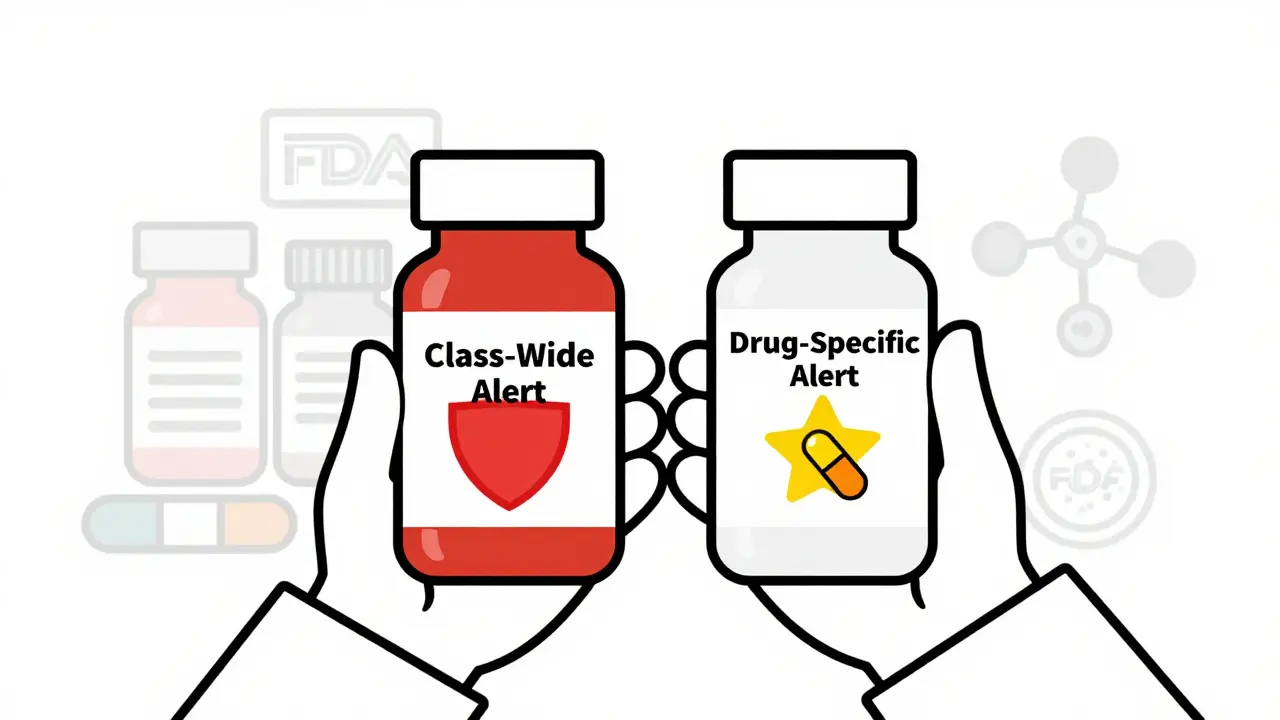
When a drug warning pops up on your screen-whether it’s a black box alert, a safety notice, or a letter from the FDA-it’s easy to assume it applies to everything in that drug family. But that’s not always true. Some warnings hit an entire class of medications. Others target just one. Getting this wrong can lead to unnecessary fear, missed treatments, or even harm. Knowing how to tell the difference between a class-wide safety alert and a drug-specific one isn’t just for pharmacists or regulators. It matters to every prescriber, pharmacist, and patient who wants to make smart, safe choices.
What’s the Difference?
Class-wide safety alerts mean the risk applies to every drug in that group because of how they work. For example, all ACE inhibitors carry a risk of angioedema-a dangerous swelling of the face and throat-because they all block the same enzyme in the body. If one drug in the class causes this, the mechanism is shared, so the warning goes across the board.
Drug-specific alerts, on the other hand, are tied to a single medication’s unique chemistry. Take cerivastatin. It was pulled from the market in 2001 because of severe rhabdomyolysis (muscle breakdown), even though other statins like atorvastatin and simvastatin stayed on the shelves. Cerivastatin had a rare metabolic pathway that made it more toxic when combined with other drugs. The risk wasn’t shared by the whole class.
The FDA uses over 22 million adverse event reports in its FAERS database to spot these patterns. But not every report leads to a class-wide warning. It takes more than one case. It takes consistency.
How the FDA Decides: The Evidence Threshold
The FDA doesn’t rush to warn everyone. It waits for signals that are strong, repeatable, and widespread. Here’s how they do it:
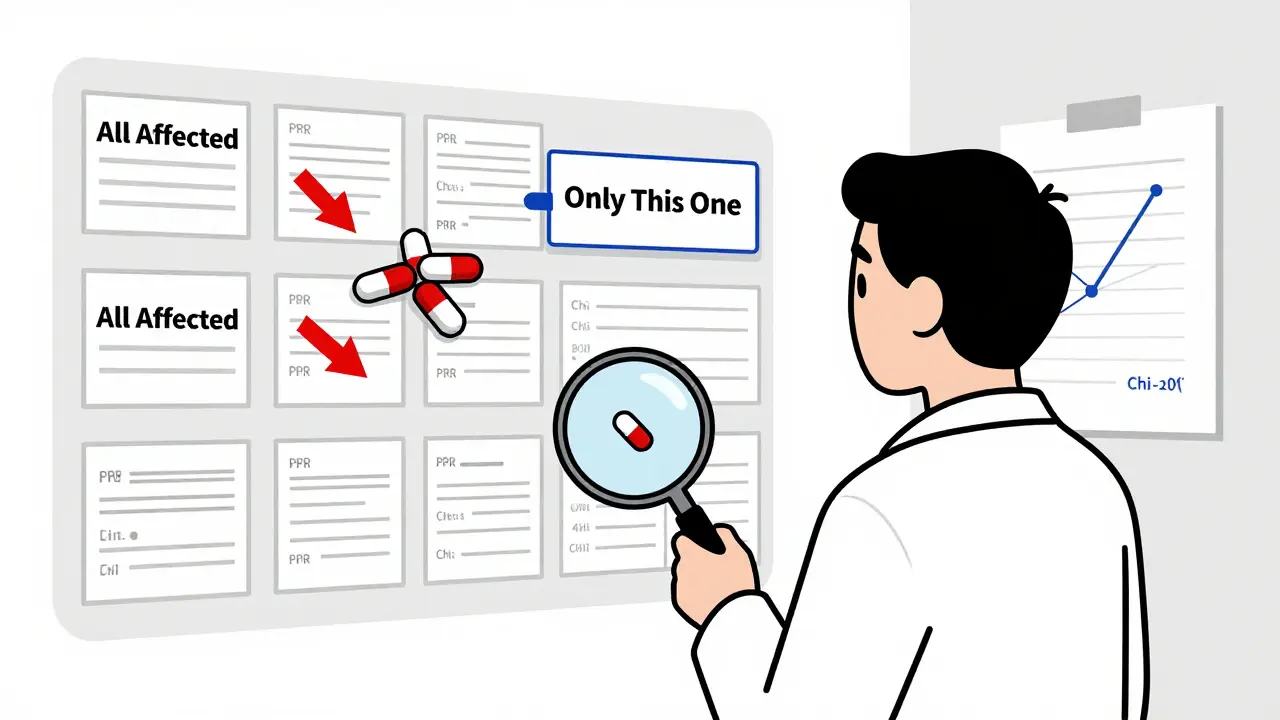
- Proportional Reporting Ratio (PRR): If a drug shows up in adverse event reports way more often than others in its class, the PRR spikes. A PRR above 2.0 is a red flag.
- Chi-squared test: This statistical tool checks if the pattern is real or just random noise. A value over 4.0 means the signal is likely not by chance.
- Multiple databases: The FDA doesn’t rely on just FAERS. It cross-checks with European, Canadian, and Japanese databases. If the same signal shows up in three different systems, the odds of it being class-wide go up.
- Pharmacokinetic data: Do all drugs in the class get metabolized the same way? If one drug is broken down by a different liver enzyme, it might be safer-even if others aren’t.
- Real-world evidence: The FDA now uses data from 100+ healthcare systems covering 100 million patients through the National Evaluation System for health Technology (NEST). If 10,000 patients on different drugs in the same class all show the same side effect, that’s powerful evidence.
For example, in 2023, the FDA updated warnings for all 12 testosterone products after ambulatory blood pressure monitoring (ABPM) studies confirmed increased blood pressure across the entire class. It wasn’t one bad actor-it was all of them.
When Warnings Get Confusing
Here’s where things get messy. The FDA doesn’t always apply warnings evenly.
A 2011 analysis found that 33% of therapeutic classes with black box warnings had them applied to only some drugs in the group. One famous case: citalopram got a QT prolongation warning in 2011 because of heart rhythm risks. But escitalopram-its close cousin, almost identical in structure-didn’t get the same warning. Why? The evidence was stronger for citalopram at the time. Later studies showed escitalopram carried similar risks, but the label never changed. That inconsistency confused doctors.
Same thing happened with the thiazolidinedione class. Rosiglitazone got a boxed warning for heart attack risk in 2007. Pioglitazone didn’t-until years later, when new data showed it carried similar risks. By then, many doctors had stopped prescribing all drugs in the class.
And then there’s the fluoroquinolone antibiotics. In 2018, the FDA issued a class-wide warning about disabling side effects like tendon rupture and nerve damage. Sales dropped 17%. But some doctors later realized: not all fluoroquinolones are equal. Ciprofloxacin, for example, still has a strong role in treating complicated UTIs. The blanket warning made them hesitate even when the benefit outweighed the risk.
What Clinicians See in Practice
A 2022 survey of 1,200 U.S. physicians found 68% were unsure whether a warning applied to the whole class or just one drug. Primary care doctors were worse off-73% were confused. Specialists? Only 58%.
Pharmacists are feeling it too. Walgreens reported a 22% increase in time spent verifying prescriptions after class-wide warnings. Why? Because they can’t just swap one drug for another-they have to evaluate the entire class. With drug-specific warnings, they can suggest a direct replacement. With class-wide, they have to dig deeper.
On Reddit’s r/medicine, a board-certified internist wrote: “I stopped prescribing all quinolones after the 2018 warning. Later, I realized I was denying patients effective treatment for serious infections. I probably hurt more than I helped.”
And it’s not just doctors. Patients hear “all drugs in this class are dangerous” and refuse to take anything-even if their doctor says it’s safe for them.
How to Tell Them Apart
You don’t need to be a regulator to spot the difference. Here’s how to check:
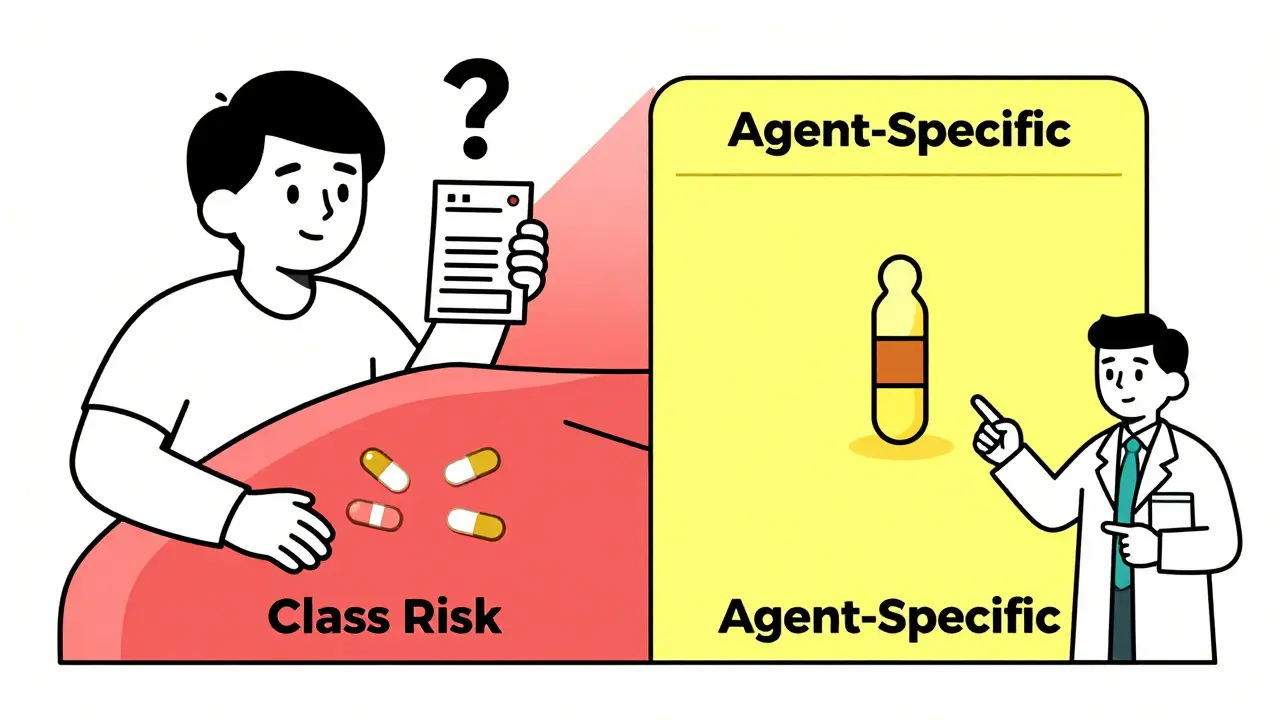
- Look at the label. The FDA now uses clear tags: “Class Risk” or “Agent-Specific Risk.” If it says “all drugs in this class,” it’s class-wide.
- Check DailyMed. The National Library of Medicine’s database color-codes warnings. Red means class-wide. Yellow means drug-specific.
- Read the FDA Drug Safety Communications. They’re public. 18% of them are class-wide. 62% are drug-specific. 20% are unclear. If it says “multiple drugs” or “all agents,” it’s class-wide.
- Ask: Is the mechanism shared? If the drug works the same way-same receptor, same enzyme, same metabolic path-it’s likely a class issue.
- Check the history. Did the warning come after a single case report? Or after 10 studies across 5 different drugs? The latter is class-wide.
Don’t assume based on names. Just because two drugs end in “-sartan” doesn’t mean they share risks. Losartan and valsartan are both ARBs, but only valsartan was recalled in 2018 due to a contaminant in its manufacturing process-not because of its pharmacology.
Why It Matters
Class-wide warnings cut overall market use by 15-25% in two years. Drug-specific ones only hit the one product-often reducing its sales by 40-60%. That’s huge for companies. But for patients? It’s about access.
When the FDA issued a class-wide warning for fluoroquinolones, it didn’t just affect patients with pneumonia. It affected people with complicated UTIs, chronic prostatitis, or even Lyme disease. Many had no alternatives. Doctors had to weigh risk against no treatment.
Meanwhile, drug-specific warnings can be lifesavers. The 2004 withdrawal of valdecoxib (Bextra) kept people safe without touching celecoxib (Celebrex), which still works for arthritis. That precision matters.
But when warnings are inconsistent-like the citalopram/escitalopram split-it breeds distrust. Patients stop believing the system. Doctors start guessing.
What’s Changing Now
The FDA is trying to fix this. In 2024, it launched a standardized warning taxonomy. Every label now must clearly state whether the risk is class-wide or drug-specific. No more ambiguity.
It’s also using AI to predict class risks before they even show up. By analyzing molecular structures and shared metabolic pathways, IBM Watson Health’s tools can now flag potential class-wide issues with 89% accuracy.
And the 21st Century Cures Act now requires manufacturers to evaluate class-wide risks during drug approval-not after.
But challenges remain. The FDA admits 72% of drug classes still lack enough post-market data to make firm calls. That’s why so many warnings are still unclear.
What You Should Do
- Always check the source of the warning-not just the headline.
- Use DailyMed or the FDA’s Drug Safety Communications to confirm scope.
- Don’t assume all drugs with similar names behave the same.
- If you’re unsure, consult a pharmacist. They’re trained to spot these differences.
- For patients: Ask, “Is this warning for all drugs like this one, or just this one?”
Drug safety isn’t about fear. It’s about precision. The right warning, at the right level, saves lives. The wrong one? It just makes people afraid of everything-even when they need it most.
15 Comments
The FDA's current taxonomy is a step forward, but let's be honest-this whole system is still built on reactive data, not predictive science. They're using 20th-century methods to manage 21st-century pharmacology. The fact that we're still relying on PRR and chi-squared tests when we have ML models that can map metabolic pathways in real-time is absurd. And don't get me started on how they ignore structural analogs in favor of clinical case reports. It's like using a slide rule to navigate a supersonic jet.
Also, the term 'class-wide' is dangerously vague. Is it based on pharmacophore? Target receptor? Metabolic enzyme? Route of excretion? The FDA doesn't define it. So every clinician ends up guessing. That's not safety-that's liability roulette.
I appreciate the thorough breakdown, but I must say-I’ve seen too many cases where a single outlier case triggers a class-wide warning, and then we lose access to life-saving drugs for patients who have no alternatives. The system rewards caution over clinical nuance. I had a patient with refractory hypertension who responded beautifully to a specific ARB-only to be denied because of a contamination recall on another drug in the same class. She ended up in the ER. Not because of the drug. Because of the panic.
It’s not about fear. It’s about fear being weaponized by regulatory inertia.
As someone working in global pharmacovigilance, I find the cross-database validation methodology compelling, particularly the use of EudraVigilance and PMDA data. However, the statistical thresholds-PRR > 2.0 and chi-squared > 4.0-are arbitrary and context-dependent. In low-incidence populations, even a PRR of 3.5 may reflect noise rather than signal. The FDA’s reliance on these metrics without adjusting for baseline reporting rates in different jurisdictions creates systemic bias.
Moreover, the NEST data is underutilized. If we integrated real-world EHR patterns with pharmacogenomic profiles, we could move from population-level warnings to precision safety alerts. That’s where the future lies.
This whole thing is a scam. The FDA doesn’t care about patients. They care about lawsuits. They scare everyone into not using drugs so they don’t get sued later. Meanwhile, people die because they’re too scared to take something that could save them. It’s not safety. It’s fearmongering with a government stamp on it.
Wow. Just… wow. So we’ve got a 10,000-word essay on how to read a warning label… and yet, somehow, we still have doctors prescribing fluoroquinolones to 80-year-olds with UTIs… and then acting shocked when they get tendon ruptures? I mean, come on. If the FDA says ‘class-wide’ and you still don’t check the label, you’re not a clinician-you’re a liability waiting to happen.
Also, ‘don’t assume drugs with similar names behave the same’? Really? That’s your takeaway? That’s like saying ‘don’t assume all dogs bark.’ It’s not a revelation. It’s basic hygiene.
Bro, I used to be one of those guys who just clicked ‘approve’ on every script that came through. Then I read that citalopram/escitalopram thing and had a full-on existential crisis. Like… if the FDA can’t tell apart two drugs that are 98% chemically identical, what else are they messing up?
Now I double-check every warning on DailyMed. I’ve got it bookmarked. I even print out the color codes and stick ‘em on my desk. It’s weird. I’m 34. I don’t usually do this. But now? I’m the guy who asks, ‘Is this a red flag or a yellow flag?’
And yeah. I’ve become that guy. No regrets.
This is so important!! 💡 I just had a patient yesterday who refused all SSRIs because she heard ‘they cause suicidal thoughts’-but she didn’t know the warning was only for fluoxetine in teens, not sertraline in adults. We spent 20 minutes going through DailyMed together. She cried. Then she took her prescription. 😭
We need more of this. Not just for docs. For EVERYONE. Patients deserve to know the difference between ‘all of these’ and ‘just this one.’ Let’s make this common knowledge. Like handwashing. 🌟
Let me guess-the FDA is ‘using AI’ now. Of course. Because nothing says ‘scientific rigor’ like IBM Watson running on a server farm in Armonk. They’re not fixing the system. They’re just slapping a tech veneer on top of a crumbling edifice.
And don’t get me started on the 21st Century Cures Act. That was a corporate giveaway disguised as reform. Manufacturers are still gaming the approval process. They submit weak data, get approval, then let the post-market surveillance do the dirty work. The FDA doesn’t protect patients. It protects Big Pharma from liability.
Class-wide warnings? More like class-wide cover-ups.
I read like 3 paragraphs of this and then just gave up. I’m tired. Can’t we just have a website that says ‘safe’ or ‘not safe’? Why does everything have to be a 5,000-word essay? I just want to know if I can give my grandma the pill or not.
At the heart of this issue is a fundamental truth: medicine is not mathematics. We treat humans, not algorithms. A warning label can’t capture the dignity of a patient who needs one drug because all others failed them. The FDA’s taxonomy is well-intentioned, but it risks reducing care to checkboxes.
True safety isn’t about avoiding risk-it’s about managing it with wisdom. We must empower clinicians to think, not just follow color codes. The best medicine is not the safest drug-it’s the right drug, for the right person, at the right time.
So you’re telling me that after 20 years of clinical use, we’re only now realizing that fluoroquinolones can cause disabling side effects? And we’re only now saying ‘oops, maybe warn everyone’?
Here’s the real problem: we treat drug safety like a game of Whack-a-Mole. We hit one mole, then another pops up. We need a system that anticipates-not reacts. We need to screen for off-target effects before Phase I trials. We need to map protein binding profiles in silico before we even give a drug to a single human.
Right now? We’re using a flashlight to navigate a minefield. It’s not enough.
One thing the post didn’t mention: the role of patient advocacy groups. They often push for class-wide warnings because it’s easier to rally around ‘all drugs in this class’ than to fight for a single drug. That’s why the fluoroquinolone warning stuck-even though the data was messy. The community wanted protection. The FDA gave it to them.
So sometimes, the warning isn’t about science. It’s about trust. And trust? It’s not built on PRRs. It’s built on stories.
Thank you for this. As a pharmacist in a rural clinic, I’ve seen the fallout from ambiguous warnings. Last month, a patient on losartan refused to refill because she thought it was ‘the same as valsartan’-even though hers was never recalled. We had to pull up the FDA letter. She cried. I cried.
It’s not just about science. It’s about communication. We need plain-language summaries. Posters in waiting rooms. A simple ‘Class vs. Single’ icon on every script.
Patients aren’t dumb. They’re just overwhelmed.
Interesting. I wonder if the statistical thresholds are too rigid. In the UK, we use Bayesian methods for signal detection-prior probabilities based on pharmacological similarity, not just raw case counts. It reduces false positives. The FDA’s frequentist approach is outdated. It’s like using a hammer to fix a watch.
Also, the 2018 fluoroquinolone warning… I recall a study from Oxford that showed the risk of tendon rupture was higher in patients with renal impairment. But the warning didn’t mention that. So now, we’re denying it to everyone-even those with normal kidney function. That’s not precision. That’s overkill.
Yessss this is so needed!! 🙌 I used to be one of those ‘I’ll just swap it’ pharmacists until I had a patient get hospitalized because I assumed all statins were equal after the cerivastatin thing. Now I check every single one. I even made a cheat sheet for my team. We’ve got a Google Doc called ‘Red Flags vs. Yellow Flags.’
Also-shoutout to DailyMed. It’s like the holy grail. Free. Reliable. No ads. I love it. 🫶
And yeah… patients ask me ALL the time. ‘Is this the bad one?’ I’m happy to help. We’re not just filling scripts. We’re protecting lives.