
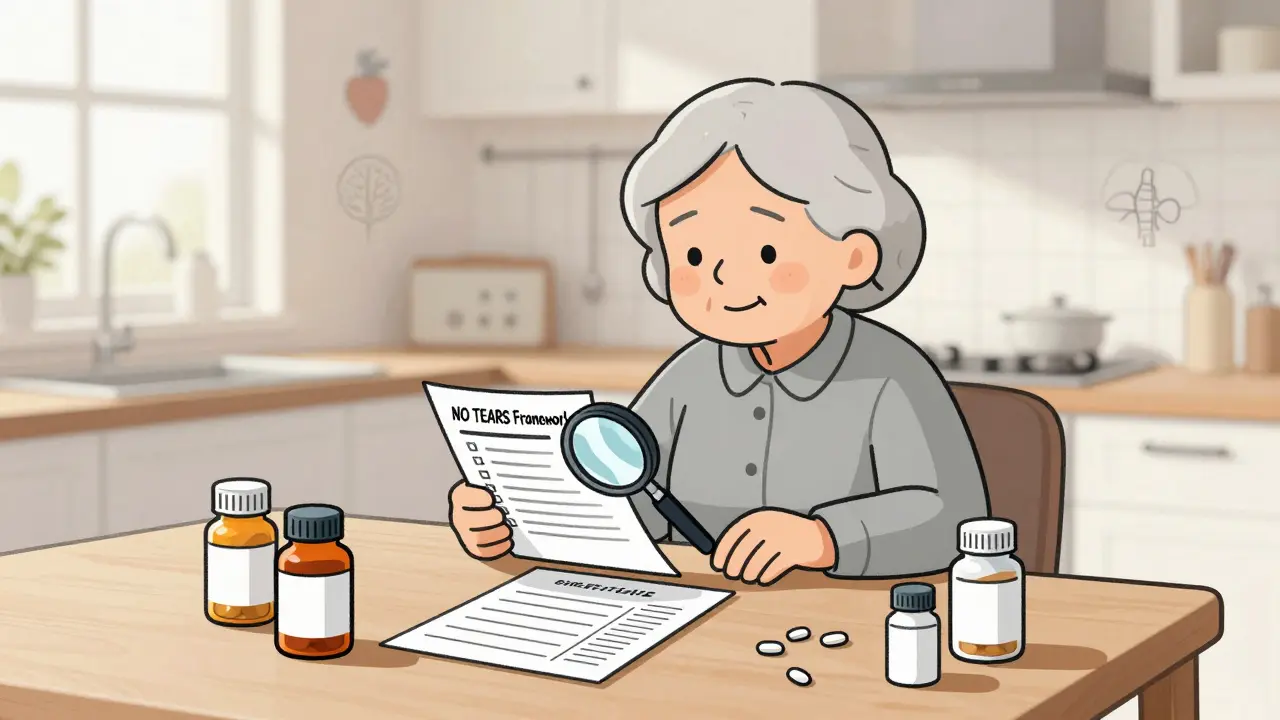
Older adults are at a higher risk of dangerous drug interactions than any other age group. It’s not because they’re taking too many pills by accident - it’s because their bodies change, their care gets fragmented, and the system isn’t built to handle it. By 2030, one in five Americans will be over 65. Right now, 40% of seniors take five or more medications daily. That’s not just common - it’s a ticking time bomb for adverse reactions.
Why Elderly Patients Are at Higher Risk
As we age, our bodies don’t process drugs the same way. The liver slows down. Kidneys filter less efficiently. Fat increases, muscle mass decreases - and that changes how drugs move through the body. One study found older adults are up to 50% more likely to suffer harmful side effects from medications than younger people.Here’s the real problem: most clinical trials for new drugs exclude people over 75. Less than 5% of participants in phase 3 trials are seniors, even though they make up 40% of the patients who actually use those drugs. So we’re prescribing based on data from 30-year-olds - and hoping it works for someone with kidney disease, heart failure, and diabetes.
And then there’s polypharmacy. Taking five or more medications isn’t unusual. It’s the norm. Seniors often see multiple doctors - three or more a year - and fill prescriptions at different pharmacies. No one has the full picture. A cardiologist prescribes a blood thinner. A rheumatologist adds an NSAID. The primary care doctor doesn’t know about either. Result? A dangerous interaction that lands the patient in the hospital.
The Most Dangerous Interactions
Not all drug interactions are created equal. The most serious ones involve two systems: the heart and the brain.Cardiovascular interactions account for nearly 39% of life-threatening drug-drug interactions in seniors. For example, combining warfarin (a blood thinner) with certain antibiotics like clarithromycin can spike bleeding risk. Or taking amiodarone (for irregular heartbeat) with simvastatin (for cholesterol) can cause dangerous muscle damage.
Central nervous system interactions make up almost 30% of serious cases. Think benzodiazepines like diazepam mixed with opioids or sleep aids. Add in an antihistamine like diphenhydramine (common in over-the-counter sleep or allergy meds), and you’ve got confusion, falls, and delirium. One study showed that just one of these combinations increased fall risk by 60% in adults over 70.
Even common OTC drugs are risky. Seniors often take ibuprofen daily for arthritis - but if they’re also on blood pressure meds like lisinopril, the combo can tank kidney function. Or they grab melatonin for sleep, unaware it interacts with blood thinners and diabetes drugs.
Tools That Actually Work
There are two proven screening tools doctors use to catch dangerous prescriptions before they’re written: the Beers Criteria and the STOPP criteria.The American Geriatrics Society’s Beers Criteria (updated in 2023) lists 30 medication classes that should be avoided in seniors - and 40 others that need dose adjustments based on kidney function. Examples? Anticholinergics like oxybutynin (for overactive bladder), which cause confusion and memory loss. Or long-acting benzodiazepines like diazepam - linked to increased fall risk and dementia. When hospitals use Beers Criteria during discharge planning, hospital readmissions drop by 17.3%.
The STOPP criteria (Screening Tool of Older Persons’ Potentially Inappropriate Prescriptions) is even more detailed. It lists 114 specific inappropriate prescriptions across 22 body systems. One example: prescribing a proton pump inhibitor (like omeprazole) for more than 8 weeks without a clear reason - it increases risk of bone fractures and C. diff infections. When STOPP was used in a 2021 study of patients over 75, inappropriate prescribing dropped by 34.7% and hospital readmissions fell by 22.1%.
These aren’t just checklists. They’re life-saving tools. But only if doctors use them.
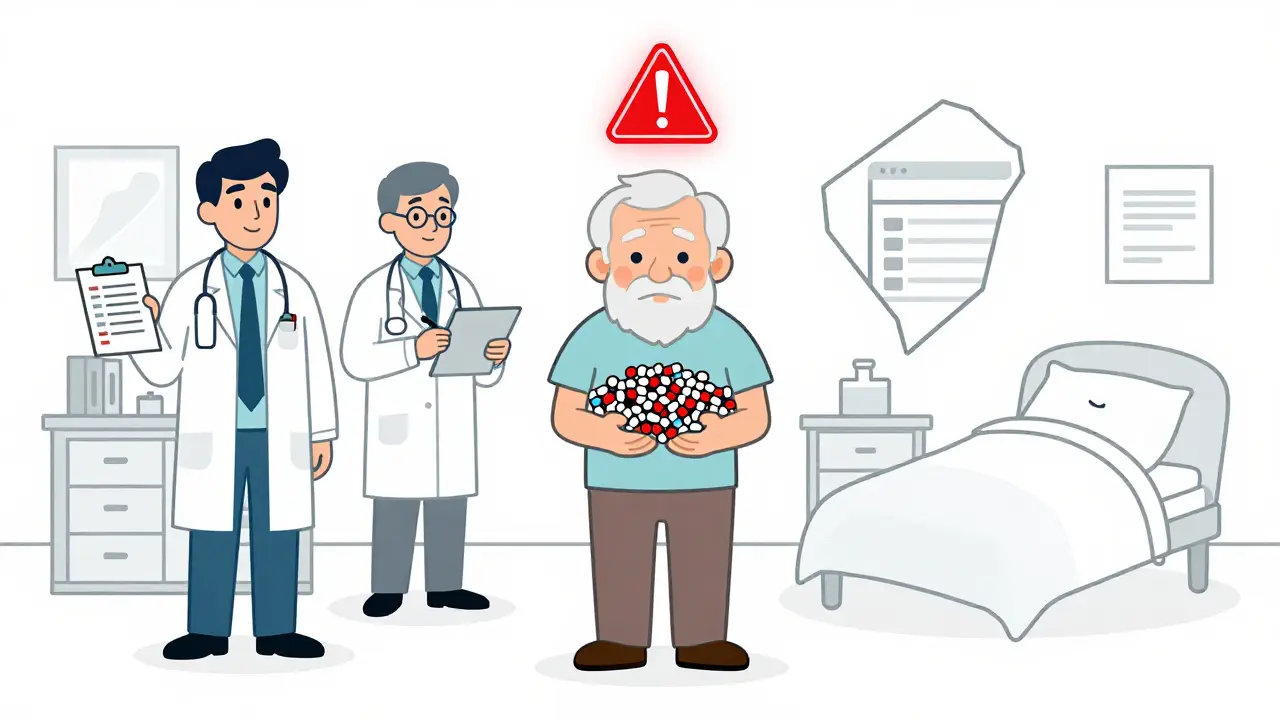
The NO TEARS Framework
Doctors need more than a checklist - they need a process. That’s where NO TEARS comes in. It’s a simple, seven-step framework for reviewing every medication a senior takes:- Need - Is this drug still necessary? Many prescriptions continue long after the original reason is gone.
- Optimization - Is the dose right? Seniors often need lower doses due to reduced kidney or liver function.
- Trade-offs - Do the benefits outweigh the risks? A statin might lower cholesterol, but if it causes muscle pain and limits mobility, is it worth it?
- Economics - Can the patient afford it? One study found 1 in 4 seniors skip doses because of cost.
- Administration - Is the patient taking it correctly? Pill organizers, vision problems, and confusion make this harder than you think.
- Reduction - Can we stop one or more? Every medication removed reduces interaction risk.
- Self-management - Does the patient understand their regimen? If they can’t explain why they take each pill, they’re at risk.
Using NO TEARS doesn’t take extra time - it just changes how you ask questions. Instead of, “Are you taking your meds?” you ask, “Tell me what each pill is for and why you take it.”
What Patients and Families Can Do
Doctors can’t fix this alone. Seniors and their families need to be active partners.First - keep a real-time medication list. Not just prescriptions. Include vitamins, supplements, and OTC drugs. Many seniors don’t mention herbal products like St. John’s wort (which can interfere with antidepressants, blood thinners, and birth control) or ginkgo biloba (which increases bleeding risk). In surveys, 68% of older adults admit they don’t tell their doctor about supplements.
Second - ask for a medication reconciliation at every doctor visit. Say: “Can we go over all my meds together? I’m worried something might be interacting.”
Third - use one pharmacy. If you’re filling prescriptions at CVS, Walgreens, and a local clinic, no one sees the full picture. One pharmacy means one pharmacist can flag interactions before you even leave the counter.
Fourth - if you’re starting a new medication, ask: “Is this safe with what I’m already taking?” Don’t assume it’s fine just because your doctor prescribed it.
The System Is Broken - But Fixable
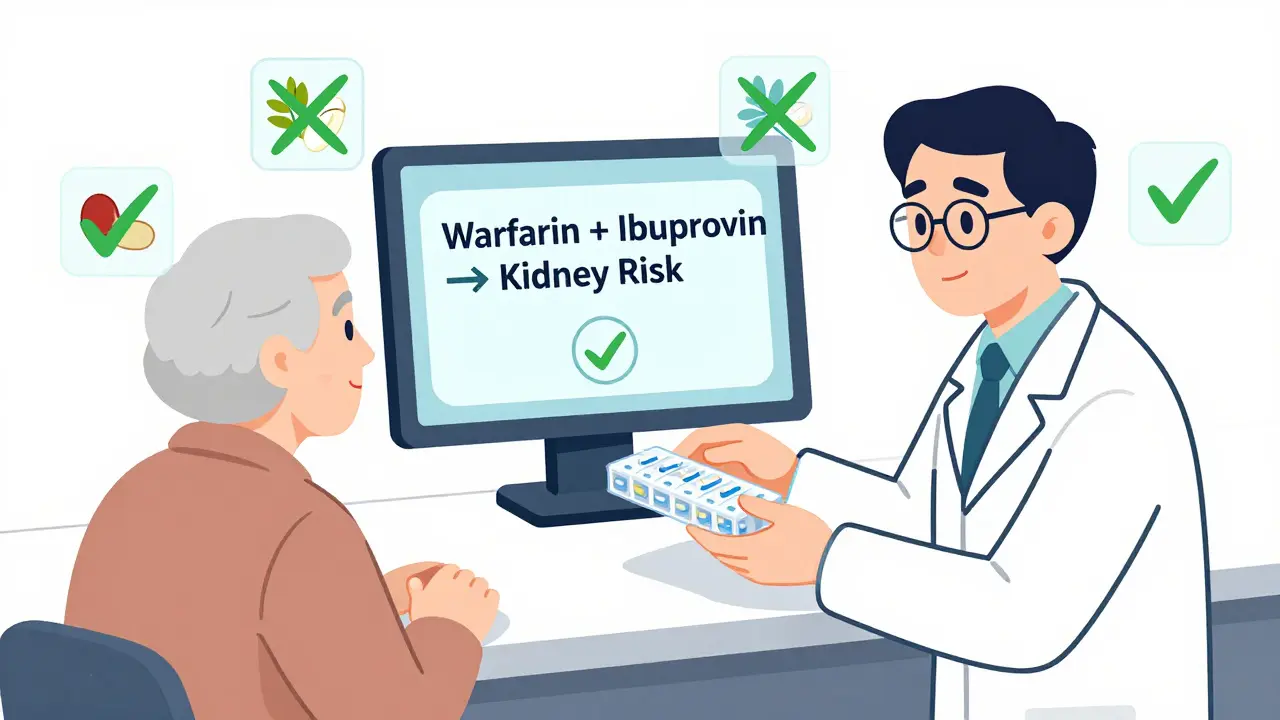
The real failure isn’t the patients. It’s the system. Most doctors have 15 minutes per visit. For someone on seven medications, that’s less than two minutes per pill. The American Academy of Family Physicians recommends at least 15 minutes just for medication review for patients on five or more drugs. And yet, only 38% of U.S. medical schools teach geriatric pharmacology.Technology is helping. AI-powered clinical decision tools are now used in 47% of U.S. hospitals - up from 22% in 2020. These tools scan all prescriptions and flag interactions in real time. But they’re only as good as the data they’re fed. If a patient doesn’t tell their doctor about their fish oil or turmeric supplement, the AI won’t know.
Regulations are catching up. The FDA now recommends collecting pharmacokinetic data from older adults in clinical trials. But only 18% of new drug applications between 2018 and 2022 included that data. The 2025 update to the Beers Criteria will add 15 more medications requiring renal dosing adjustments - a step forward.
Medicare’s Medication Therapy Management program has already helped over 11 million seniors. Participants saw a 15.3% drop in hospitalizations. That’s proof that structured review works.
What Needs to Change
This isn’t about blaming doctors or patients. It’s about fixing a system that treats aging like a disease to be managed with pills - not a stage of life that needs thoughtful care.We need:
- More time in appointments - at least 15 minutes for medication review
- One pharmacist managing all prescriptions
- Doctors trained in geriatric pharmacology - not just general medicine
- Patients empowered to ask: “Is this still needed?”
- Supplements treated like drugs - tracked, reviewed, and questioned
Every time a senior takes a pill they don’t need, or a dangerous combo slips through, it’s not bad luck. It’s a system failure. And it’s fixable.
What are the most common drug interactions in elderly patients?
The most common and dangerous interactions involve blood thinners (like warfarin) combined with NSAIDs or antibiotics, benzodiazepines mixed with opioids or sleep aids, and anticholinergic drugs (like oxybutynin) used for bladder issues. These can cause bleeding, confusion, falls, and kidney damage. Over-the-counter meds like diphenhydramine (Benadryl) and ibuprofen are frequent culprits because they’re often taken without medical oversight.
How many medications are too many for seniors?
Taking five or more medications is defined as polypharmacy and significantly increases interaction risk. Studies show that seniors on five or more drugs are twice as likely to experience an adverse drug event. The goal isn’t just to reduce numbers - it’s to ensure every medication is necessary, effective, and safe with the others. Sometimes, stopping one or two pills can improve health more than adding a new one.
Can herbal supplements cause drug interactions?
Yes - and many seniors don’t realize it. St. John’s wort can reduce the effectiveness of antidepressants, blood thinners, and birth control pills. Ginkgo biloba increases bleeding risk when taken with aspirin or warfarin. Garlic, ginger, and fish oil can also thin the blood. These aren’t harmless - they’re unregulated and rarely documented in medical records. Always tell your doctor about every supplement you take.
How often should seniors have their medications reviewed?
At least once a year - and every time a new medication is added or a doctor changes. If you’re on five or more drugs, aim for a full review every six months. Hospital discharge is a critical time - 35% of hospital admissions in seniors are medication-related, and many happen within 30 days of leaving the hospital. A medication reconciliation at discharge can prevent 20% of these.
What should I bring to a medication review appointment?
Bring a complete list of everything you take: prescription drugs, over-the-counter medicines, vitamins, herbs, and supplements. Include dosages and how often you take them. Also bring the actual pill bottles - packaging has expiration dates and warnings doctors might miss. Don’t rely on memory. Write it down. And if you’re seeing multiple doctors, bring the list to every appointment.
10 Comments
Let’s be real - this isn’t about ‘system failure,’ it’s about lazy doctors and seniors who think ‘natural’ means ‘safe.’ You take ginkgo biloba like it’s cereal? You think your grandma’s fish oil doesn’t interact with warfarin? Wake up. The system isn’t broken - it’s being sabotaged by people who refuse to listen to science because some Instagram guru told them turmeric cures everything. Stop romanticizing ‘holistic’ nonsense and start treating meds like the chemicals they are.
They’re not even trying anymore. We’ve turned healthcare into a conveyor belt of pills. You’re 70? Here’s a statin. You’re tired? Here’s a benzo. You’ve got arthritis? Here’s ibuprofen. And then you wonder why you’re confused, falling, and bleeding internally. This isn’t medicine - it’s industrial-scale chemical dumping. We used to treat people. Now we treat symptoms like inventory. And the FDA? They’re still running trials on 25-year-old college kids. We’re not just failing seniors - we’re erasing them.
YAS QUEEN 💅🏽 this is why I made my mom print out ALL her meds - prescriptions, supplements, that weird ‘energy boost’ powder from the gas station, even the CBD gummies she swears are ‘just for relaxation.’ I made her bring the actual bottles to her doc. He looked at the gummies and said, ‘...I didn’t even know those were a thing.’ 😳 We laughed. Then we cried. Then we deleted three meds. She sleeps better now. And no, she’s not ‘cured’ - but she’s not falling either. 🙌🏽 #MedicationReconciliationIsLove
Just wanted to add something practical - if you’re helping an elderly loved one, use a pill organizer with alarms. Not the fancy ones with Bluetooth - just the basic $10 ones from Walmart. Pair it with a handwritten log: ‘Monday - 10am: Lisinopril, 2pm: Melatonin.’ Simple. No tech needed. And when you go to the pharmacy, ask the pharmacist: ‘Can you check if these interact?’ They’re trained for this. Most of them will do it for free. No one’s coming to save us - but we can save each other, one pill at a time.
You know what’s really happening? Big Pharma’s been pushing these drugs for decades. The FDA’s in their pocket. The clinical trials? Fake. They exclude seniors because they don’t want to admit their drugs don’t work on real people. And now they’ve got AI tools ‘flagging interactions’ - but those are just algorithms trained on biased data. They’re not fixing anything. They’re just making it look like they care. Meanwhile, your grandma’s on 8 meds because the reps gave the doctor free lunches and free samples. It’s all a scam. Don’t trust the system. Trust nothing.
I just want to say… thank you for writing this. I’ve been scared to say anything because everyone just says ‘oh, that’s just aging.’ But it’s not. It’s neglect. I sat with my dad last week while he tried to explain why he takes seven pills - and he couldn’t. He didn’t know what half of them were for. I cried. Then I made a color-coded chart. We’re down to four now. He’s walking better. He’s not confused anymore. It’s not magic. It’s just… listening. Maybe that’s the real medicine.
Oh, so now we’re supposed to be ‘active partners’? Like, what, we’re supposed to be medical detectives on top of being caregivers, accountants, therapists, and emotional support humans? My aunt’s on 11 meds. She has dementia. She doesn’t know her own name half the time. And you want her to ‘tell her doctor about her supplements’? Please. The system doesn’t care. It’s not broken - it’s designed to fail. And the worst part? The people who suffer the most are the ones who can’t scream loud enough.
They don't want you to know this but the pills are poison. The doctors are paid. The pills make you weak. The system is a trap. Your body was meant to heal. Not be filled with chemicals. The truth is hidden. They don't want you to live long. They want you to buy more. You are being used.
Per the 2023 Beers Criteria, the prevalence of potentially inappropriate medication (PIM) use among community-dwelling older adults remains at 32.7%, with anticholinergics and benzodiazepines being the most prevalent classes. When combined with polypharmacy (>5 medications), the odds ratio for adverse drug events increases to 2.91 (95% CI: 2.47–3.42). Furthermore, the STOPP/START criteria demonstrate that 48% of PIMs are preventable with structured review. The NO TEARS framework, while not yet validated in RCTs, shows preliminary feasibility in outpatient geriatric clinics with 78% adherence. However, without standardized EHR integration and pharmacist-led reconciliation protocols, scalability remains a critical bottleneck.
Look, I’m not some bleeding-heart liberal. I’m a veteran. I’ve seen what happens when you don’t take care of your body. But this? This is pathetic. We’re letting old people die because we’re too cheap to give doctors enough time. We’re letting pharmacies compete instead of coordinate. We’re letting supplements fly under the radar like they’re harmless. This isn’t about politics - it’s about basic human decency. We don’t abandon our elders. We fix this. Or we deserve what we get.