
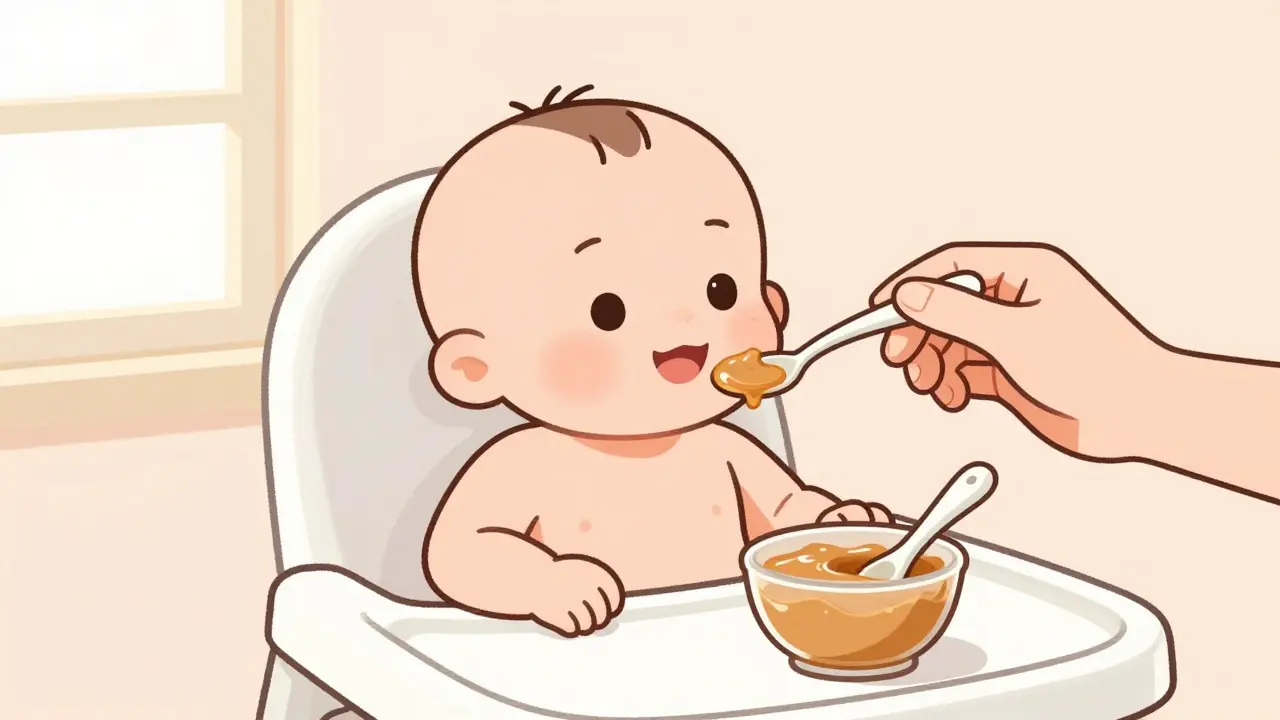
For decades, parents were told to wait until their child was two or three years old before giving them peanut butter. It seemed like a simple way to avoid danger. But the result? More kids than ever developed peanut allergies. By 2010, about 2% of U.S. children had a peanut allergy - up from less than 0.5% in the 1990s. Then came a game-changing study. The LEAP study, published in 2015, showed something shocking: early exposure to peanuts could actually prevent allergies from forming at all. Today, we know the truth: waiting too long increases risk. Introducing peanut early - the right way - can slash the chance of allergy by up to 98%.
Why Early Introduction Works
Peanut allergy isn’t something you’re born with. It develops when the immune system mistakes peanut protein as a threat. The key insight from the LEAP study was that the immune system learns best during infancy. If a baby’s first exposure to peanut happens through the skin - like from eczema flakes or contaminated hands - the body may see it as an invader. But if peanut enters through the gut, early and regularly, the immune system learns to tolerate it.
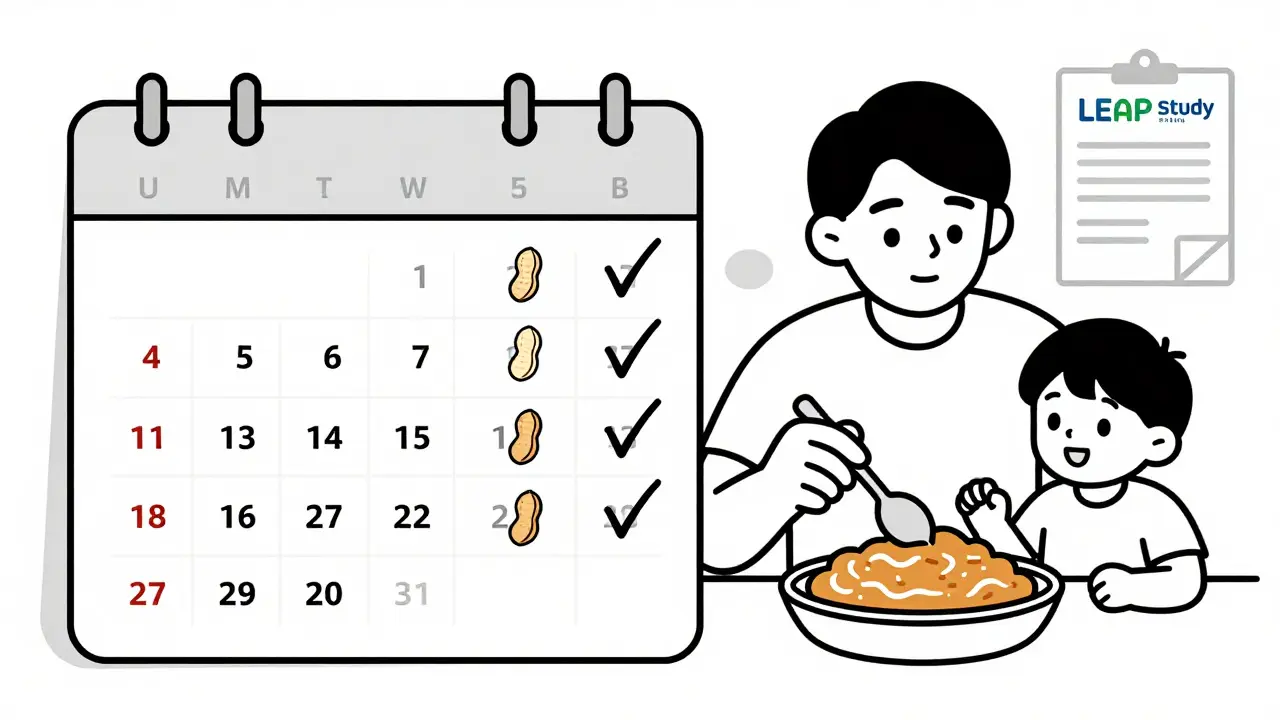
This isn’t just theory. In the LEAP study, high-risk infants (those with severe eczema or egg allergy) who ate peanut protein three times a week from 4 to 11 months old had an 86% lower rate of peanut allergy by age 5 compared to those who avoided it entirely. That’s not a small difference. That’s life-changing. Follow-up data from the same study, published in The Lancet in 2016, showed the protection lasted even after a full year without eating peanut. This wasn’t just temporary desensitization - it was true tolerance.
The NIAID Guidelines: A Three-Tiered Approach
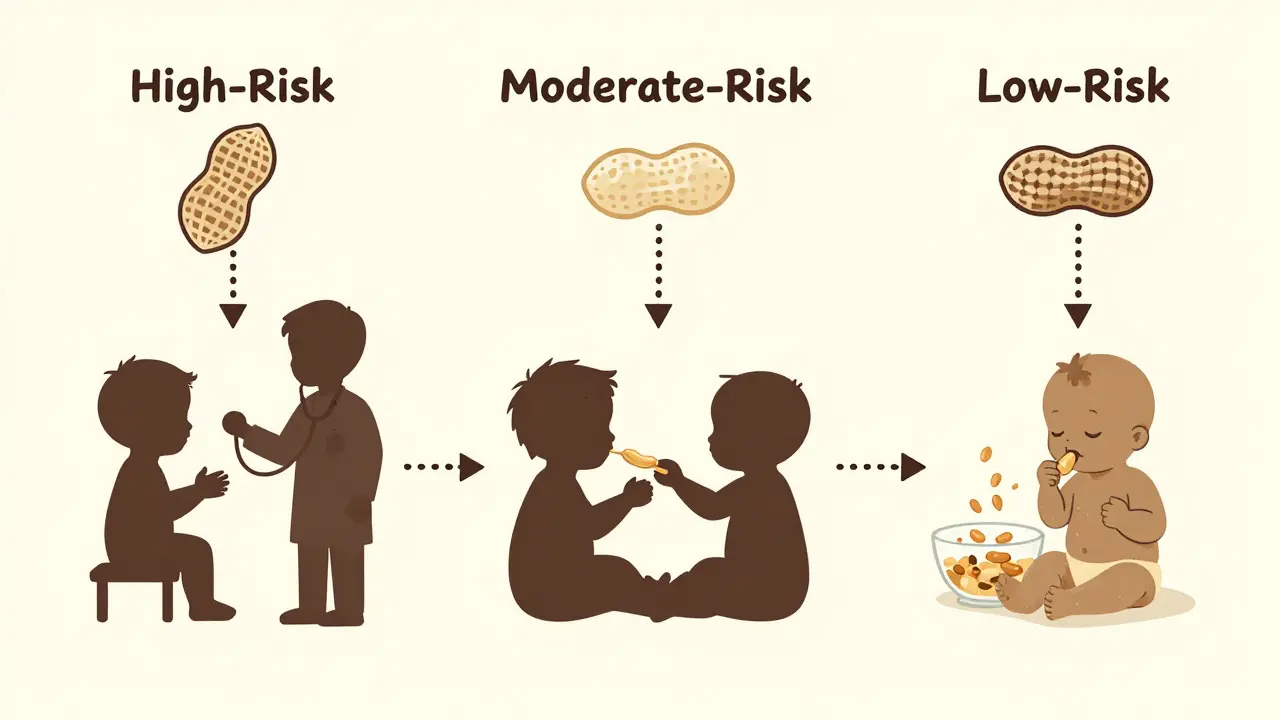
In 2017, the National Institute of Allergy and Infectious Diseases (NIAID) released clear, science-backed guidelines based on the LEAP and EAT studies. They broke infants into three risk groups - and gave specific advice for each.
- High-risk infants (severe eczema and/or egg allergy): Introduce peanut between 4 and 6 months, after evaluation by a doctor. This usually means skin or blood testing first. If the test is negative, start with 2 grams of peanut protein - about 2 teaspoons of smooth peanut butter - three times a week. The first dose is often given in the doctor’s office for safety.
- Moderate-risk infants (mild to moderate eczema): Introduce peanut around 6 months at home, no testing needed. Use the same amount: 2 grams of peanut protein, three times weekly.
- Low-risk infants (no eczema or food allergies): Introduce peanut anytime after starting solids, usually around 6 months. No special steps needed.
These aren’t suggestions. They’re evidence-based standards endorsed by the American Academy of Pediatrics, the American College of Allergy, Asthma, and Immunology, and over two dozen other medical groups. The goal? Stop peanut allergy before it starts.
How to Safely Introduce Peanut
Never give whole peanuts or chunky peanut butter to babies. They’re choking hazards. Instead, use smooth peanut butter mixed with water, breast milk, or formula to make a thin paste. You can also mix it into baby cereal, applesauce, or mashed banana.
One easy method: Mix 2 teaspoons of smooth peanut butter with 2-3 tablespoons of hot water. Stir until it’s runny. Let it cool. Offer a small amount on the tip of a spoon. Wait 10 minutes. Watch for signs of reaction: hives, vomiting, swelling, or trouble breathing. If nothing happens, give the rest. Continue this three times a week - even if your baby doesn’t love the taste. Consistency matters more than quantity.
Some parents use products like Bamba (a puffed maize snack with peanut), which was used in the LEAP study. Others use specially formulated peanut powders or pre-mixed infant foods. The key is getting 2 grams of peanut protein per week, spread across at least three feedings.
What About Oral Immunotherapy (OIT)?
Oral Immunotherapy (OIT) is different from prevention. It’s a treatment for children who already have a peanut allergy. In OIT, a child eats tiny, gradually increasing amounts of peanut protein under medical supervision to build tolerance. It’s not a cure - most kids still need to keep eating peanut regularly to stay protected. And it carries risks: vomiting, itching, and even anaphylaxis can happen during treatment.
OIT is not for prevention. It’s for management. The NIAID guidelines are very clear: early introduction is for babies without peanut allergy. OIT is for those who already have it. Mixing them up can be dangerous. Don’t try to use OIT protocols on a healthy infant. And don’t assume early introduction will fix an existing allergy.
Why So Many Parents Still Don’t Follow the Guidelines
Despite strong evidence, only about 39% of high-risk infants in the U.S. are getting peanut introduced early, according to a 2022 study in Pediatrics. Why?
- Fear: Parents worry about anaphylaxis. But the risk of a reaction during supervised introduction is low - and far lower than the risk of developing a lifelong allergy.
- Confusion: Many pediatricians still give outdated advice. A 2023 survey found only 54% of pediatricians knew the current NIAID guidelines.
- Access: Not every family can easily see an allergist. And not all clinics offer early introduction services.
- Cultural and racial gaps: Black and Hispanic infants are 22% less likely to receive early peanut introduction than white infants, according to a 2023 study. This contributes to ongoing disparities in allergy rates.
Education is the biggest missing piece. Parents need clear, simple instructions. Providers need training. Hospitals need protocols. We know what works. Now we need to make sure everyone gets it.
What’s Changing Now - and What’s Next
The science keeps evolving. A 2023 meta-analysis of LEAP and EAT data showed that introducing peanut before 6 months gave the strongest protection - up to 100% reduction in allergy for babies with mild to moderate eczema. The window is narrow. Waiting until 8 or 10 months cuts the benefit in half.
Researchers are now looking at introducing multiple allergens at once. The EAT study extension found that introducing peanut, egg, milk, and other common allergens early reduced not just peanut allergy, but also egg and milk allergies. This suggests early exposure might be a broader shield against food allergies.
The PRESTO trial, funded by NIAID with $35 million, is currently testing the best timing and dose for high-risk infants. Results are expected in 2026. Meanwhile, companies are responding: peanut pouches and infant-specific peanut products have grown 27% annually since 2018.
The CDC reports that peanut allergy rates in U.S. children have dropped from 2.2% in 2015 to 1.6% in 2023 - roughly 300,000 fewer children affected. If we get early introduction rates up to 65% among high-risk infants, GlobalData predicts peanut allergy could fall to just 1.2% by 2030.
What Parents Should Do Today
Don’t wait. Don’t assume your pediatrician knows the latest. Ask these questions:
- Does my baby have severe eczema or egg allergy? If yes, we need to talk about allergy testing before introducing peanut.
- Does my baby have mild eczema? If yes, we can start peanut at home around 6 months.
- Does my baby have no eczema or allergies? Then just start peanut with solids - no special steps needed.
Use smooth peanut butter. Never whole peanuts. Start with a tiny taste. Watch for reactions. Keep going - three times a week, for months. It’s not a one-time event. It’s a habit.
If you’re scared, talk to your doctor. But don’t let fear stop you. The data is clear: early, safe exposure saves lives. This isn’t a gamble. It’s medicine.
Frequently Asked Questions
Can I give my baby peanut butter straight from the jar?
No. Whole or chunky peanut butter is a choking hazard for babies under age 4. Always thin smooth peanut butter with water, breast milk, or formula to make a runny paste. Mix it into cereal or purees. Never give whole peanuts, peanut pieces, or sticky globs.
What if my baby has eczema? Should I wait to introduce peanut?
No - you should introduce it earlier. Babies with eczema are at higher risk for peanut allergy. For severe eczema, see a doctor before starting. For mild or moderate eczema, start around 6 months at home. The earlier you introduce peanut, the better the protection - especially before 6 months.
Is oral immunotherapy (OIT) the same as early introduction?
No. Early introduction is for babies without peanut allergy - it prevents allergy from forming. OIT is for kids who already have a peanut allergy. It involves slowly increasing peanut doses under medical supervision to reduce reaction severity. OIT is not a prevention strategy and should never be used on a healthy infant.
How much peanut protein should I give my baby?
Aim for 2 grams of peanut protein, three times per week. That’s about 2 teaspoons of smooth peanut butter. You can also use peanut powder, peanut puffs like Bamba, or infant-specific peanut products. Consistency matters more than the exact amount - spread it across at least three feedings each week.
What if my baby has a reaction?
If you see hives, swelling, vomiting, or trouble breathing, stop feeding immediately and call 911 or your emergency number. For mild reactions like a few hives, contact your pediatrician. If you’re introducing peanut for the first time and your baby is high-risk, do it in the doctor’s office. Most reactions during supervised introduction are mild and manageable.
Do I need to keep giving peanut after I start?
Yes. The protection only lasts if your child keeps eating peanut regularly. After the first few months, continue giving peanut protein at least three times a week. Even after age 1, make peanut a regular part of their diet. Skipping weeks can reduce the protective effect.
Are there any foods I should avoid before introducing peanut?
No. There’s no need to delay other solids. Introduce peanut along with other foods. In fact, introducing multiple allergens early (like egg, milk, and tree nuts) may offer broader protection. The only rule: don’t introduce peanut before 4 months, and always wait until your baby shows signs of readiness for solids - good head control, interest in food, and ability to swallow.
Is there a difference between organic and conventional peanut butter?
No. The type of peanut butter doesn’t matter for allergy prevention - only the protein content. Choose smooth, unsweetened, unsalted peanut butter with no added oils or sugars. Organic doesn’t mean safer or more effective. Check the label: the first ingredient should be peanuts.
Can I introduce peanut if my family has a history of allergies?
Yes - and you should. A family history of allergies increases your baby’s risk. That makes early introduction even more important. Follow the NIAID guidelines based on your baby’s eczema status, not just family history. Talk to your pediatrician if you’re unsure.
Will early introduction help my older child who already has a peanut allergy?
No. Early introduction only works to prevent allergy before it develops. Once a child has a diagnosed peanut allergy, early introduction is not safe or effective. For existing allergies, talk to an allergist about oral immunotherapy (OIT) or other management options - but never attempt to introduce peanut at home without medical supervision.

15 Comments
This is just another Western medical scam
My grandma fed peanuts to babies at 3 months and no one died
You people turn everything into a lab experiment
Okay but like... I just gave my 5 month old a spoonful of peanut butter straight from the jar?? 😅 I mean... she didn't choke?? And she loved it?? So like... what's the big deal?? Also I read somewhere that organic is better?? Idk I'm just a mom trying not to panic?? 🤷♀️
The LEAP study is foundational. Early oral exposure induces immune tolerance via regulatory T-cell pathways. Skin exposure, in contrast, promotes Th2 polarization. This isn't opinion-it's immunology. If your pediatrician hasn't updated their protocol since 2015, find a new one.
You're telling parents to feed their babies peanut butter like it's baby food? And then you say 'watch for reactions'? What if they die? What if their face swells up and they can't breathe? You call that medicine? That's reckless. Where's the liability? Where's the warning label? This is how kids die.
The NIAID guidelines represent the gold standard in pediatric allergology. To suggest otherwise is to misunderstand the epistemological basis of evidence-based medicine. The LEAP cohort demonstrated a statistically significant reduction in IgE-mediated sensitization with p < 0.001. This is not anecdotal. This is paradigm-shifting.
So... we're supposed to trust doctors who told us to wait until 3? Funny how that worked out huh? I guess now we're supposed to trust them again? I'll pass. I'll just keep feeding my kid avocado and hope for the best.
If your baby has eczema, don't wait. Start at 4 months. Use smooth peanut butter. 2 tsp three times a week. That's it. No testing needed for mild cases. You don't need permission. You don't need a PhD. Just do it.
We used to think the world was flat. Then we thought germs were evil. Then we thought vaccines caused autism. Now we think feeding babies peanut butter prevents allergies. What's next? Feeding them arsenic to prevent cancer? Maybe the immune system isn't a switch we can flip. Maybe we're just seeing patterns in noise.
I did this with my twins and IT WORKED 🙌🎉 No allergies at all!! I used Bamba and mixed peanut butter into their oatmeal 🥄💛 My pediatrician cried when I told her. We're living proof! If you're scared, just start with 1/4 tsp. Baby steps! You got this! 💪❤️
This is why Western medicine is broken. You make simple things complicated. In India, we give peanuts to babies at 6 months. No testing. No doctors. No fear. And guess what? We don't have peanut allergies. Because we don't overthink everything
Let me tell you what really happened. My neighbor’s kid had a full-blown anaphylactic reaction during their first peanut taste test. The ambulance came. The EpiPen was used. The hospital stay. The PTSD. And guess what? That kid’s still allergic. So don’t come at me with your ‘science’ and your ‘guidelines’-I’ve seen the blood. I’ve smelled the fear. This isn’t prevention. It’s Russian roulette with a spoon.
The EAT study's crossover design introduced confounding variables in the 12-month follow-up. The statistical power for low-risk infants was underpowered (n=187). The NIAID guidelines overextrapolate from high-risk cohorts. We need more RCTs with stratified allergen exposure timelines before implementing population-wide mandates.
I followed the guidelines exactly. My daughter had mild eczema. We introduced peanut at 6 months, 2 tsp three times a week, diluted in applesauce. No reaction. At age 3, she had a skin test: negative. She eats peanut butter sandwiches every day. I'm grateful. This isn't luck. It's science.
I want to say this from the bottom of my heart: if you're reading this and you're scared, you're not alone. I was terrified too. My son had severe eczema, and I spent weeks crying over the thought of giving him peanut butter. But I did it. I went to the allergist. I held his hand. I watched every second. And when he smiled after eating it? That was the most beautiful moment of my life. You are not failing if you're scared. You're failing if you don't try. Please. Just try. One teaspoon. One day. You can do this. I believe in you. And your baby is going to be okay.
I'm a dad. I didn't believe any of this until my cousin's kid had a reaction. Now I'm the guy at the park handing out peanut butter cups to every baby I see. 'Here, try this, kid.' No big deal. You think I'm crazy? Maybe. But I'd rather be the weird dad who gave his kid peanut butter than the one who lost him to a preventable allergy.