
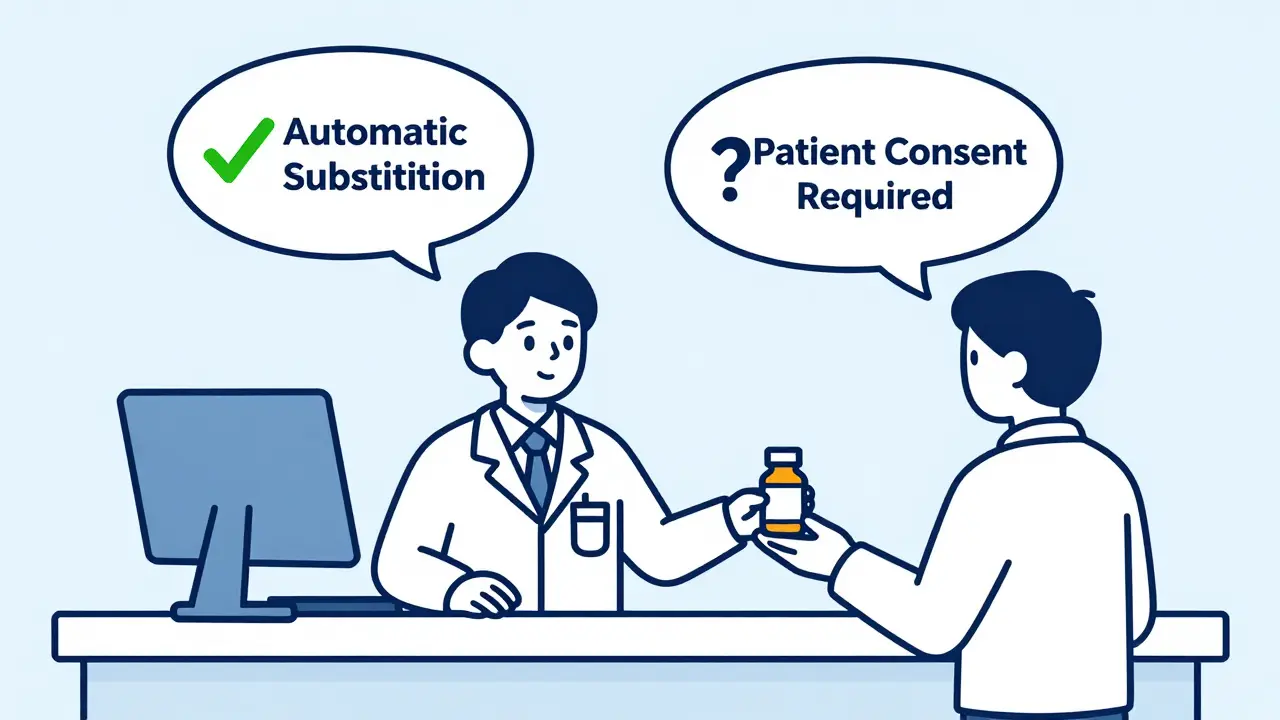
Ever wonder why your pharmacy in one state automatically gives you a generic pill, but in another state, the pharmacist has to ask your permission first? It's not just store policy; it's a complex web of state laws. In the US, while the federal government decides if a drug is "equivalent," individual states decide how that information is used at the pharmacy counter. This patchwork of rules affects about 6 billion prescriptions every year, balancing the need to save money with the need to keep patients safe.
The Quick Rundown on Generic Substitution
- Federal Role: The FDA determines if a generic is therapeutically equivalent via the Orange Book.
- State Role: States decide if pharmacists must, can, or cannot substitute a brand-name drug.
- Cost Impact: Generic drugs saved an estimated $1.7 trillion between 2009 and 2019.
- Key Risk: Narrow Therapeutic Index (NTI) drugs can be dangerous if substituted incorrectly.
How State Substitution Laws Actually Work
To understand the madness, you have to look at the Hatch-Waxman Act, which is a 1984 federal law that created the modern pathway for generic drug approval. This law gave us the FDA Orange Book, which is the official publication listing all approved drug products and their therapeutic equivalence ratings. But the Orange Book doesn't tell a pharmacist in Texas or New York what to do-that's where state laws kick in.
Most states fall into two camps: mandatory or permissive. In mandatory states, the pharmacist is required to switch you to a generic unless the doctor explicitly wrote "dispense as written." In permissive states, the pharmacist can suggest a generic, but they don't have a legal mandate to do so automatically. This difference isn't just a formality; research shows that mandatory states see significantly higher generic fill rates, sometimes over 94%, compared to permissive states.
The Four Pillars of Pharmacy Regulation
When a state writes its substitution laws, it usually focuses on four specific areas. Depending on where you live, your experience at the pharmacy counter will change based on these rules:
- Pharmacist Duty: Is it a requirement (mandatory) or an option (permissive)? About 22 states mandate substitution.
- Patient Consent: Do you have to say "yes" (explicit consent), or is it assumed you want the cheaper version unless you say "no" (presumed consent)? Presumed consent is much more common, used in 32 states.
- Notification: Does the pharmacist have to tell you the switch happened? 41 states require a post-substitution notice.
- Liability: If a pharmacist follows the law but the patient has a bad reaction, are they protected? 37 states provide immunity from civil or criminal liability if the protocol was followed correctly.
| Feature | Mandatory Substitution | Permissive Substitution |
|---|---|---|
| Fill Rate | Higher (approx. 94.1%) | Lower (approx. 88.3%) |
| Patient Interaction | Automatic unless opted out | Pharmacist offers/suggests |
| Medicaid Savings | Higher annual savings | Moderate savings |
| Doctor Control | Must specify "Dispense as Written" | More flexibility in prescribing |

The Danger Zone: Narrow Therapeutic Index (NTI) Drugs
For most meds, like a basic statin for cholesterol, switching to a generic is a no-brainer. But Narrow Therapeutic Index (NTI) drugs are a different story. These are medications where a tiny change in the dose or the way the body absorbs the drug can lead to a major medical failure or toxicity.
Think of drugs like warfarin (a blood thinner) or levothyroxine (for thyroid issues). Because the margin for error is so slim, some states don't trust the standard Orange Book ratings. For instance, Kentucky maintains its own specific list of NTI drugs, including certain antiepileptics, that cannot be substituted without extra caution. In Minnesota, there have been documented cases where substituting warfarin led to adverse events, even though the drugs were technically rated as equivalent. This is why 28% of cancer patients often have "dispense as written" on their scripts-they can't afford a slight variation in how their body processes the drug.
The New Frontier: Biosimilars and Biologics
While small-molecule generics are well-understood, Biosimilars are the new challenge. These are highly complex biological products. Unlike a chemical generic, a biosimilar isn't an exact copy; it's "highly similar." This creates a whole new legal headache for pharmacists.
As of 2023, almost every state has a law for biosimilars, but they are all different. Florida, for example, requires pharmacies to create their own formulary to ensure a substitution doesn't threaten patient safety. Meanwhile, Hawaii is much more restrictive, often requiring both the doctor and the patient to agree before a switch happens. The industry is currently pushing for the Model State Biologics and Biosimilars Act to stop this confusion and create a unified national standard.

The Real-World Headache for Pharmacists
If you've ever seen a pharmacist look stressed while typing into a computer, they might be fighting with state borders. Imagine a patient who lives in New York but fills their prescription in New Jersey. In New York, the pharmacist has to ask for consent; in New Jersey, they just do it. This creates massive confusion for patients and a huge workload for staff.
On average, a pharmacist spends nearly 13 minutes per prescription just verifying if a substitution is legal in that specific jurisdiction. To survive this, 83% of pharmacies now use software that automatically checks state laws. Without these tools, the risk of a legal mistake is high, which is why almost every state board of pharmacy now requires intensive training on these laws for licensing exams.
Does a generic drug work exactly like the brand name?
According to the FDA, generics with an "A" rating in the Orange Book are therapeutically equivalent, meaning they have the same active ingredient, strength, and dosage form. However, for some people-especially those taking NTI drugs-the inactive ingredients or slight differences in absorption can lead to different results.
Can my doctor prevent a pharmacy from substituting a generic?
Yes. Doctors can write "Dispense as Written" (DAW) on the prescription. In mandatory substitution states, this is the primary way doctors ensure a patient stays on a specific brand, particularly for high-risk medications.
Why do state laws vary so much if the FDA handles the drug approval?
The FDA handles the science (is the drug safe and equivalent?), but the states handle the practice of pharmacy (how should the drug be dispensed?). This allows states to tailor rules to their local healthcare needs and liability preferences.
What is a biosimilar and how is it different from a generic?
A generic is a chemical copy of a small-molecule drug. A biosimilar is a version of a large, complex protein drug (biologic). Because biologics are grown in living cells, they can't be copied exactly, which is why the substitution laws for them are generally stricter than for traditional generics.
Will I save money if I live in a mandatory substitution state?
Generally, yes. Mandatory substitution laws tend to result in higher generic fill rates, which reduces out-of-pocket costs for patients and saves millions for state Medicaid programs.
What to Do if You're Concerned About Your Medication
If you're taking a medication for a chronic condition, especially something like an anticonvulsant or a blood thinner, don't just hope for the best. Talk to your doctor about whether your drug is a Narrow Therapeutic Index (NTI) medication. If it is, ask them to specify "dispense as written" if you've had bad reactions to generics in the past.
When you get to the pharmacy, always double-check the label. If you see a different manufacturer than what you used last month, ask the pharmacist if the therapeutic equivalence rating has changed. While the software helps, a quick conversation can prevent a medical mishap.
12 Comments
This is a really helpful breakdown of how the system works. I've always wondered why my prescriptions felt different depending on where I filled them, and the part about NTI drugs is a great reminder to be cautious with specific medications.
Funny how we're told it's all about 'patient safety' and 'saving money' while the pharmaceutical giants just use this legal mess to keep the margins high. It's almost like the lack of a national standard is a feature, not a bug, designed to keep us confused and dependent on a broken system that prioritizes corporate liability over actual health outcomes.
Oh, please. Imagine thinking the 'Orange Book' is some holy grail of science. It's essentially a corporate brochure. The idea that a 'highly similar' biosimilar is acceptable is just a cute way of saying 'we couldn't actually copy the protein but it's close enough to charge you a fortune anyway.' Absolutely precious.
USA laws r just too confusing lol 🇺🇸 pharmacy stuff is such a mess but at least generics save us money $$$ 💊
It is truly an absolute travesty that a patient's health can be subject to the whims of state borders, and I find it utterly heart-wrenching to think about the poor souls who have suffered adverse effects simply because they crossed a state line! We must demand a more unified approach to our healthcare system because the current patchwork is nothing short of a catastrophic failure of governance that leaves the most vulnerable among us trembling in fear of their own medicine cabinets!
big pharma wants us on the switch they control the lists
Stay in your lane with the conspiracy talk. The FDA doesn't just wake up and decide to mess with people's lives for fun 🙄 Just read the guidelines and talk to your doctor like a normal person 👊
The pharmacokinetic variance in NTI drugs is definitely the biggest hurdle here. When the bioavailability differs by even a small percentage, the steady-state concentration in the plasma can fluctuate wildly 💊🤓
That's a great point about bioavailability. For anyone feeling overwhelmed by this, just remember that your pharmacist is there to help you navigate these rules-don't be afraid to ask them for a detailed explanation!
The whole vibe of this system is just... chaotic 🌀 it's like a jigsaw puzzle where the pieces don't actually fit together 😵💫
not sure why we even need a guide for this because common sense says the government can't be trusted to regulate pills without making it a nightmare for the actual workers who have to deal with the software glitches and the angry patients who don't get why their pill is a different color this month and honestly it all just seems like a giant waste of everyone's time
imagine thinking US healthcare is efficient lol 🤡 my country does it better 🇮🇳 no need for a 13 minute verification process when you actually have a system that works 💅