Imagine picking up a bottle of heart medication. The instructions say "take once daily." But the label, translated by a computer, reads "once" as eleven in Spanish. You take the pill eleven times instead of one. This isn't a hypothetical nightmare; it is a documented reality for millions of Americans. A single mistranslated word can turn a therapeutic dose into a toxic overdose.
If you or someone you love speaks a language other than English at home, this issue affects you directly. About 25.5 million Americans have limited English proficiency (LEP), representing roughly 8.3% of the population. For these patients, prescription labels are not just paperwork-they are life-or-death instructions. Yet, the systems designed to help them often fail spectacularly.
The Hidden Dangers of Machine Translation
Most pharmacies rely on automated software to translate prescription labels. These systems use third-party aggregators that pull from generic databases. The result? A patchwork of inconsistent translations that change depending on which pharmacy chain you visit. In a study of 286 pharmacies in the Bronx, New York, researchers found that 86% used computer programs for Spanish translations. Only 3% used professional human interpreters.
The accuracy gap is staggering. Professional human translators achieve 98-99% accuracy for medical content. Machine translation alone yields only 65-75%. When no human reviews the output, error rates can hit 50%. That means half of all Spanish-language labels in some areas contain mistakes. These aren't minor typos. They are critical errors regarding dosage, frequency, and warnings.
Consider the false cognate problem. The English word "once" (meaning one time) translates to "onze" in French but sounds like "once" (the number eleven) in Spanish. If a system blindly swaps words without context, "Take once a day" becomes "Take eleven times a day." Another example: "alcohol" means rubbing alcohol in Latin America but drinking alcohol in Spain. A label warning against "alcohol" might confuse a patient from Madrid into thinking they cannot drink wine, while a patient from Mexico City might misunderstand a warning about ingesting the medication with spirits.
Why Do These Errors Happen?
The root cause lies in how pharmacy management systems handle data. When a doctor prescribes a drug, the instruction goes into a digital queue. The pharmacy software then sends this text to a translation engine. Often, the engine lacks context. It doesn't know if "bid" means "twice a day" or something else. It doesn't understand regional dialects.
Furthermore, there is a lack of standardization. Generic instructions on labels often differ from what the doctor said during the appointment. If the doctor says "take with food" but the label says "take on an empty stomach," the patient is confused. Add poor translation into the mix, and the confusion turns into danger. According to Dr. Glenn Flores, a professor of pediatrics, pharmacy computer systems generate translation errors at rates exceeding 40% for critical dosage instructions.
Regulatory frameworks also vary wildly. California and New York mandate prescription label translation into non-English languages. California's Senate Bill 853, effective since 2016, requires bilingual labels. Other states have no such requirements. This creates a patchwork where your safety depends on your zip code rather than national standards.
Real-World Consequences for Patients
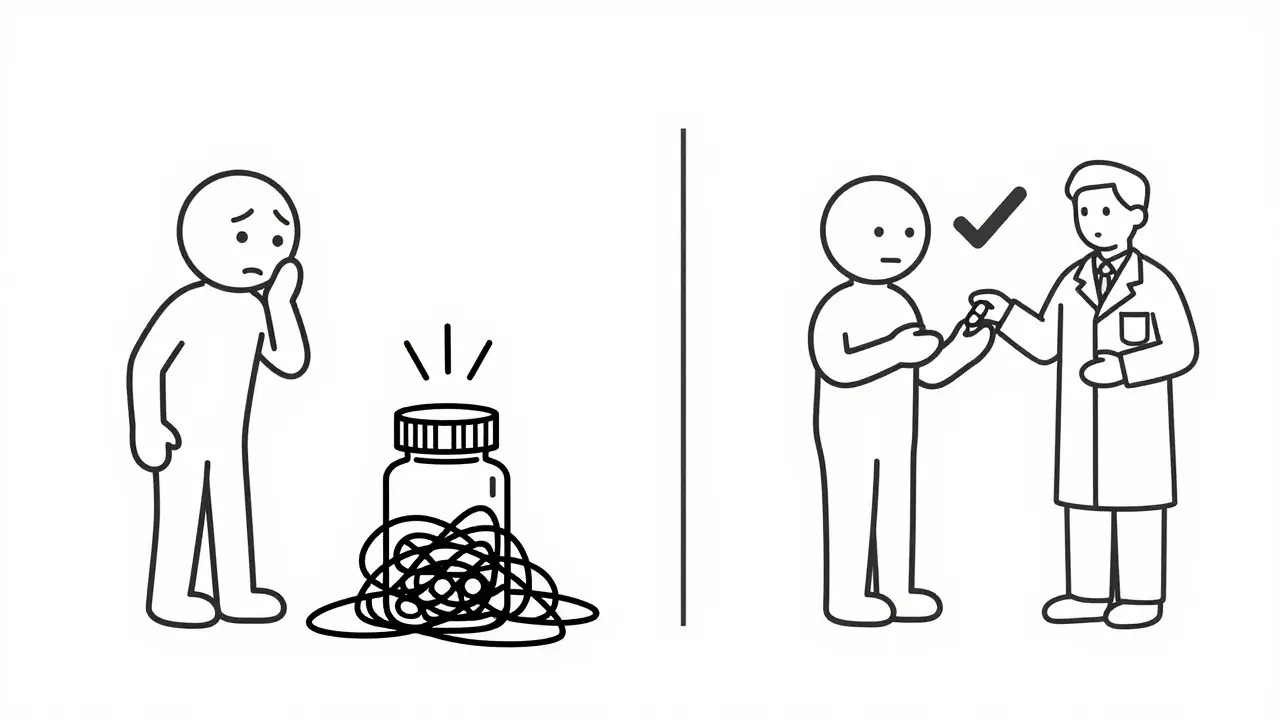
The stakes are high. A survey by the National Health Law Program found that 63% of LEP patients reported confusion about medication instructions. Of those, 28% admitted to taking incorrect doses due to translation problems. On online forums, pharmacists and patients share alarming stories. One user noted that "take two tablets twice daily" was translated correctly at one pharmacy but as "twice weekly" at another chain, leading to treatment failure for a chronic condition.
These errors lead to preventable hospital visits. A UCLA Health Policy Study showed that California's mandatory bilingual labeling program reduced medication errors among Spanish-speaking patients by 32% compared to national averages. Conversely, UCSF Health found that proper translation reduced medication-related ER visits among LEP patients by 27%. Every dollar invested in proper translation yields $3.80 in avoided adverse events, according to McKinsey & Company analysis.
The disparity is stark for less common languages. While Spanish services are available at 87% of major chains like CVS and Walgreens, translation into Chinese, Vietnamese, or Arabic exists at only 23% of locations. If you speak Tagalog or Arabic, your risk of encountering an untranslated or poorly translated label is significantly higher.
How to Spot a Bad Translation
You don't need to be a linguist to spot red flags. Look for these common issues:
- Inconsistent Terminology: Does the word for "tablet" change between bottles? Does "dose" appear as "dosis" in one place and "medicina" in another?
- Literal Translations: Phrases like "take by mouth" translated literally might sound awkward or unclear. Look for natural phrasing.
- Missing Context: Warnings about "avoid grapefruit" might be omitted or mistranslated if the system doesn't recognize the interaction.
- Mixed Languages: "Spanglish" or mixed English-Spanish phrases indicate a failed machine translation attempt.
If the label looks confusing, do not guess. Guessing with medication is dangerous. Always verify.
Steps to Get Accurate Labels and Help
You have power in this process. Here is how to ensure your labels are safe:
- Ask for Human Verification: When you pick up your prescription, ask the pharmacist: "Can you confirm this label is translated by a certified medical translator?" Many pharmacies now offer this service upon request, even if it's not automatic.
- Use Interpreter Services: If you are unsure, ask the pharmacy to connect you with a medical interpreter. Hospitals and large health systems like Kaiser Permanente have dedicated language access programs. Don't rely on family members, especially children, to translate medical instructions.
- Check for Bilingual Options: In states like California and New York, you have a legal right to a bilingual label. Ask specifically for the "bilingual version" or "etiqueta bilingüe."
- Switch Pharmacies if Needed: If your current pharmacy consistently provides confusing labels, consider switching to a chain known for language access, such as those participating in the HHS Language Access Grant Program. CVS and Walgreens have been rolling out AI-assisted verification systems, but human oversight remains key.
- Report Errors: If you find a dangerous error, report it to the pharmacy manager and your state's board of pharmacy. This helps track systemic failures and pushes for better regulations.
The Role of Technology and Future Outlook
Technology is improving, but slowly. Major chains are deploying AI-assisted tools. Walgreens launched its MedTranslate AI system in late 2023, reducing errors by 63% in pilot locations. CVS rolled out its LanguageBridge platform in 2024, using neural machine translation combined with pharmacist checkpoints. These systems are better than old-school machine translation, but they still require human review to catch subtle nuances.
The FDA released draft guidance in January 2024 mandating standardized plain language formats. This simplifies the source text, making translation easier and more accurate. The goal is to reduce complexity so that even machine-assisted tools can perform better. However, full implementation will take years.
For now, the burden falls on patients and providers to bridge the gap. The market for prescription translation services is growing, valued at $187 million in 2022, driven by regulatory pressure and demographic shifts. As the LEP population grows by nearly 19% over the last decade, the demand for accurate communication is undeniable.
Is it illegal for pharmacies to provide bad translations?
Not necessarily in all states. Currently, only California and New York have laws mandating specific translation standards for prescription labels. In other states, pharmacies may rely on automated systems without legal penalty, though they can face liability if an error causes harm. Federal guidelines under Title VI of the Civil Rights Act require healthcare providers receiving federal funds to provide meaningful access to LEP individuals, but enforcement varies.
What should I do if I think my label is wrong?
Do not stop taking your medication abruptly without consulting your doctor. Instead, contact your pharmacist immediately. Ask them to verify the instructions with the prescribing physician. If you are unsure about the translation, request a certified medical interpreter to explain the label. Report the error to the pharmacy manager to prevent future issues.
Are online pharmacies safer for translation?
Online pharmacies often use similar automated translation systems as brick-and-mortar stores. Some specialized international pharmacies may offer better multilingual support, but you must verify their credentials. Look for pharmacies accredited by the National Association of Boards of Pharmacy (NABP). Always double-check labels before relying on them, regardless of the source.
How much does professional translation cost?
Professional medical translation adds approximately $0.15 to $0.30 per prescription, compared to $0.02 to $0.05 for automated systems. While this seems small, it adds up for pharmacies. However, the cost of avoiding a single adverse event far outweighs this expense. Many health systems absorb this cost as part of their quality assurance protocols.
Which languages are most commonly mistranslated?
Spanish is the most common due to its prevalence, but it also suffers from high error rates because many systems use generic translators. Less common languages like Chinese, Vietnamese, Arabic, and Tagalog have fewer resources available, leading to higher risks of complete omission or poor quality. Dialect-specific variations, such as differences between Latin American and European Spanish, also cause frequent errors.