

Drinking kombucha for its probiotics and tangy flavor is common-but what if you’re on medication that can’t handle even a little alcohol? Many people assume kombucha is just tea with bubbles. But it’s not. It’s a fermented drink, and fermentation makes alcohol-naturally, unavoidably, and sometimes more than you think.
How Much Alcohol Is Actually in Kombucha?
The alcohol in kombucha isn’t added. It’s made by yeast during fermentation. Yeast eats sugar and turns it into alcohol and carbon dioxide. That’s how beer, wine, and kombucha get their alcohol. Commercial brands are required to keep alcohol under 0.5% ABV (alcohol by volume) to be sold as a non-alcoholic beverage. That’s less than what you find in a ripe banana or a glass of orange juice left out overnight.
But here’s the catch: that 0.5% limit only applies to store-bought bottles. Homemade kombucha? It can hit 2.5% ABV. That’s more than some light beers. Temperature, how long you ferment, and how much sugar you use all change the final alcohol level. A batch left fermenting for three weeks in a warm kitchen can easily cross 1.5% ABV. And most homebrewers never test it.
Hard kombucha-marketed as a craft alternative to beer-deliberately pushes alcohol to 3-8% ABV. These aren’t health drinks. They’re alcoholic beverages in disguise. If you’re on medication that warns against alcohol, hard kombucha is off-limits.
Which Medications Are at Risk?
It’s not just about getting drunk. Even tiny amounts of alcohol can cause serious reactions when mixed with certain drugs. The American Pharmacists Association lists 17 medication classes that interact dangerously with alcohol-and kombucha can trigger them.
- Metronidazole (Flagyl) and tinidazole: These antibiotics cause violent nausea, vomiting, flushing, and rapid heartbeat when combined with alcohol. A 2023 case report in the Journal of Clinical Pharmacy and Therapeutics described a patient who ended up in the ER after drinking homemade kombucha (1.8% ABV) while on metronidazole.
- SSRIs and other antidepressants: Alcohol can worsen side effects like dizziness, drowsiness, and mood swings. People on sertraline or fluoxetine have reported sudden dizziness and confusion after drinking kombucha.
- Diabetes meds like metformin and chlorpropamide: Alcohol can cause dangerous drops in blood sugar. One user on Diabetes Daily reported a 15-point blood sugar plunge after kombucha with metformin-leading to an ER visit.
- Benzodiazepines (Xanax, Valium): Alcohol boosts the sedative effect. Even 0.5% ABV can make you feel foggy, unsteady, or dangerously sleepy. Dr. Andrew Huberman from Stanford noted this synergy affects GABA receptors in the brain.
- Nitrates (for heart conditions): Alcohol can cause a sudden, dangerous drop in blood pressure. Combining this with kombucha could lead to fainting or falls.
These aren’t rare reactions. ConsumerLab’s 2023 survey found 18% of kombucha drinkers reported medication interactions. Of those, 62% involved antidepressants. Another 29% involved antibiotics.
Commercial vs. Homemade: The Real Danger
Store-bought kombucha is safer-not because it’s harmless, but because it’s regulated. Brands like GT’s and Health-Ade pasteurize their product or use membrane filtration to lock alcohol below 0.5%. They test every batch using HPLC machines. In 2023, 92% of commercial brands did this, according to Kombucha Brewers International.
Homebrewers? Only 15% test their batches. Most rely on guesswork. A 2022 study of 200 home batches showed alcohol levels varied by 300%. One batch might be 0.4% ABV. The next, made the same way, could be 1.9%. That’s the difference between a harmless sip and a medical emergency.
And labeling? Only 63% of commercial bottles say “contains trace alcohol.” You have to read the fine print. In January 2024, the FDA finally mandated that all kombucha sold in the U.S. must clearly state: “Contains Trace Alcohol.” But that rule only applies to new batches after that date. Older stock? Still unlabeled.

What Should You Do If You’re on Medication?
If you take any of the medications listed above, here’s what to do:
- Check your prescription label. Look for warnings like “avoid alcohol” or “may interact with alcohol.” If it’s there, assume kombucha counts.
- Don’t assume store-bought is safe. Even 0.5% ABV adds up. Drinking one bottle a day for a week equals 1.75 standard drinks per week. That’s enough to matter for some drugs.
- Avoid homemade kombucha entirely. Unless you’ve tested it with an alcoholmeter (like the HM Digital HA-520), you don’t know what you’re drinking.
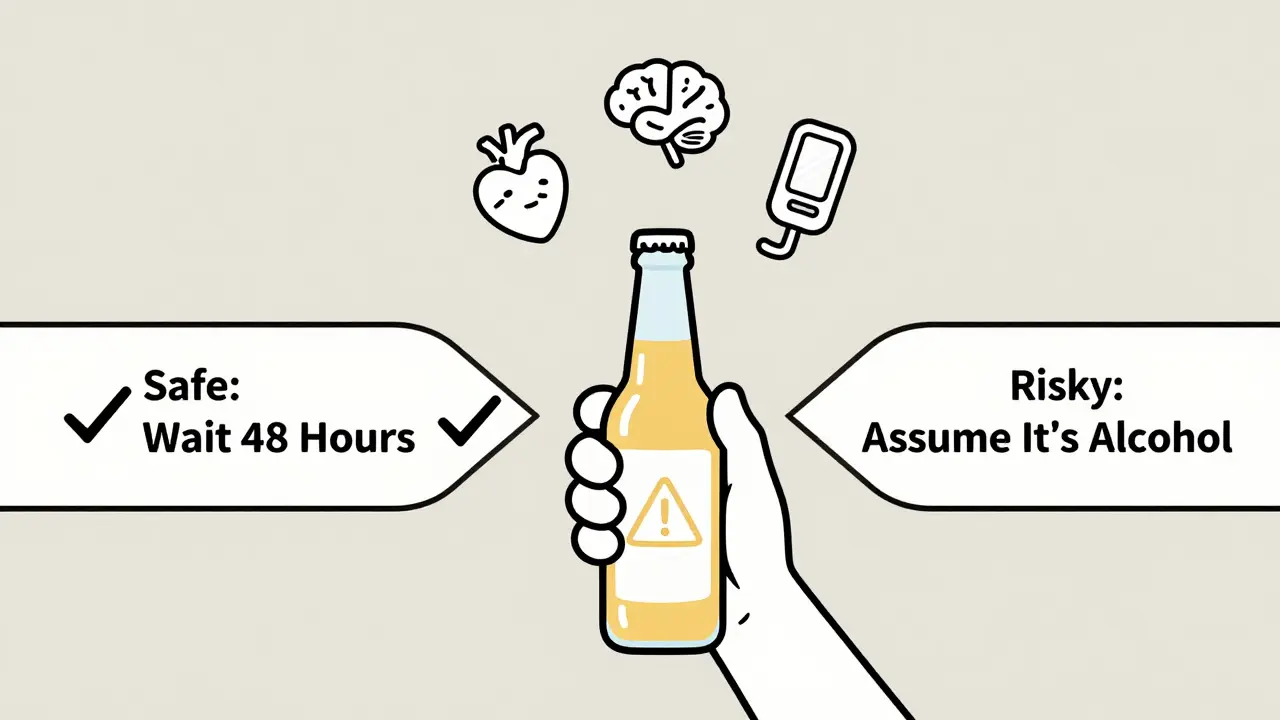
- Wait 48 hours. The Cleveland Clinic recommends waiting at least two days after taking alcohol-sensitive meds before consuming kombucha. And vice versa: wait two days after drinking kombucha before taking those meds.
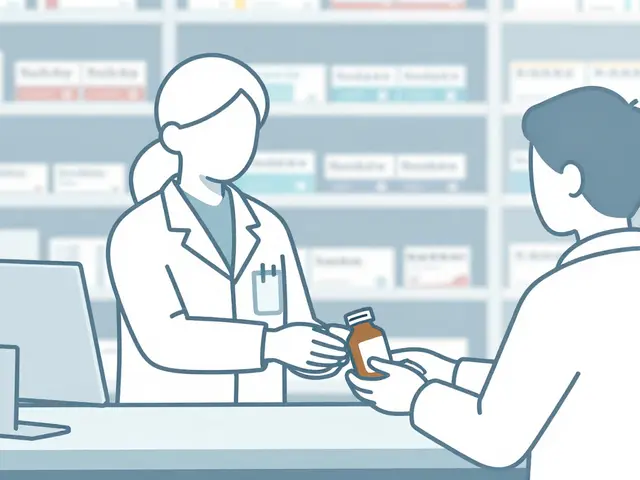
- Ask your pharmacist. Only 32% of pharmacists in a 2023 survey correctly identified kombucha as an alcohol source. Don’t assume they know. Bring the bottle. Ask: “Does this interact with my medication?”
Some brands are starting to help. Health-Ade launched a “Transparency Project” in February 2024. Scan the QR code on the bottle, and you’ll see the exact ABV for that batch. That’s the gold standard. But it’s still rare.
What About Other Fermented Foods?
Sauerkraut? Kefir? Miso? They also contain trace alcohol-usually 0.1-0.8% ABV. But kombucha is different. It’s a drink you consume in larger amounts, more frequently. People drink a bottle a day. That’s 8-16 ounces of liquid with alcohol. Sauerkraut? You eat a forkful. The total alcohol intake is far lower.
Plus, kombucha is marketed as a health drink. People don’t think of it as alcohol. That’s the trap.
Is There Any Safe Amount?
Dr. Darya Rose, author of Kombucha Revolution, says 0.5% ABV is “pharmacologically insignificant.” She compares it to overripe fruit. But major medical groups disagree. The Institute for Safe Medication Practices doesn’t make exceptions. Their 2023 alert says: “No safe threshold is established for alcohol-sensitive medications.”
For most people, kombucha is fine. But if you’re on one of these medications, your body isn’t the same as someone who isn’t. Even small amounts can tip the balance.
What’s Changing in 2025?
The kombucha market hit $3.2 billion in 2023. It’s growing fast. But safety concerns are forcing change.
The FDA’s 2024 labeling rule is now fully in effect. All new kombucha bottles must say “Contains Trace Alcohol.” The National Institutes of Health launched a $2.3 million study in March 2024 to map out exactly how kombucha interacts with medications. Preliminary results are due in mid-2025.
Alcohol testing equipment sales to kombucha producers jumped 212% in 2023. More brands are adopting blockchain traceability. The industry is waking up.
But homebrewers? They’re still flying blind. A 2024 Harvard study found 43% of homebrewed kombucha exceeded 0.5% ABV. Twelve percent hit 3.2%-equivalent to light beer.
If you’re brewing at home and on medication, stop. Get a meter. Or stop drinking it.
Final Advice
Kombucha isn’t the enemy. But it’s not harmless, either. For most people, it’s a tasty, probiotic-rich drink. For people on alcohol-sensitive medications, it’s a hidden risk.
Don’t rely on labels alone. Don’t assume “natural” means safe. Don’t trust your gut feeling. If you’re on metronidazole, an SSRI, metformin, or any drug with an alcohol warning-skip kombucha. Or wait 48 hours. Or test your homebrew. But don’t gamble with your health.
Your body is already working hard to process your meds. Don’t add an unpredictable variable.
8 Comments
Just because something’s ‘natural’ doesn’t mean it’s safe-especially when you’re on meds. I’ve seen friends end up in the ER over kombucha and metronidazole. No joke. 🤕
Always check with your pharmacist. They’re not just there to hand out pills.
And yeah, even 0.5% adds up over time. Your liver doesn’t care if it’s ‘just tea.’
Let’s be honest-this whole ‘kombucha is healthy’ narrative is a marketing scam engineered by Silicon Valley wellness bros who conflated fermentation with biohacking.
The fact that you need a 2.3 million dollar NIH study to confirm what pharmacists have known since the 90s is embarrassing.
Alcohol is alcohol. Whether it’s in a wine glass or a $5 bottle labeled ‘probiotic elixir,’ it’s still a CNS depressant with pharmacokinetic implications.
Calling it ‘trace’ is linguistic sleight-of-hand designed to bypass regulatory scrutiny.
And let’s not pretend that ‘homemade’ is somehow more authentic-it’s just unregulated chaos with a cult following.
I’ve been brewing kombucha for seven years now and I can tell you, the alcohol variance is insane. I once left a batch fermenting too long during a heatwave and it hit 2.7%-I didn’t even realize until I drank it and felt dizzy. Like, *really* dizzy. Not drunk, but… off.
My wife was on sertraline at the time and she started having panic attacks after her morning kombucha. We thought it was stress. Turns out, it was the booze. She didn’t even know kombucha had alcohol.
I started testing every batch after that. Bought a digital hydrometer. It’s like $40. Why wouldn’t you? It’s not like you’re launching a rocket.
And the labeling? Ridiculous. I read the fine print on a Health-Ade bottle once-it said ‘contains trace alcohol’ in 6-point font under the barcode. Like, who’s supposed to see that?
People think they’re drinking ‘wellness.’ They’re not. They’re drinking fermented sugar water with a side of delusion.
And now the FDA’s forcing labels? Took them long enough. I’ve been screaming about this since 2019.
Also, have you ever tried kombucha with metformin? I did. Felt like my legs turned to jelly. Ended up sitting on the toilet for 20 minutes just trying to stand up.
It’s not about being ‘anti-kombucha.’ It’s about being informed. And right now, most people aren’t.
Oh my god, I can’t believe people still drink this. You’re telling me you’re on antidepressants and you think a ‘health drink’ with alcohol is fine? You’re not ‘being natural,’ you’re being reckless.
And don’t even get me started on homebrewers. You’re not a ‘craftsperson,’ you’re a walking public health hazard.
It’s 2025. We have science. We have data. And you’re still drinking fermented tea like it’s 2012?
Stop pretending kombucha is magic. It’s just sugar + yeast + denial.
My mom took metronidazole and drank kombucha. ER. 3 hours. She’s fine now but I’ll never let her near it again.
Stop lying to yourselves.
It is both scientifically and ethically indefensible to market a fermented beverage containing ethanol as a ‘non-alcoholic health product’ while omitting explicit, legible disclosure of its alcohol content. The current regulatory framework is woefully inadequate and constitutes a failure of consumer protection.
Furthermore, the normalization of untested home fermentation practices in the context of pharmacologically sensitive populations represents a preventable public health risk of significant magnitude.
The FDA’s 2024 labeling mandate, while long overdue, remains insufficient without mandatory batch testing and public disclosure protocols.
Until such measures are implemented universally, consumers are being systematically misled by industry actors who prioritize profit over safety.
OMG I just realized I’ve been drinking kombucha every morning while on my antidepressant 😭
I’ve been feeling so foggy lately and thought it was just burnout…
But now I’m like… is it the kombucha??
Thank you for this post. I’m stopping immediately. 🙏
Also, I just scanned my Health-Ade bottle and it says 0.4% ABV for my batch-so weird to see actual numbers!
Wish all brands did this. I’m gonna tell my whole wellness group about this. 💙
It’s not about kombucha. It’s about the pathological delusion of ‘natural’ as a proxy for ‘safe.’
You’re conflating microbiome modulation with pharmacological innocence. The fermentation process is a biochemical reaction-alcohol is an inevitable byproduct. Period.
And the fact that people think ‘trace’ means ‘harmless’ reveals a fundamental misunderstanding of pharmacokinetics.
There is no safe threshold for GABAergic drugs + ethanol. Not 0.1%. Not 0.5%. Not 0.0001%.
And yes, this is why the ‘wellness’ industry is a cult disguised as science.
Stop drinking your way to a serotonin crisis because you think you’re ‘healing.’ You’re just self-sabotaging with fermented sugar water.
And if you’re homebrewing? You’re not a ‘craftsman.’ You’re a liability.
Get tested. Or stop. There’s no middle ground.