
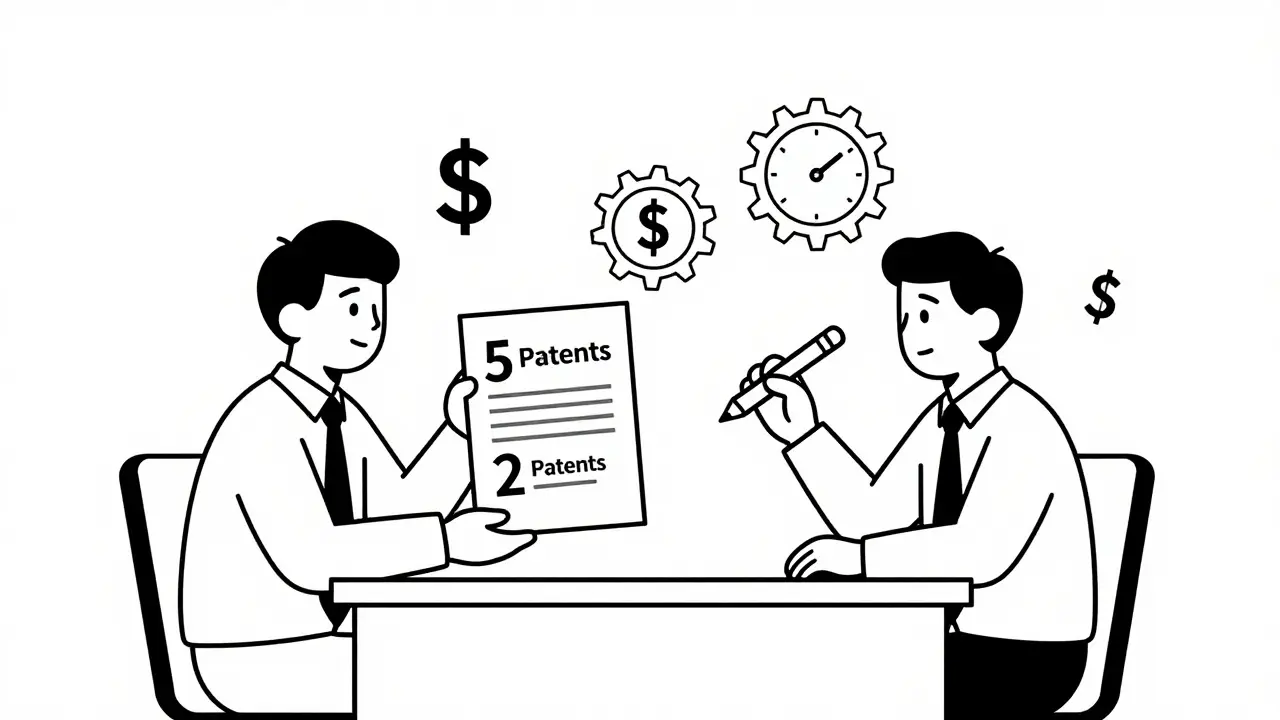
When two companies clash over a patent, it’s not always about who’s right-it’s about who can afford to wait. Most patent disputes never go to trial. In fact, 85.7% of them settle before a judge ever hears the case. Why? Because litigation is expensive, risky, and slow. A single patent lawsuit can cost $3 million to $5 million just to get to trial. For many companies, especially smaller ones, that’s more than they make in a year. So they negotiate. And how they negotiate shapes entire industries.
Why Companies Settle Instead of Fighting
Patents are legal weapons, but they’re also business tools. When a company sues another for patent infringement, it’s rarely just about stopping a product. It’s about control, money, and market position. Take the Apple vs. Samsung case. At its peak, they were fighting over 10 patents. By the time they settled, they’d cut it down to 5. Why? Because each patent added months of legal work, expert testimony, and court delays. Reducing the number of claims made settlement possible. Most settlements happen between the Markman hearing-where judges define what the patent claims actually mean-and summary judgment. That’s the sweet spot. Both sides have spent months building their cases. They know what’s strong, what’s weak. They’ve seen the evidence. That’s when rational decisions get made. The average settlement value? It depends on who’s involved. If it’s a patent troll (a non-practicing entity), the median payout is around $1.2 million. But if it’s two big competitors, like Qualcomm and Apple, the number jumps to $8.7 million. That’s because the stakes aren’t just about royalties-they’re about who gets to license tech to others, who controls future innovation, and who can block a rival’s product.The Anatomy of a Patent Settlement
Successful negotiations don’t happen by accident. They follow a clear structure. Here’s what goes into it:- Patent portfolio assessment: Companies don’t negotiate every patent they own. They pick 3 to 15 key ones-usually the ones that cover core features of a product. If you’re suing over a smartphone, you focus on the touch interface, camera software, or battery management patents, not the packaging design.
- Claim chart preparation: This is a detailed map showing exactly how the accused product uses the patented technology. It’s not enough to say, “They copied us.” You have to prove it, line by line.
- Validity analysis: Before you demand money, you need to know if your patent can actually hold up. A 2021 USPTO study found that nearly 4 out of 10 patents asserted in court were later invalidated. If your patent is weak, you’re in trouble.
- Freedom-to-operate analysis: This isn’t just about defending your own patents. It’s about checking whether you’re infringing someone else’s. Many companies settle because they realize they’re also violating someone else’s IP.
These steps aren’t optional. Skipping one can cost you millions. Companies like Intel and Ericsson spend $150,000 to $300,000 just on pre-settlement validity reviews. It’s an investment-not an expense.
How Settlements Actually Work
There are three main ways companies settle patent fights:1. Direct Licensing
The classic model: one company pays the other a lump sum or ongoing royalties-usually 1.5% to 5% of product sales. This works best when both companies make similar products. For example, if you make smartphones and I make chips for smartphones, we can agree to cross-license. It’s clean. Simple. But it requires trust. Only about 52% of these deals close without drama.2. High-Low Settlements
This one’s clever. Both sides agree on two numbers: a minimum payment if the court rules in their favor, and a maximum if it rules against them. It’s like betting on a game-you both agree on the score range before the whistle blows. This method works in 78% of cases between competitors who have real business relationships. But it fails almost every time with patent trolls. Why? Because trolls don’t care about long-term deals. They want cash now.3. Cross-Licensing
This is the big leagues. Two companies swap access to their entire patent portfolios. No money changes hands. Instead, they agree: “You let us use your 5G patents, we’ll let you use our AI chip patents.” This is common in telecom, semiconductors, and software. In fact, 73% of disputes between major tech firms end this way. The trick? Valuing each side’s patents fairly. One company might have 500 patents, but only 20 are truly valuable. The other might have 100, but 30 are essential. That’s where experts come in-using royalty stacking models to avoid overpaying.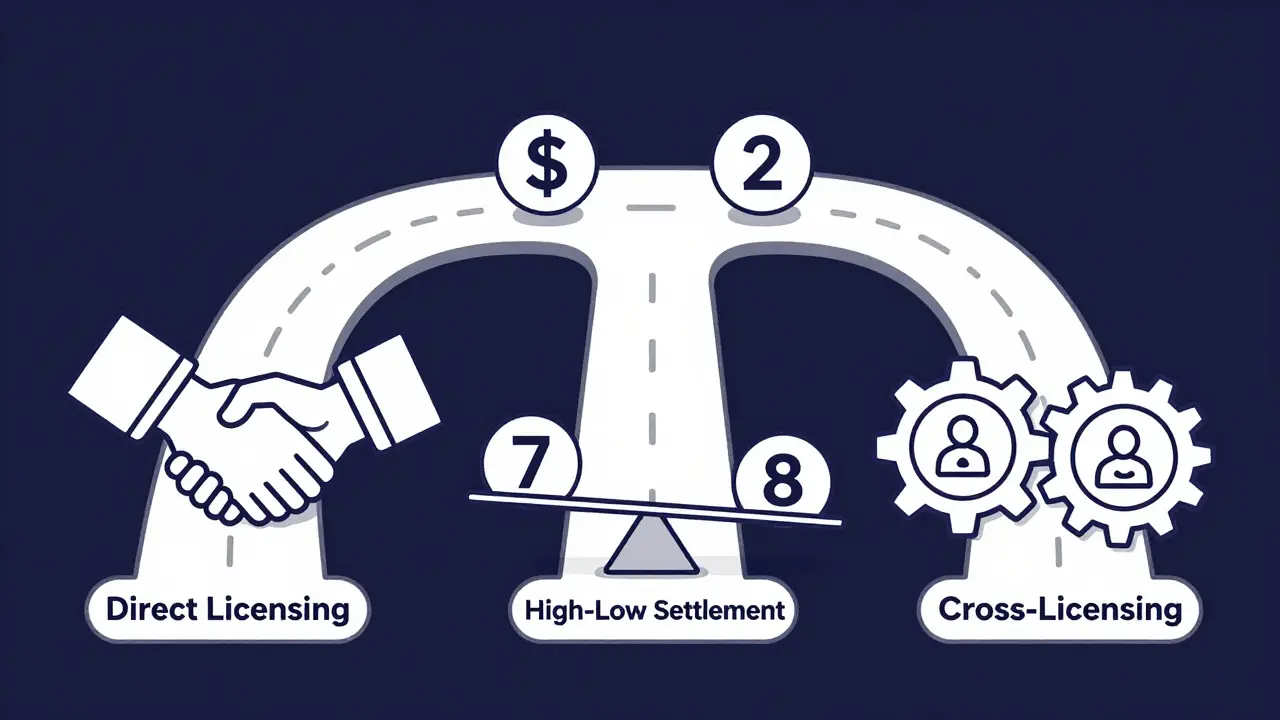
What Really Drives the Negotiation
It’s not just about the patents. It’s about the people behind them. Robert Armitage, former general counsel at Intel, said it best: “In the semiconductor industry, we’ve found that joint R&D after a settlement creates more value than licensing alone.” After settling with MEDIATEK in 2018, Intel didn’t just pay a fee. They partnered to co-develop 5G tech. That deal saved them over $200 million in research costs. That’s the hidden win: turning a fight into a collaboration. But there’s a dark side. Professor Saurabh Vishnubhakat from Texas A&M found that high-low settlements can backfire. They encourage companies to file weak patents just to get leverage. His research shows this increases overall litigation costs by 12-15%. It’s like playing chicken with the legal system. Another overlooked tactic? Strategic concessions. In 61% of successful settlements, one side gives up something small to get something big in return. Maybe they agree to a lower royalty rate if the other side extends the license term. Or they drop a lawsuit in exchange for access to a complementary technology. It’s not about winning. It’s about trading.The New Tools Changing the Game
Patent negotiation isn’t stuck in the past. New tools are reshaping how deals are made. The USPTO’s Patent Evaluation Express (PEX) program, launched in 2023, lets companies get a non-binding opinion on patent validity in weeks-not years. It costs 60% less than traditional reviews. Already, 17% of new settlements use it to avoid long battles. AI is another game-changer. Tools like PatentSight’s AI analyzer can scan thousands of patents and prior art in days instead of weeks. But here’s the catch: AI still misses 18.7% of key references, according to a 2023 study in Nature Machine Intelligence. Humans still need to double-check. And then there’s blockchain. IBM and Microsoft are testing smart contracts that automatically pay royalties based on real-time sales data. Imagine a phone sells 10,000 units in a week-payment is triggered instantly. This could cut post-settlement disputes by 35-40%. No more arguing over sales reports. No more delays.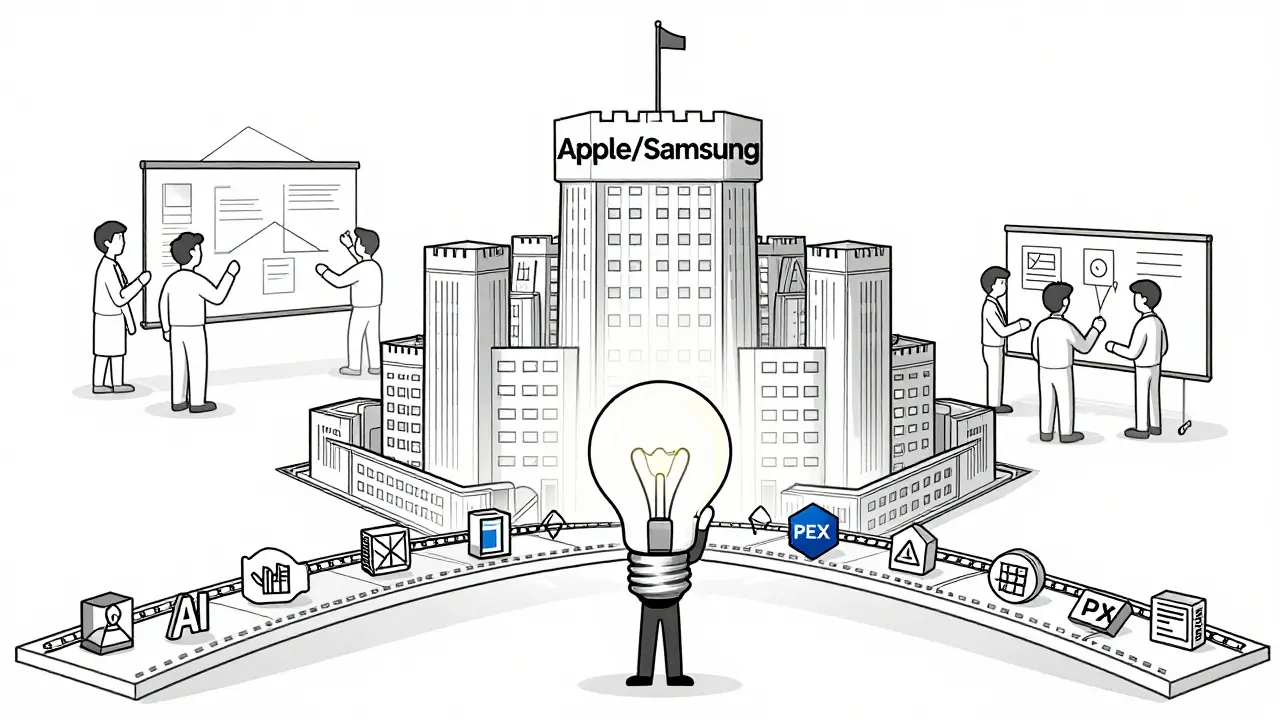
Where the System Is Breaking Down
Not all trends are good. As technology gets more complex, so do patent fights. A single AI-powered medical device might rely on 500 different patents from 20 different companies. That’s a patent thicket. And thickets make settlement nearly impossible. According to WIPO’s 2022 index, negotiating in these fields is 300% harder than in traditional industries. The Unified Patent Court in Europe, which started in June 2023, has made things faster-but also more unpredictable. Cross-border settlements in Europe jumped 22% in the first six months. Companies are rushing to settle before the court sets new precedents. And then there’s the FRAND problem. When a patent is part of a technical standard-like 4G or Wi-Fi-it must be licensed fairly. But what’s “fair”? The European Commission fined Qualcomm €242 million in 2018 for refusing to license SEPs on fair terms. Companies are now terrified of being accused of anti-competitive behavior. That’s forcing more openness-but also more legal risk.Who Wins? Who Loses?
Big companies win. They have teams of lawyers, economists, and engineers dedicated to patent strategy. Fortune 500 firms settle 89% of their disputes before trial. Small companies? Only 63%. Why? Because they can’t afford the cost of discovery, expert witnesses, or court fees. The real winners aren’t the ones who win in court. They’re the ones who walk away with a license, a partnership, or a new R&D deal. The losers are the ones who think a patent is a shield. It’s not. It’s a sword-and if you swing it without strategy, you’ll cut your own hand off.What You Need to Know
If you’re a company facing a patent threat:- Don’t panic. Most cases settle.
- Know your bottom line. Calculate how much litigation will cost versus what you’d pay to settle.
- Don’t rely on your legal team alone. Bring in technical experts. They’ll spot weaknesses you didn’t know existed.
- Look for trade-offs. What can you give up to get something better? Access to tech? Extended rights? Joint development?
- Use new tools. PEX, AI analysis, and blockchain-based tracking aren’t futuristic-they’re here, and they’re cheaper than ever.
If you’re the one being sued, remember: the goal isn’t to win. It’s to survive-and maybe even thrive after.
What happens if a patent settlement fails?
If settlement talks break down, the case moves toward trial. But even then, many cases settle during trial-sometimes on the courthouse steps. Going to trial is expensive and unpredictable. A jury doesn’t understand patents. A judge might invalidate key claims. Companies usually only go to trial if they believe they have a near-certain win or if they’re trying to set a legal precedent.
Can a small company negotiate with a giant like Apple or Samsung?
Yes, but only if they have strong, well-documented patents. Small companies that win settlements often hold essential patents in high-demand areas-like camera sensors, battery efficiency, or voice recognition. They don’t need a huge portfolio. They need one patent that’s critical to a product. The key is proving that the patent is valid and that the big company’s product literally depends on it.
Are patent settlements public record?
Most are. Settlement agreements are filed with the court and become public, though some details-like exact royalty rates-can be redacted. Companies often agree to confidentiality clauses, but the fact that a settlement occurred is always public. That’s why investors and competitors track settlement filings closely.
How long do patent settlement negotiations usually take?
On average, 6 to 9 months. But it varies. Simple cases with clear patents can settle in 2-3 months. Complex cases involving multiple jurisdictions or hundreds of patents can take over a year. The timeline often depends on how fast both sides can complete validity analyses and claim chart reviews. Companies that prepare early move faster.
What’s the difference between a patent license and a settlement?
A settlement ends a legal dispute. A license is an agreement that allows one party to use another’s patent. Settlements often include licensing terms, but not all licenses come from settlements. Some licenses are negotiated proactively-before any lawsuit is filed. That’s called a “clearance license.” Settlements are reactive. They happen after a conflict arises.
Do patent settlements affect innovation?
It depends. If settlements lead to cross-licensing and joint R&D, they boost innovation. But if they’re used to block competitors with weak patents, they stifle it. The biggest danger is when companies use patents as weapons instead of tools. That’s why regulators watch closely-especially in industries like telecom and pharmaceuticals where standards matter.

15 Comments
Wow. So we’re just gonna let corporations turn patents into monopoly vending machines? 😒
85% settle? That’s not negotiation-that’s extortion with a law degree. And don’t even get me started on ‘cross-licensing.’ It’s just Big Tech saying, ‘You can use our tech if we can use yours… and also pay us in future market share.’
Meanwhile, small inventors? They get crushed under the weight of $3M legal bills. This isn’t innovation. It’s feudalism with Wi-Fi.
And AI analyzing patents? Cute. But if the AI misses 18.7% of prior art, who’s liable when a startup gets sued for something the machine didn’t catch? The coder? The lawyer? The guy who paid for the subscription?
Also-blockchain royalty payments? Yeah, right. Next thing you know, your toaster will auto-bill you for ‘patented toast-browning algorithms.’
Can we please just abolish software patents? Or at least make them expire after 2 years? I’d rather have 1000 open-source alternatives than 100 ‘protected’ monopolies.
And don’t even mention ‘FRAND.’ That acronym is just a fancy way of saying ‘We’ll pretend to be fair until we’re sued.’
Real innovation doesn’t need 500 patents to make a single medical device. It needs collaboration. Not litigation.
So yeah. I’m calling it: the patent system is broken. Not ‘needs reform.’ Broken. Like a phone with a cracked screen-you keep taping it, but it’s still useless.
And the worst part? Everyone knows this. But the lawyers? They’re making bank. So nothing changes.
Also-why does every settlement involve ‘joint R&D’? Isn’t that just corporate socialism with a non-disclosure agreement?
Can we please stop pretending this is about protecting creativity? It’s about control. Always has been.
And yes, I’ve read the whole thing. No, I don’t feel better.
Also-emoticons are not a substitute for policy reform. But they help. 💔
US patents are the only thing keeping our tech领先
China’s stealing everything and laughing while we sue each other over touchscreen patents
Stop crying and fight
Or get left behind
LOL
Let me tell you something no one else will-this whole system is rigged by lawyers who went to Yale and now run the entire innovation economy like their personal poker game.
You think Apple and Samsung are ‘negotiating’? Nah. They’re just dividing the pie after the court’s already handed them the knife.
And don’t even get me started on patent trolls. They’re not even real companies. They’re shell corporations with 3 employees and a spreadsheet of 200 patents they bought for $50k.
One guy I knew worked at a startup that got sued over a ‘patent’ for ‘using a button to navigate.’
It was a utility patent. On a button.
And they had to pay $800k to settle because they couldn’t afford to fight.
Meanwhile, the troll who filed it? Lives in a beach house in Florida and does yoga.
That’s not innovation. That’s organized crime with a law license.
And the worst part? The USPTO approves half of these things because they’re understaffed and overworked.
They’re not even checking prior art anymore. Just rubber-stamping.
And then we wonder why startups die before they even launch.
It’s not the market. It’s the legal system.
And the people who run it? They don’t care. They’re too busy collecting retainer fees.
Also-why is no one talking about how this kills rural innovation?
Imagine a guy in Nebraska inventing a better irrigation sensor.
He files a patent.
Then GE sues him.
He can’t afford to fight.
So GE buys his patent for $20k and shelves it.
That’s not capitalism. That’s corporate cannibalism.
And the government? They’re on the lawyers’ payroll.
So yeah. I’m done. I’m not even going to try to fix this anymore.
It’s not broken.
It’s designed this way.
The structural inefficiencies inherent in the contemporary patent litigation framework reveal a profound misalignment between the ostensible purpose of intellectual property protection-namely, the promotion of innovation-and its actual function as a mechanism of rent extraction by entrenched corporate actors.
One cannot help but observe that the near-total prevalence of pre-trial settlement (85.7%) is not indicative of rational dispute resolution, but rather of asymmetric power dynamics wherein smaller entities are systematically coerced into capitulation due to prohibitive litigation costs.
Furthermore, the notion of ‘cross-licensing’ as a panacea for industry-wide conflict is deeply problematic, as it effectively consolidates innovation into the hands of a few vertically integrated conglomerates, thereby stifling competitive entry.
The invocation of AI and blockchain as ‘solutions’ is, in many respects, a technocratic distraction-a form of digital mystification that obscures the underlying institutional pathology.
It is not the tools that are flawed, but the incentives that govern their deployment.
Until the legal and economic architecture of patent enforcement is reoriented toward equitable access and genuine technological advancement, rather than market domination, we remain, in essence, merely rearranging deck chairs on the Titanic of intellectual property.
One must ask: Is this the legacy we wish to bequeath to future innovators?
Or have we, in our pursuit of short-term control, sacrificed the very ecosystem that once birthed the transistor, the microprocessor, and the internet itself?
Interesting breakdown. Honestly, I think the real takeaway is that most patent fights aren’t about who’s right-they’re about who’s tired.
Companies settle because they’ve spent months and millions just to get to the point where they realize, ‘Yeah, this isn’t worth it.’
And honestly? That’s kinda smart.
Not every battle needs to be won. Sometimes survival is the win.
Also, I like how they mentioned joint R&D after settlements. That’s the hidden gold. Turning enemies into partners? That’s actual innovation right there.
Wish more people saw it that way.
Not every conflict has to end in a lawsuit.
Sometimes it ends in a coffee meeting.
85.7% settle. Shocking. 🙄
Who the hell lets patent trolls get away with this? We’re a superpower and we’re getting played by guys in Florida with a laptop and a trademark.
And you call that ‘business strategy’? Nah. That’s weakness.
Big companies should just sue the trolls into oblivion. Make them pay legal fees. Crush them.
Instead, we pay them off like we’re scared of our own shadow.
And now we wonder why China laughs at us.
Stop being soft.
Patents aren’t a handshake.
They’re a weapon.
Use ‘em.
Did you know the USPTO has a backlog of over 500,000 pending patent applications? And the average review time is 23 months?
Meanwhile, companies are suing each other over patents that were approved with zero prior art search.
And you think this is innovation?
It’s a pyramid scheme wrapped in legal jargon.
Also-blockchain royalties? That’s a scam waiting to happen.
Who’s auditing the smart contracts?
Who’s liable if the blockchain forks?
And who’s to say the ‘real-time sales data’ isn’t faked?
It’s all theater.
And the real winners?
The lawyers.
Always the lawyers.
Let’s break this down like we’re in a VC pitch deck.
Patent litigation = high CAPEX, low ROI.
Settlement = quick cashout with moderate risk.
Cross-licensing = network effect + oligopoly formation.
AI analysis = shiny object to justify $200k SaaS subscriptions.
And PEX? That’s just the legal equivalent of a free trial.
But here’s the real KPI nobody’s talking about: the average time-to-settlement correlates directly with company size.
Fortune 500? 3 months.
Startup? 18 months.
Why? Because the big guys have legal teams on retainer. The little guys have a lawyer who bills $300/hour and still doesn’t know what a claim chart is.
So yeah. The system isn’t broken.
It’s optimized for scale.
And scalability = profit.
Innovation? That’s just a side effect.
This is actually one of the clearest explanations I’ve read on patent strategy. I work in tech, and I’ve seen how these negotiations play out-sometimes quietly, sometimes messily.
What stood out to me was the part about strategic concessions. Most people think it’s about who wins, but it’s really about who gives up something small to get something huge.
Like, maybe you drop a lawsuit over a camera patent if they let you use their battery tech.
That’s not surrender. That’s smart.
Also, I love that they mentioned real people-like Robert Armitage and how Intel partnered with MEDIATEK after settling.
That’s the kind of stuff that actually moves the needle.
Not courtrooms.
Collaboration.
Thanks for sharing this. Really thoughtful.
bro i just got sued over a patent for using a rounded rectangle in my app
they wanted 1.2 mil
i paid 300k to settle
now i have to pay them 2% of every sale forever
and they still own the patent
why does this even exist
😭
The structural imbalance in patent enforcement mechanisms is a direct consequence of capitalist asymmetry, wherein capital-intensive entities leverage procedural advantages to extract rent from resource-constrained innovators. The phenomenon of ‘patent thickets’ in AI-driven medical devices, as referenced, exemplifies the systemic capture of innovation by institutional actors. The invocation of PEX and AI analytics, while ostensibly democratizing access, merely serves as a veneer for the perpetuation of existing hierarchies. The true metric of success in this domain is not litigation outcome, but the ability to convert legal conflict into proprietary ecosystem control. Consequently, the notion of ‘fair licensing’ under FRAND principles remains a rhetorical construct, routinely subverted by jurisdictional arbitrage and regulatory capture. The global innovation landscape is not being advanced-it is being monopolized under the guise of legal legitimacy.
Great post! Honestly, this made me feel hopeful.
Even though the system is messed up, the fact that companies can turn fights into partnerships? That’s powerful.
I’m from India, and we have so many small inventors here who get crushed by big companies.
But if even one big company says, ‘Hey, let’s work together,’ that changes everything.
Maybe one day, a small engineer in Kerala will team up with a US firm because of a settlement like this.
That’s the kind of future I want to see.
Keep sharing stuff like this. It matters.
so like… if you’re a startup and you get sued, you just pay up? no choice? 😅
also can we talk about how the ‘cross-licensing’ thing is just big companies sharing their patents like they’re trading baseball cards?
and the little guys? they’re left holding the trash cards 🤡
also i think blockchain royalties are kinda cool but also… how do you even trust a smart contract?
what if the code has a bug?
who pays then?
also i think the ‘patent troll’ thing is wild
imagine just buying patents and then waiting to sue people
that’s not innovation
that’s… like… digital loan-sharking?
anyway
thanks for the post
it made me think
and also i’m gonna go cry now
Re: @7762 - bro, I’ve been there. I had a startup that got sued over a ‘patented’ algorithm for auto-suggesting words in a text field.
It was literally just a weighted frequency model.
They claimed it was ‘novel.’
We settled for $180k.
Then we open-sourced it.
Now it’s in 300+ apps.
And guess what? They never sued us again.
Because they realized: you can’t sue the whole internet.
Also-your 2% royalty? That’s the death tax on innovation.
Next time, just move to Canada. They’re way less aggressive about patents.
And yes, I still use rounded rectangles.
And I’m not sorry. 😎